

First published in different form, Science and Public Policy, February 1987; updated in Asgard, March 2002; reprinted as Appendix in Incoming Asteroid!, What Could We Do About It?, Springer, 2013; updating February 2025.
Synopsis
- Phrases such as ‘Limits to Growth’ or ‘Alternatives to Growth’ imply objections to continuing economic development, and there are valid objections in regard to overpopulation, destruction of irreplaceable natural resources and pollution of the environment. But any strategy we adopt to counter those dangers must also take account of the other threats to human survival: the man-made ones of weapons of mass destruction and of long-term genetic breakdown, and the external ones posed by giant meteor or comet impact, a change in the Sun or a nearby supernova, or by Contact with other intelligence. Big impacts, and probably supernova shockwaves, have brought about major changes on Earth in the past and will undoubtedly happen again in the future. To have a reasonable guarantee of surviving such catastrophes any future society will require extensive development of resources outside the Earth. Technological and industrial development in space, and self-supporting extraterrestrial settlements, must be regarded as essential to any policy for future development.
We therefore need a ‘Politics of Survival’, a series of practical programmes with the object of guaranteeing the survival of mankind against all foreseeable dangers: an objective which could be met within 300 years. Since continuing space development should be used to the full in solving terrestrial problems, two practical programmes are suggested: the first, an international effort to free the world from hunger within the next 20 years; the second, to remove all major raw materials gathering and industry from the Earth’s surface by the end of the 21st century. Ways are also suggested for extra-terrestrial settlement to help, psychologically and sociologically, to meet the dangers of warfare, overpopulation and genetic breakdown.
Text
In 1972 the Club of Rome published a book and computer programme called The Limits to Growth,1 which made a profound impression at the time, so much so that New Internationalist held an essay competition the same year on the theme ‘Alternatives to Growth’, reflecting a growing awareness of the dangers of population growth, uncontrolled industrial growth, and the uncritical use of the environment to supply raw materials and to absorb pollution. They were direct challenges to the assumptions made by “most decision makers on all levels… that past trends will continue and to rely on growth as a panacea”.2 In the interests of survival such assumptions should be challenged, even if on examination they proved to be correct. However the initial challenges were followed by the widespread acceptance of philosophies which were little more attractive and very little less dangerous. It was argued that with the right social policies and alternative technologies a stable culture could be created, regulating the numbers of mankind, living in harmony with the other inhabitants of the Earth’s ecosystem, and neither adding to nor subtracting from the available pool of natural resources. Within the confines of the planet, obviously, such accommodations do indeed have to be reached.
But it also came to be said, or implied, and widely believed, that the technological level of such a culture would be lower, and the range of its exploratory, scientific and industrial activities would be less, than those of the present ‘Developed World’. Such predictions have two major weaknesses:
1. Human nature being what it is, and natural phenomena being what they are, any stable culture – even a global one – will eventually be perturbed by social forces or natural changes drastic enough to upset the balance. The alternatives are then contraction, which if continued leads to extinction, or a new phase of expansion leading back to the previous crisis level.
2. The findings of the Earth sciences, space research and solar physics now strongly reinforce the conclusion – previously obvious from first principles, but little heeded – that any purely Earth-based civilisation will be subject, sooner or later, to external natural forces strong enough to change its character utterly if not to destroy it altogether.
The objective of the ‘Politics of Survival’ is to formulate a series of practical programmes whose final aim, perhaps 300 years in the future, would be to guarantee the survival of mankind against any foreseeable catastrophe. To see clearly what has to be done, no qualification of the word ‘any’ can be permitted: the aim is to make sure that some self-supporting element of the human race will survive, in sufficient numbers and with the full resources of history at their disposal, so that what has been accomplished shall not be lost – even if Earth itself or even the Solar System did not remain able to support life.
To a great extent such a programme, encompassing almost all human activities, would have to proceed by persuasion rather than coercion. Its underlying principle would become ‘that no individual interest, national, commercial, political, religious, military or scientific, should contribute to the potential extinction of mankind’. Such a ‘Politics of Survival’ would become the international morality of the 21st and 22nd centuries, and would be built up out of decisions on the applications of particular technologies – just as the 20th century had to arrive at a consensus on the uses of nuclear power, organ transplants and genetic engineering. Since we don’t know what the controversial technologies of the next two centuries will be, we can’t plan the route to ‘guaranteed survival’ in detail; but since it can be shown that space technology has to be incorporated, and since we already have a general idea of the resources available, hazards to be countered and techniques to be used, we can construct a generalised set of strategies which provide the Politics of Survival with a framework and a timescale.


Fig. 1 shows the beginning of a classification system for the dangers to be met and countered in accordance with such a philosophy. The eight headings on the top line represent categories of disaster which could, alone, bring about the annihilation of mankind. Those eight headings are the main subject-matter of this essay. It should be remembered that they are closely linked and could occur in synergistic combinations – i.e. that accidents in two or more categories, though not drastic enough to wipe out the race, could combine to bring about that effect. For example, even a limited nuclear war, in a context of overpopulation, a polluted environment or dependence on advanced medical technology, could have far worse effects than the mathematics of yield and fallout alone would predict. The second line of Fig. 1 shows examples, a far from exhaustive list, of sub-headings, two or more of which might act in concert to equal the annihilating outcome of a major disaster on line 1.
The eight headings of line 1 are (1) weapons of mass destruction, (2) overpopulation, (3) destruction of irreplaceable natural resources, (4) pollution of the environment, (5) long-term genetic breakdown, (6) large-scale impacts, (7) Sun change or nearby supernova, (8) Contact with other Intelligence (not necessarily with malevolent intent). The first five are dangers of our own making, the other three represent outside forces which could intervene drastically in human affairs.
Those three are normally overlooked in discussion of human survival, and if they are invoked, are usually dismissed as ‘irrelevant’ or ‘statistically remote’ by comparison with the more ‘immediate’ dangers posed under the other five headings. But another view of their immediacy and relevance can be taken. Unlike, say, pollution or overpopulation, which are cumulative over decades, they could strike without warning at any time, they threaten our extinction on a day to day basis, and cannot be prevented at the present state of our technology. Some time in the future, probably the near future relative to the timescale of biological evolution, the Earth will be struck by an asteroid – or the Solar System by supernova shockwaves – with sufficiently destructive effects to remove the higher life-forms including ourselves, unless we acquire the means to prevent it.
Thus any long-term plan to guarantee the survival of the human race must include the cancellation of headings (6), (7) and (8), and solutions to headings (1) to (5) must be selected accordingly. In plain words, the human race dare not adopt ‘alternatives to growth’ which ignore or preclude what Dr. Krafft Ehricke has called ‘the strategic approach to the Solar System’3 – i.e. survey and exploitation of interplanetary resources for the practical benefit of mankind. Such a conclusion is a major departure from most publicly discussed ‘alternative’ strategies and obviously requires detailed justification. Headings (6), (7) and (8) are therefore discussed below in ascending order of immediacy, as defined above.
8. Direct Contact with Other Intelligence is the hazard which might not exist in reality. We simply do not know whether or not we are alone in the Galaxy, and scientific opinion is divided. ASTRA, then Scotland’s national spaceflight society, discussed the possibilities in Man and the Stars (1974),4 and although the technological background to that discussion is now out-of-date, the general rules established remain valid. It is not impossible that direct Contact with some highly advanced spacefaring culture might disrupt our own, even accidentally, to a point where self-supporting survival became impossible; or even that some destructive group might deliberately attempt the extirpation of the human race. No matter how advanced their technology, however, if our culture is spread through the cometary halo of the Solar System in self-supporting habitats, hunting down all of its elements would seem to be out of the question.5 So that is the level of advance at which the survival of the human race is guaranteed, and it’s this heading, even if included only for the sake of completeness, which sets the bottom line of the Politics of Survival framework in Fig. 2.


7. Sun Change or Nearby Supernova groups together the dangers of which we have become aware through advances in stellar physics and related Earth-based studies. It is not yet clear just how much we are threatened by variations in our own Sun, but correlating tree ring studies, climatic studies, and visual observations, particularly since the invention of the telescope, that the ‘mini-ice ages’ of the last few thousand years have coincided with periods of little or no sunspot activity, i.e. extended breaks in the regular 11-year sunspot cycle,6 and periods such as ‘the Roman warming’ and ‘the Mediaeval Warming’ corresponding to periods of heightened solar activity.


In the 12th century, for example, the Sun was at its most active since the Bronze Age (Fig. 3), with sightings of naked-eye sunspots, red aurora seen as far south as Syria, and huge auroral displays over Britain, often interpreted as dragons (Fig. 4).


Viniculture was practised throughout Britain and up into Scotland (as it had been in the Roman warming), and the general warming of the northern hemisphere generated droughts in the west of North America which caused massive population movements, with wars between displaced North Americans and local tribes. Statements that this year or that, or this month or that, are ‘the hottest on record’, are only true if northwest American and Saharan rock drawings, and pre-industrial chronicles of China, Japan, Korea, and western Europe, are not regarded as ‘records’. While there’s no doubt that the climate is currently changing, it always is changing, and how much of the current change is due to human activity is by no means as certain as often made out.
Another cause for concern was the continued failure of research groups to detect the neutrino flux from the core of the Sun, predicted by nuclear physics. Determination of the mass of the neutrino solved the problem, with the realisation that neutrinos change type in the 8-minute journey from the Sun, but it may also be that conditions in the solar core do not match the standard model, and just how serious for us the differences may be remains to be seen. One suggestion was that fusion reactions in the core of the Sun might be intermittent and give rise to ‘hiccups’ of violent solar activity – perhaps responsible for the ‘megadeaths’ in Earth’s history, when great numbers of species died out simultaneously.7 That was disproved by the Mariner 10 missions of the 1970s and subsequent Mercury orbiters, which showed that the planet had not been subjected to such outbursts at close range.
A quite opposite idea is that the outer layers of the Sun have been enriched by passing through an interstellar dust cloud, and our model of the core may therefore be inaccurate. If so, the absorbing effect of dust between us and the Sun might have started the present Ice Age cycle,8 but there would seem to be less of a direct extinction threat. (The indirect one comes under heading 6.)
Supernova explosions are estimated to occur in the Galaxy every 50 years or so on average, and at least three have been bright enough to be visible to the naked eye during the last 1000 years. At its peak output a star exploding as a supernova can emit as much energy as all the other stars of the Galaxy combined. Planets of any star for many light-years around would be subjected first to an intense radiation bombardment, later to magnetic disturbances and radioactive fallout from the shockwaves which once formed part of the mass of the exploding star. It was often suggested that some such event was responsible for the most famous ‘megadeath’, the extinction of the dinosaurs, and one scenario attributed it to a rare and very violent ‘Type 3’ supernova more than 3000 light-years away.9 Although the dinosaur extinction is now known to have been an impact event (see below), there is some evidence that supernovae may have caused other megadeaths. At present it seems that only one of the rarer, more violent, events could harm us under heading 7, because there are no supernova candidates in the immediate stellar vicinity; but even so, we don’t know just how much warning we would have. In the longer timescale of millions of years (the timescale of mankind on Earth thus far) only statistical chance determines when one of the more common, less violent supernovae will occur close enough to do serious damage.
A change in the Sun or a nearby supernova would force us to abandon the open surfaces of the Earth and any other inhabited worlds ‘for the duration of the emergency’ in order to survive. The technology required to keep large numbers of people alive underground or on the sea-bed for years or decades would be very high indeed, and on Earth fighting around the available shelters might well be so fierce that no-one would survive. Self-sustaining settlements in space, or on the Moon, Mars or the asteroids, will have to be fully shielded against the existing primary cosmic radiation and would therefore be virtually safe from the radiation flux of a supernova, though decontamination procedures would be needed for incoming personnel and materials during and after the supernova phase.
While the possible magnitude of change in our Sun is uncertain, the supernova event is only a matter of time. Some future society will experience it, and the prospects for a low-technology one on Earth’s open surface do not appeal. There is, however, a worse possibility, which is likely in the still shorter term.
6. The danger of Asteroid or Comet Impact has become apparent over the last 30 years. In the early 1960s it could still be argued that the craters on the Moon were volcanic in origin, since the Earth showed few signs of similar bombardment. The argument was weakened when the first successful Mars flyby showed a surface intermediate between ours and the Moon’s – cratered, but showing extensive weathering. From later Mars missions, the Moon landings and Mercury flybys, the mapping of Venus, and the Voyager missions to Jupiter, Saturn, Uranus and Neptune, we learned that the Solar System was subjected to an intense bombardment in the final stages of its formation, and many individual impacts have occurred since. By the mid-1970s, over 200 impact features had been identified on Earth’s surface;10 then came the evidence of a really big impact, probably one of a series, coinciding with the extinction of the dinosaurs and many other species, followed by the rise of new ones (Fig. 5).


The growing evidence for multiple impacts suggests that in many of the ‘megadeaths’, comets rather than asteroids may have been responsible. A catastrophe of that kind would at least give decades or more of warning, as the skies filled with spectacular comets: but a single comet or asteroid approaching Earth at present might not be detected until scant minutes before impact – if at all.


The destructive effects of a big impact are proportional to the energy absorbed by the environment. On land, an impact equivalent to the formation of the Vredevort Ring in Africa (Fig. 6) would sterilise the continent affected, but other parts of the world would suffer relatively little harm apart from widespread earthquakes and volcanic eruptions. The white-hot crater, initially penetrating through the crust of the Earth to the magma, would radiate much of the impact energy back into space. But in the sea, which offers a much larger target, the effects are much worse. Tsunamis up to thousands of feet high would circle the planet, sweeping most populated areas virtually without resistance. Vast volumes of water would be converted into superheated steam before the crater walls and the rising magma were quenched. Half the world, at least, would be ravaged by the resulting storms, while earthquakes and eruptions reduced the chances of survival even above wave height in the other hemisphere. Lastly, enough matter might be lifted into the atmosphere to black out the surface for years and cause a temporary Ice Age.
‘Vredevort events’ may not occur more than once in 200 million years. But it has been estimated that the Earth suffers blows violent enough to reverse the magnetic field, by the effect of shockwaves passing through the core, about every 170,000 years on average;11 and the association with impacts is strengthened by simultaneous ‘megadeaths’ in the seas as well as on land.12 Less violent impacts are still more frequent: there were at least three in the 20th century, two of them in the territory of the former Soviet Union, with results which would have been catastrophic in populated areas, and in 1972 a giant meteor flew through the atmosphere over the USA, miraculously not striking the ground.13 Upper estimates of its mass are around 4000 tons, giving it enough kinetic energy to devastate an entire state. But at that time even a small impact, with an energy release comparable to a nuclear weapon, posed a terrible danger to the human race because it could have led to war between the major powers. Almost unbelievably, the present leaderships of the USA and Russia now seem to be locked into a return to that state of affairs.
The danger may not be met as popularly supposed, by intercepting the asteroid. A magnetic field reversal/megadeath event could be perpetrated by a body as small as 300 metres across,11 virtually undetectable by present-day methods and especially so when coming straight towards the Earth at tens of miles per second. Even if it was picked up on radar at, say, the distance of the Moon, there would not be time to programme and aim a missile to intercept it. A direct hit would not significantly harm any but the smallest asteroids: published scenarios involve explosions beside the asteroid, so that vaporising material thrusts it off the colliding course,14 but the guidance requirements for close flybys are still more demanding and less likely to be met in time. Even fragmenting the asteroid provides little respite: splitting a billion-ton mass into a million fragments would reduce some of the worst overall effects, but a million thousand-ton impacts would still devastate the Earth’s surface.
In 2002-2012 ASTRA ran a discussion project which led to the book Incoming Asteroid! What Could We Do About It?15 in answer to the question, ‘If we knew there was to be an impact in 10 years’ time, what could we do? What would we do?’ For book purposes, we had to devise a ‘designer hazard’, something not too easy and not too hard to get to, not too easy and not too hard to deflect. Our answer was a solid rock asteroid about 1 kilometre in diameter, in an orbit similar to Encke’s Comet, but with perihelion much closer to Earth’s orbit. We concluded that it could be done, using light-sail deflectors like the ‘Comet-Chaser’ designed by Gordon Ross,15 then of Glasgow School of Art (Fig. 7), and failing that, a crewed expedition using mass drivers and gravity tractors.


The DART experiment of 2015 showed that a small asteroid like its target Dimorphos, 160 metres across, can be deflected by an impactor, as Prof. Colin McInnes suggested during the Incoming Asteroid! project. But on Christmas Day 2024, an asteroid named 2024 Y24 was detected by ATLAS, the Asteroid Terrestrial-Impact Last Alert System, in Chile. When first seen its chances of hitting Earth were 1 in 83, but then shortened to 1 in 43, with ‘a ‘redline’ possible impact track crossing South America and Africa on December 22nd, 2032. It will be lost to sight in May, with no prospect of checking further until 2028, which is cutting it fine. Described as ‘the size of a football pitch’, and depending on its composition, it has the potential to do a great deal of damage around the impact site, by tsunamis if it hits ocean, and to climate worldwide. Dr. Brian Cox has suggested that a deflector be prepared in case it’s needed, because if not, it can be used elsewhere, and that makes a lot of sense.
But the only way to protect the Earth from big impacts is to maintain continuous radar mapping of the entire inner Solar System, to detect hazards in time to cancel them far from Earth. Merely shattering a big asteroid is still an inadequate answer, since it will add enormously to the number of smaller hazards to be traced, and is very much a risk if the deflection is to achieved at long distance using nuclear weapons. But in the long term, the most effective course would be to send an industrial task force to a threatening asteroid (or comet, if time allows) to process it entirely, launching the products on controlled trajectories to the various planets and leaving the residues (if any) to disperse as harmless dust. Comets pose much bigger problems: no two of those visited have been alike, and while there are no really large asteroids threatening Earth. there are very large comets.
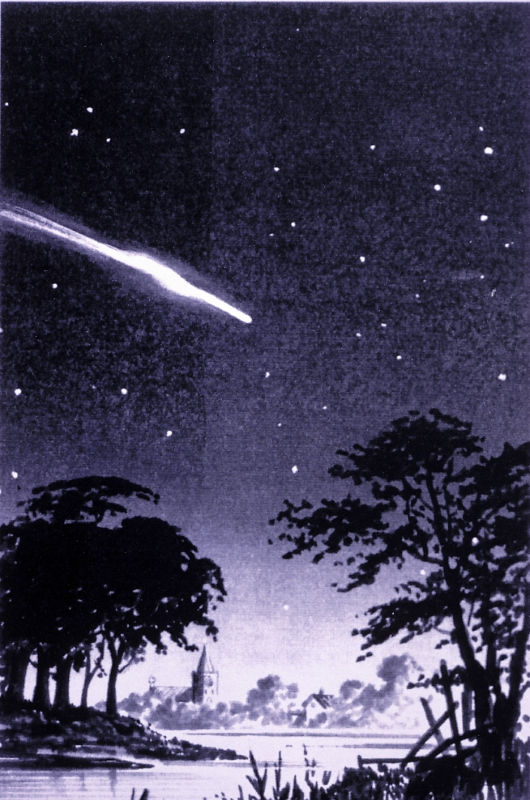

Comet Swift-Tuttle, the parent body of the Perseid meteors (Figs. 8 & 9), is 26 km across and will pass very close to us in 2126; Comet Hale-Bopp, which passed through the inner Solar System in 1997, was 60-80 km across, and fortunately will not be back for a very long time. As the late Dr. Arthur Hodkin said, in the Incoming Asteroid! project, to deal with that we need Star Trek technology at least.
In other words, to guarantee the survival of mankind against the impact threat, we have to raise our technological level at least as far as the exploitation of the Asteroid Belt and the ‘earth-grazing’ asteroids. Since as already shown such an approach would also permit us to survive a change in the Sun or a supernova shockwave, that level of attainment must be an interim objective of the Politics of Survival.
It cannot be too strongly stressed that any alternative society that limits itself to Earth must face disaster or destruction from the natural forces discussed, sooner or later. The chance of a giant impact in any given year may be statistically remote, but that will be scant consolation in the year that it happens. All viable models for future societies must therefore include an ongoing space effort. But to ensure that some self-supporting group of humans will survive anything we can foresee is only a minimum objective of the Politics of Survival: a still more worthy aim would be to use the same development in space to help solve the terrestrial threats to survival, headings 1-5 of Fig. 1.
(to be continued)
References
1. Donella R. Meadows, Dennis L. Meadows, Jörgen Randers, William W. Behrens III, The Limits to Growth, New American Library, 1972.
2. Mitchell Prize Contest Guidelines, ‘Alternatives to Growth’, New Internationalist, 1972.
3. K.A. Ehricke, ‘A Strategic Approach to Interplanetary Flight’, in Roadman, Strughold and Mitchell, eds., Fourth International Symposium on Bioastronautics and the Exploration of Space, Aerospace Medical Division (AFSC), Brooks Air Force Base, Texas, 1968.
4. Duncan Lunan, Man and the Stars, Souvenir Press, London, 1974. (“Interstellar Contact” in USA, Henry Regnery Co., 1975).
5. Duncan Lunan, Man and the Planets, Ashgrove Press, Bath, 1983.
6. (Anon), ‘Monitor’, New Scientist, vol. 70, no. 996, p.129 (15th April, 1976).
7. W. Fowler, Nature, vol. 238, p.24.
8. (Anon), ‘Solar Neutrino Problem May Be a Remnant of the Ice Age’, New Scientist, vol. 71, no. 1015, p.436 (1976).
9. V.A. Hughes, D. Routledge, ‘An Expanding Ring of Interstellar Gas with Centre Close to the Sun’, Astronomical Journal, 77, 210 (1973).
10. (Anon), ‘Another Giant Meteor Crater Identified’, Sky & Telescope, 50, 3, 156 (September 1975).
11. (Anon), ‘Earthquakes and the Earth’s Magnetism’, Journal of the British Interplanetary Society, 27, 2, 150 (February 1974).
12. Carl Sagan, The Cosmic Connection, Doubleday, 1973.
13. L.G. Jacchia, ‘A Meteorite that Missed the Earth’, Sky & Telescope, 48, 1, 4-9 (July 1974).
14. Sharon Brownlee, ‘Cycles of Extinction’, Discover, 5, 5, 22-32 (May 1984).
15. Duncan Lunan, ‘Keep Watching the Skies!’, Analog, October 1994; Incoming Asteroid! What Could We Do About It?, Springer, 2013.