
Recap
The ‘Politics of Survival’ was devised in 1969 to bring about the Guaranteed Survival of Mankind, a programme which might take 200-300 years to reach that objective. To discuss it the possible threats to survival were discussed under eight headings: (1) weapons of mass destruction, (2) overpopulation, (3) destruction of irreplaceable natural resources, (4) pollution of the environment, (5) long-term genetic breakdown, (6) large-scale impacts, (7) Sun change or nearby supernova, (8) Contact with other Intelligence (not necessarily with malevolent intent) – the first five being dangers of our own making, and the other three outside forces which could intervene drastically in human affairs (Fig. 1).

In Part 1, those last three were discussed to show that space technology would be needed to counter them, and therefore should be factored into discussion of the first five.
Continuation
Man-made Hazards – 1. Weapons of Mass Destruction. There is of course no purely technological counter to a danger generated by humans – no defence is 100% effective. Indeed, when I was writing in the 1960s further technological breakthroughs were to be feared, since, if the balance of power was seriously disrupted, the logic of deterrence drove both sides towards an attempt at a pre-emptive first strike. In 1969, I wrote a story called ‘The Day and the Hour’, set 150 years after an unspecified such event, in which Russia had devastated the USA, discovered that no first strike had been planned, and being Russian, had been consumed with guilt and destroyed their own economy trying to make reparations. The alternative threat from biological and chemical weapons also loomed large then, but seems to have been reduced by international treaties, though it keeps rearing its head.
With nuclear weapons, in the 1980s there were two developments which significantly changed the picture. In 1983 the TTAPS study (from the initials of the last names of its authors, R.P. Turco, O.B. Toon, T.P. Ackerman, J.B. Pollack, and Carl Sagan), concluded that even a 100-Megatonne nuclear exchange would have significant climatic effects, while a 3000-MT strategic strike would have catastrophic results. In 1983 it was estimated that the world’s nuclear arsenals held 19,000 warheads with a total yield of 10,000 MT, and the authors called for a reduction to 1000 warheads of 100 KT each.1 As the Encyclopedia Britannica says,
“A number of scientists have disputed the results of the original calculations, and, though such a nuclear war would undoubtedly be devastating, the degree of damage to life on Earth remains controversial”.
Or as Dr. Richard Garwin put it at the time, discussing the hypothesis at the 1984 IBM Heathrow Conference, “Even if they’re wrong, a nuclear summer isn’t going to be much fun either”.
Meanwhile the alternative notion had arisen that the USA could create a missile shield, the Strategic Defence Initiative (aka SDI or ‘Star Wars’) using ‘battle stations’ in Low Earth Orbit, firing x-ray lasers at upcoming missiles in launch phase, backed up by ground-based anti-missiles firing at them in atmosphere entry phase, and finally high-powered guns firing at them in low altitude, before detonation over missile silos. Statistically, it was estimated that about 10% of warheads would still get through, and one of the original advocates of the SDI proposal, Larry Niven, pointed out at the 1984 World Science Fiction Convention that the existing US policy, of siting missile silos away from cities, meant that the USSR could launch a first strike against a civilian target, threatening to repeat it if there was any retaliation, and demanding surrender. (My hand shot up with such force that mine was the first question taken, and when I asked, “What about Glasgow?”, the reply from the panel was, “Where’s Glasgow”?).
Nevertheless, putting SDI together with Nuclear Winter raises possibilities. If existing nuclear arsenals were cut by 90%, and all of them were fired, the 10% of 10% of the present arsenals which got through would be below extinction levels. There would be scope for further reductions once the annihilation threat was removed. My letter on the subject was published by Analog (April 1986) and Dr. Garwin replied that he was glad I was still thinking about the matter, though it didn’t have any other influence that I know of. One major question was who would oversee the disarmament, and what kind of inspectorate would follow, and I suggested that this could be an initial way for the organisation I called ‘IRL’ (see below) to gain experience and respectability.
Other political, social or ideological answers can’t be foreseen in detail at this stage; but in setting the objective of ‘guaranteed survival’ 2-300 years hence, we have to accept that the issues which divide the modern world will have changed, probably out of all recognition, in much less time than that. In a century from now we might hope that with intelligent planning, not merely deterrence but the institution of warfare itself might be a thing of the past.
[I put that in as a throwaway line, deliberately, because it is an option which the Politics of Survival offers and not a necessity for making the PoS happen. The Editor of Science and Public Policy latched on to it, however, and isolated that line in a box in large italics. It is an option, something which we could do if we choose.]
In that time, furthering the Politics of Survival, there should be settlements on the Moon, in free space, probably on Earth-grazing asteroids, the moons of Mars and even Mars itself. Such settlements should be self-supporting. As such, they will have much greater symbolic value than the research stations in Antarctica, to which they are so often compared at present. It is an old argument that self-supporting extraterrestrial colonies would prevent humanity’s total extinction in war on Earth. But even more important, from the philosophical viewpoint, is that such colonies will have to work in cooperation, not competition, because under existing international agreements the resources and territory of the heavenly bodies are ‘the common heritage of mankind’. (See ‘The Ownership of the Moon’, ON, June 18th, 2023). While disagreements are bound to arise, warfare between such settlements would be either impossible or suicidal. There have been societies on Earth in which warfare is unknown, but it has always been possible until now to deride them as primitive or irrational. When there are sophisticated offshoots of our own societies working together without the constant threat of war, they may provide models for less violent international relations on Earth.
2. Overpopulation. In the PoS discussions a major part was played by the late Andy F. Nimmo, who strongly maintained that United Nations figures for world population and growth were erroneous, possibly deliberately so. In his last essay for the PoS Asgards (‘The Population Imperative’, December 2003) he quoted, and disputed, their 2000 prediction, published in 2001, that world population would reach 9.3 billion by 2025, with India having the largest population and China close second. It assumed that birth rates and mortality would remain unchanged, and he predicted that advances in medical science would bring the world population to 14 billion by 2050. In the same year HRH Prince Charles predicted a 2050 world population of 10 billion, of which AFN said,
“The figure… is so ultra conservative it must already presume either extensive starvation or the sudden advent of miraculous world wide wealth for all”.

Both HRH and AFN’s predictions have turned out well above the mark. The UN’s 2015 predictions put the 2050 figure at around 9 billion (Fig. 2), with the growth curve flattening at 9.5 billion around 2060. Their figure for 2025 is around 8 billion, and such is the interconnectedness of the world today that one can look up daily figures online, finding a range of estimates between 8.1 and 8.3 billion, so the UN predictions were pretty close to the mark. (See for instance https://populationtoday.com.) Today’s figures also show the growth curve considerably flattened and the 2015 prediction concerning it is even more striking, showing a plunge in growth rates beginning in 1975 and heading towards zero by 2050. AFN would have dismissed that outright, saying that any palliative measures could only make the situation worse, by increasing the numbers who have to be convinced that they should not raise large families. Ten years on from the 2015 forecast, it seems that space communications and other advances have played a major role, by making education in farming methods, hygiene, medicine and birth control available to large numbers through communications satellite television, and the global spread of broadband through constellations like Starlink can only speed the process. With increased prosperity it seems that people no longer need the security of large families, and Asia should no longer be regarded as ‘developing’ in this respect, with a 1% growth rate comparable to Oceania, North and South America, while Europe’s is even lower. Only in Africa does the birth rate still significantly outpace the mortality rate, and that too can be expected to fall if things get better. Concerns are beginning to be expressed about economic problems caused by a falling world population, and an ongoing fall to below replacement levels, which strikes me as excessively alarmist. Europe came back from a 50% population drop during the Black Death, and modern humanity fell to an estimated 10 – 15,000 people after the eruptive explosion of Toba c. 74,000 BC.2
Back in the 1960s, when overpopulation was considered to be a major threat to humanity (for instance in the Club of Rome publications cited in Part 1), it was customary to reject outright the idea that interplanetary emigration could be even a partial answer to population problems on Earth. However in the 1970’s Prof. Gerard O’Neill outlined a possible answer in ‘Island Three’ space habitats, huge cylinders made of lunar materials and spun to generate the equivalent of Earth-surface gravity on their inner surfaces, which would become farmland and provide a reasonably close model of Earth-surface conditions (Figs. 3 & 4).


Each Island Three could house several million people, and in theory they could be built sufficiently rapidly to keep pace with Earth’s present population increase.3 O’Neill did not suggest that this is the best answer (what if nobody wants to go?) but he foresaw a less frenzied situation, where in a hundred years’ time the total population of the Earth-Moon system might be 8,000 million, half of them living in space settlements. Earth’s population would be lower than it was then, and stable, with most of the energy and raw materials for their needs coming from off-planet (see headings 3 & 4 below).
The difficulty was to see ‘how we get there from here’: The surface-to-space transport fleet would have to be as large as all the world’s commercial airlines, and the low-orbit-to-lunar one as large as as all the world’s commercial shipping. One slight problem, given the population trends which we now know were starting, was that to keep up with the population increase, the emigrants would have to come from the developing world. The late John Braithwaite and I suggested instead a ‘Project Starseed’ which would at least open the possibility of space settlement for those who wanted to go (see ON, November 20th, 2022.)4 As Andy Nimmo suggested in my Man and the Planets,5 in a world subject to overall population control, not having space habitats, or having them, would be like the difference between living in a box and living in a box with the lid off. Andy nevertheless regarded our solution as inadequate, especially for the much larger population he envisaged, and he considered that the emigration needs could be met by space elevators, for which he remained a dedicated advocate thereafter.
Suffice it to say that most of us regarded that solution as impractical. Space settlements will come, nevertheless, and life in them will be more immediately purposeful, and the need for restraint and mutual cooperation will be more apparent, than in day-to-day life on Earth today. Carl Sagan suggested that such settlements may provide new social models which will help to resolve tensions on Earth. At the other end of the social spectrum, Freeman Dyson argued that ‘city-states’ in the outer Solar System will be needed as outlets for independent, innovative spirits, to escape the pressures towards conformity in a high-technology civilisation.6

Project Starseed had one major sticking point, which was that the baseline programme was nuclear waste disposal in space, using a mass driver in Low Earth Orbit and delivering cargo with a Heavy Lift booster using Space Shuttle components (Fig. 5), whose External Tanks would be used to build the Starseeds, which O’Neill called ‘construction shacks’ (Fig. 6).

The initial cost would be 25 times that of burial, and the Space Shuttle technology is now a thing of the past. In 1991 Bill Ramsay and I suggested in a special issue of Asgard that after the end of the Cold War Russia should join the European Space Agency, and build a launch pad for Energia boosters at Kourou in east Africa to run Starseed and build the ‘shacks’ out of their upper stages. The idea was backed by Prof. Heinz Wolff of ESA and Dr. Roy Gibson, former Director-General of ESA and Director of the British National Space Centre, and it’s known to have reached the desk of Vladimir Putin, but what came of it was a Soyuz launch pad at Kourou, no longer used now that international cooperation with Russia has collapsed. Meanwhile the stored Energia facilities at Baikonur collapsed, destroying the boosters and Buran shuttles, so that door too was closed.
In my Incoming Asteroid! What could we do about it?7, and in Orkney News above, I suggested a stripped-down Starseed project using the upper stages of 36 Space Launch System boosters, which would send the crewed mission to the threatening asteroid on their way The SLS Artemis booster is prohibitively expensive and facing probable cancellation, and the SpaceX Starship is not right for this purpose, but there is a possible answer in the recent developments I’ve reported on in ‘Space Notes’.

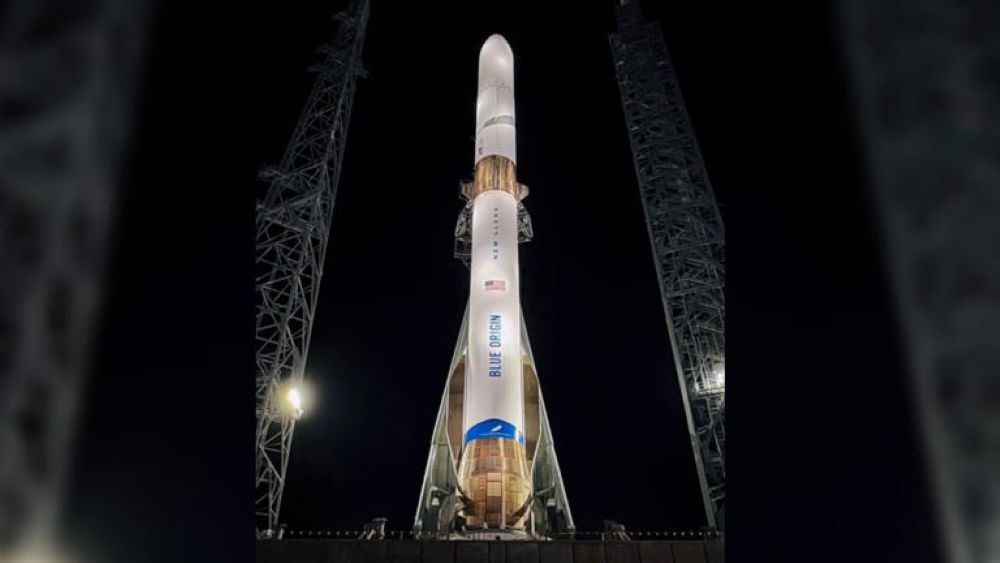
The upper stage of the Blue Origin New Glenn booster (Fig. 7), expected to be operational after two more test launches, is probably big enough for purpose and can be taken into orbit on 8 launches per year, so the Blue Ring orbital transfer vehicle, a simulator for which flew successfully on the first launch, could gather them together to build Starseed, if required.
(To be concluded)
References
1. Paul R. Ehrlich, Carl Sagan, Donald Kennedy, Walter Orr Roberts, The Cold and the Dark: The World After Nuclear War, Norton, 1984.
2. ‘Killer Volcanoes’, Channel 5, 23rd September 2002.
3. G. K. O’Neill, The High Frontier, Jonathon Cape, 1977.
4. Duncan Lunan, ‘Project Starseed: an Integrated Programme for Nuclear Waste Disposal and Space Solar Energy’, Journal of the British Interplanetary Society, 36, 9, 426-432 (September 1983); ‘Project Starseed, or, Nuclear Waste Saves the World’, Analog, CV, 2, 54-73 (February 1985).
5. Duncan Lunan, Man and the Planets, Ashgrove Press, 1983.
6. F.J. Dyson, ‘Human Consequences of the Exploration of Space’, in Eugene Rabinowitch & Richard S. Lewis, eds., Men in Space, Medical & Technical Publishing Co., Ltd., 1970.
7. Duncan Lunan, Incoming Asteroid! What could we do about it?, Springer, 2013.
Duncan’s story ‘The Day and the Hour’ was updated in 1986 and is reprinted in The Elements of Time, Shoreline of Infinity, 2016, available from the publishers and through Amazon. Details of that and his other books are on his website, www. duncanlunan.com.




Leave a Reply