
By Eamonn Keyes
When I discovered we were going to be featuring some articles about the Falkland Islands for our readers prior to the Island Games, I initially wondered how similar life there was to life here on Orkney. Since we can’t exactly nip down the 8,000 miles or so, I wondered how I would find out. A light bulb must have appeared above my head as I remembered my friend Jeff Windsor.
Jeff is an extraordinarily modest and down to earth guy who I had recruited to work in the NHS Orkney Laboratory when I was manager there. He normally works as a senior Biomedical Scientist in the Public Health Wales Laboratory at Aberystwyth. He has over 45 years’ experience in labs in England, Wales, Scotland, Gibraltar, Saudi Arabia, South Africa and Oman. Despite holding down his job in Aberystwyth since 1999, Jeff has also travelled widely by using his annual leave to work as a locum scientist and particularly enjoyed working in remote island labs. Then I remembered- Jeff had worked in Shetland , Orkney and the Falkland Islands. The ideal man to ask about his experiences there and what he knew about the character of the Falkland Islanders and about any comparisons to Orkney.
Unfortunately Jeff was diagnosed with MS in May 2022, which ended his locum travelling days, but he still continues to work in Aberystwyth with an electric power chair there.
I gave Jeff a ring and we had a good old natter for a while, catching up on our respective frailties and life in general. I asked him about his memories of the Falkland Islands and he was very kind in not only providing this information, but also to provide a piece he himself had written on his trip to the Falkland islands, which I reproduce here with his kind permission.
I have included the occasional clarification in italics for readers, as there are some scientific terms and abbreviations they may not be familiar with.
Unlike much of Orkney, the Falklands are fairly bleak islands, and like us they do not have very many trees. Jeff found the countryside and terrain more akin to rural Shetland than to Orkney, and told me that the wind was truly dreadful, the worst he has ever experienced, with it blowing him over several times. There are also many, many sheep! The internet and Wi-Fi systems have many problems, both with bandwidth and reliability, with frequent outages common.
The people he described as the ‘salt of the earth’, with no airs and graces- proud, resilient and self-sufficient and very patriotic after the 1982 invasion by Argentina. He mentioned the hotels as being quite good, with the pubs not being quite as genteel as in Orkney.
Transportation off-island is again at a different level from Orkney, given the distances involved, although there is also a travel reduction for Islanders as there is in Orkney. There is a severe knock on effect in terms of ordering clothes, electrical goods etc, as these have to come from the UK, and may take a couple of months at least. Fruit and vegetables can therefore be very expensive because of transportation costs.
Although the Falkland islands are at the other end of the world they also get the aurora at times, but the Aurora Australis (the Southern Lights)rather than Orkney’s Aurora Borealis (the Northern lights) and as our seasons are opposite, this will usually be from April to August, when the sky is darkest. There was a particularly good display on October 10th 2024.

Aurora Australis from the Falkland Islands
The following article was written by Jeff Windsor and is reproduced here in The Orkney News with his kind permission.
Microbiology and Penguins: a Locum in the Falkland Islands
by Jeff Windsor
I was working away in the Gilbert Bain Hospital microbiology laboratory in Shetland last September. While I was there I received an intriguing email asking if I would be interested in working in a remote island location? I thought I was in a remote island location – Shetland is closer to Norway than Edinburgh, but how wrong I was! The lab manager at the King Edward VII Memorial Hospital (KEMH), in Stanley, the Falkland Islands, phoned me up to discuss the position. He wanted to know if I was interested in working there, and whether I was suitably experienced to work as a lone worker in Microbiology. Having worked many times in small laboratories in Gibraltar, Orkney and Shetland over the last decade or so, I convinced him that I was up for the challenge. To be honest, once he mentioned that there were 5 different types of penguins in the Falklands, I was desperate to go! It took some time to sort out the work permit, and to book my seats on the flight to the Falklands, out of RAF Brize Norton. Most of the passengers are military, or MOD, but there are a small number of civilians on each flight. The full cost of the flight is £2,222 for a return ticket, although mine was paid for by the Falkland Islands Government. At least the flight nowadays is an Air Tanker Airbus A330 and not a RAF plane, however, the journey is not for the faint-hearted! The usual route is via Ascension Island, but the runway is being repaired so the South Atlantic Airbridge flights now go via Cape Verde. The flights are not allowed to fly over Argentina, so they go straight down over the South Atlantic Ocean. It was a 6.5-hour flight to Cape Verde, where we left the plane for 3 hours while they refuelled, cleaned the aircraft, and changed crews. The flight to Mount Pleasant Airport) MPA took 10.5 hours, followed by 45 minutes to Stanley, on a pretty rough road. I can never sleep on a plane, so by the time I arrived at the hospital house, at the quaintly named No: 10 Dairy Paddock Lane, I was pretty exhausted.

Gypsy Cove, Falkland Islands (with mine warnings!)
KEMH has a very small Pathology Laboratory, with 2 Biomedical Scientists (one is the lab manager and a haematologist; the other is the quality manager and the microbiologist), an MLA (lab assistant), and an Advanced Practitioner. Although I am used to picking up things very quickly, it became apparent that I would not have long with the Microbiology BMS, as she was travelling to West Falkland by ferry that afternoon! For comparison, when I worked in Shetland and Orkney, I had a week’s training and familiarisation – here it was 2 hours! Thankfully the LIMS (computer) system was more like a word processor, so if I messed something up I could just delete it and re-type!
The lab makes all its own media (petri dishes etc) in-house, just like the old days in the UK. European and North American laboratories use sheep blood as a supplement in their basic agar plates. The British just have to be different and use horse blood. Having worked in the lab in Gibraltar many times, I know that bacteria look different on sheep blood agar, and it takes a couple of days to get used to it. Horse blood does not travel well over 8,000 miles, especially as the planes out of Brize Norton are often subject to delay. Consequently, they decided to use expired human blood that was not used for transfusion for their basic media! I had some experience using human blood agar to confirm haemolysis, when identifying Gardnerella vaginalis many years ago, but I must admit it took some getting used to. Producing chocolate agar was also problematic. They bought in horse blood lysed from the UK, then heated it to 80°C. This media had a very short shelf-life and had to be re-made once the QC (quality control)started struggling.
The lab was not very busy in terms of specimen numbers, but the MLAs left the putting up of specimens for me, and the weekly media and susceptibility testing kept me occupied early on in the week. The lab had a GeneXpert (PCR testing analyser), which was used for CT/NG (Chlamydia/Gonorrhoea)on genital specimens on a daily basis. Although the population of Stanley is only 2000, there is a sizeable military presence at MPA. There is no military laboratory, so the samples are processed at KEMH.
One of my strangest afternoons in the lab there began with receipt of a dog faeces for culture and ended with 2 bovine milk samples from cows with suspected mastitis! Apparently, they had cultured dog faecal samples before, so when in Rome and all that. In the absence of a SOP (standardised procedure), I used the same culture plates we would use for human faecal samples and grew a Campylobacter! The milk samples involved some more research on-line, but one of the two specimens grew a heavy growth of a haemolytic Staphylococcus aureus. Although I would never process animal samples back home in the UK, as they are outside of our scope, the vets were very grateful for the results and the sensitivities on the Staphylococcus, although they had limited access to antibiotics. Interestingly, the organism in the main inoculum was completely killed, suggesting that there was some antibiotics in the milk. I was chatting to a nurse the next day, who told me that in the past it was not unusual to see horses in the hospital corridors, coming in for x-rays or scans!
There are no ATMs in Stanley, and only one bank, so I came prepared with a large amount of cash. Similar to Gibraltar, the currency is Sterling, and they accept ours, but you will not be able to spend theirs in the UK. Although cards could be used in supermarkets, shops and restaurants, I needed cash to pay for a couple of penguin safaris I’d arranged before I left.
There are Magellanic penguins quite close to Stanley, in Gypsy Cove. These South America penguins are also called Jackass penguins as they make a braying sound! They are burrowing penguins, and the scenery around this area is stunning, but there are signs advising caution over the possibility of mines on the beach, left after the 1982 war.

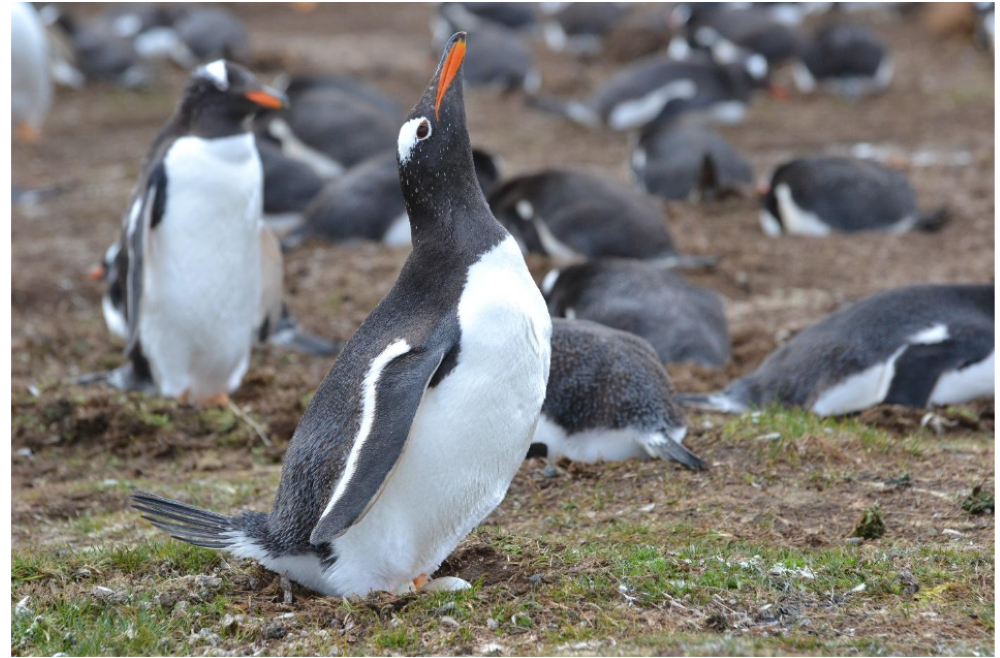
Gentoo penguins
My first penguin tour was to Volunteer Point. This took 2.5 hours in a 4×4 vehicle, over some very rough and boggy terrain. It was a fantastic drive and well worth the trip to see Magellanic, Gentoo, and King Penguins. There are around 1000 King Penguins at Volunteer Point, which raise around 500 chicks each year. These majestic birds were the stars of the show. Adults stand tall, reaching heights of 85-95 centimetres, making them the second largest penguins in the world.

King penguin chick and juvenile

Macaroni penguins

King penguins
My second 4×4 trip was to Seal Bay, which was even more inaccessible than Volunteer Point. This area has been closed to the public for over 20 years, and ours was the only vehicle there. We saw all 5 species of penguin that day, with numerous Rockhopper penguins and a lone Macaroni on the cliffs. The Macaroni are very few in number in the Falkland Islands, so often mate with the Rockhoppers, resulting in hybrids.
As my trip to the Falklands was mainly about the wildlife, I flew across to Sea Lion Island and stayed at the Lodge overnight. The food at the lodge was very good, and they had a well-stocked honesty bar. I saw 4 types of penguins, elephant seals, sea lions and lots of birds, ranging from vultures, peregrine falcons and striated caracara to waders and geese. Orca killed some elephant seal pups at 04:00 the day I arrived, but unfortunately, they were nowhere to be seen for the rest of my stay there. On the Falkland Islands Government Air Service (FIGAS) flight to Sea Lion Island, I was the only passenger and the flight took 40 minutes. There were already passengers on the plane on my return journey. The pilot announced that we were making 3 stops and that we would land in Stanley in around 2 hours. The FIGAS flights bring passengers, mail and supplies to the many small islands. We stopped at Waddell Island, New Island and Fox Bay, on West Falkland, landing on grass strips. What a memorable flight, without doubt the best I’ve ever been on!
My flight home was delayed by a day, due to the aircraft from the UK being unable to fly to MPA because of the high winds. Although the return trip was long and gruelling, I feel very privileged to have had the opportunity to work and play in the Falkland Islands. The local people were very friendly, and in some ways their patriotism reminds me very much of my Gibraltarian friends. The hospital was very efficiently run, staffed both with healthcare professionals from around the world, and local nursing and other staff. Consultants from Chile and the UK also regularly visit, and the theatre was very busy during my 3 weeks there. I have done countless locum jobs over the years, but I think this one is an impossible act to follow. But then again…you never know! I wonder if they have locums in St Helena?!

King penguins

Rockhopper penguin and chick

King penguins


Donate to The Orkney News
£2.00

Leave a Reply