
By Ian Cooper, from his excellent series Records of a Bygone Age, first published in The Stronsay Limpet and republished here with kind permission.
Although the South School was the longest lasting and busiest of Stronsay’s side schools, the other schools in the North End, Rothiesholm and, to a lesser extent, Papa Stronsay also played a significant part in local education for many years.
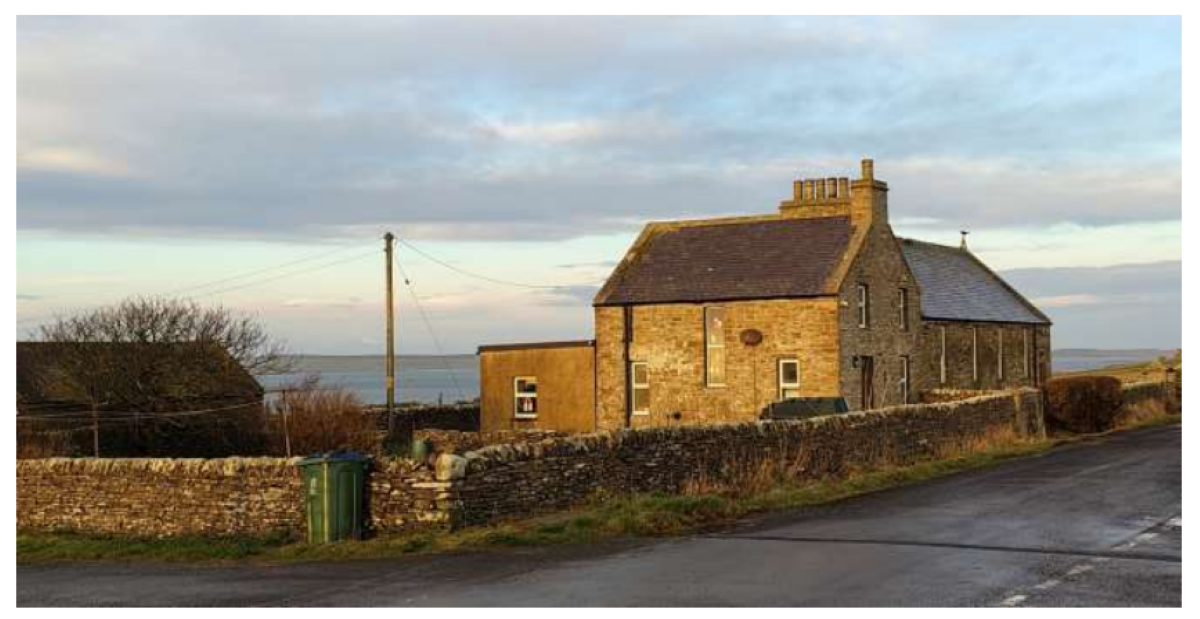
I’ve always had an active interest in the North School and Schoolhouse as it was bought by my uncle and aunt Dave and Nan Fotheringhame after it was closed as a school. When they moved away my parents bought it for use as a farm cottage, also making use of the old school building as an implement shed and general store.
To better understand its history and original purpose we need to go back to the introduction of the 1872 Education (Scotland) Act which enshrined in law compulsory education for every child in Scotland between the ages of 5 and 13. This Act stated that
“There shall be provided for every parish and burgh a sufficient amount of accommodation in public schools available for all persons resident in such parish and burgh for whose education efficient and suitable provision is not otherwise made…”
and was the catalyst for a huge leap in the provision of education in Stronsay.
This Act was to be overseen by the Scotch Education department in London and a vital component of its implementation was the formation of elected School Boards in every burgh and parish, Boards who were charged to “maintain and keep efficient every school under their management, and shall from time to time provide such additional school accommodation as they shall judge necessary.”
With the Act gaining Royal Assent in August 1872, the formation of around 1,000 School Boards in Scotland moved rapidly forward and, with Stronsay and Eday linked together to form a joint School Board, elections were soon held there.
Those successful in the first election were Colonel David Balfour of Balfour, Rev Joseph Caskey of Stronsay, Rev James Ingram of Eday, Mr Adam Horne of Eday and Mr Thomas Scott of Stronsay and they moved to their first meeting on 25th March 1873.
At this meeting, noting that
“in performing their duties under this Act, it shall be lawful for any school board to acquire by purchase or otherwise sites for schools, teachers houses and gardens, and to enter into contracts for the erection of schools and teachers houses thereon…”
it was resolved to proceed immediately with the erection of two Female Infant Schools, complete with schoolhouses, one in the north end of the island and one in the south. There were about 10 school age children in the area of the Rothiesholm peninsula and, as these scholars would be some distance from the existing school in the centre of the island and either of the proposed new schools it was agreed to correspond with the Education Department as to how these children could best be educated.
By the end of October 1873 grant applications for funding the new schools had been submitted to the Scotch Education Department and had been agreed by them. Sites for the new schools had also been agreed, the ‘South’ school at the junction of the Housebay and Everby roads and the ‘North’ school at the junction of the Whitehall road with the main road near Clestrain. Both sites were owned by Colonel Balfour and I’ve been able to have a look at the original title deed for the land at the North School, written in beautiful copperplate script but with no punctuation whatsoever which does make it a little difficult to read. It begins:
“I David Balfour of Balfour and Trenabie Heritable Proprietor of the subjects
hereinafter disponed in consideration of the Feu Duty hereinafter stipulated to be paid to me do hereby under authority of an Act passed in the Fifth year of the reign of Her Majesty Queen Victoria entitled “An Act to afford further facilities for the conveyance and endowment of sites for schools” The Education (Scotland)act 1872 And all other Acts powers and authorities enabling me herein Sell alienate and in feu-farm dispone from me my heirs and successors to and in favour of the School Board of the Parishes of Stronsay and Eday in Trust for the purposes of the said Acts and to be applied as a site for a Public School within the meaning of the said Education (Scotland) Act 1872 in the Parish of
Stronsay for a playground for the Scholars and for a residence for the Teacher or Teachers in the said school and for no other purpose whatever”

It then goes on to give the area and location of the site and, with no GPS available, describes the site at the North School as “bounded on the South by the public road leading from Clestrain to the Pier at Whitehall Stronsay and on the North and West by lands belonging to me the said David Balfour” Interestingly, in what must have been an early ‘cut and paste’ type error, the document states that the site is bounded “on the East by the public road leading from the North end of Stronsay to and forming a Junction with the Public Road leading from Housebay to Odiness and Kirbuster”, with this description undoubtedly referring to the feu granted for the South School, not the North!
The date of entry was given as Martinmas 1874, with the feu duty for the site, set at ten shillings and sixpence (52½p), to be paid to David Balfour or his heirs and successors at Martinmas 1875 and annually thereafter. Martinmas, one of the 4 Scottish quarter days or ‘term days’ fell on November 11th (later 28th November) and was the date on which most farm and property lets and employment contracts began and ended. The deed, dated 6th October 1875, was signed by David Balfour and witnessed by his factor Marcus Calder and his butler Alexander Robertson but it was March the following year before the deed was finally registered in Edinburgh.
Tenders for building both North and South Schools and attached Schoolhouses were submitted in April 1875, with the South School tender being accepted and moving rapidly ahead, opening its doors in October 1876. The tender for the North School, however, failed to find favour with the School Board and was put on hold. The project was again put out to tender in October 1876 but this time attracted no interest. It was advertised once again in March 1877, this time attracting a tender for £641 from Robert Fea of Kirkwall and one for £545 from James Chalmers from Sandybank. This lower tender found favour with the School Board, with the caveat that he should be bound and obliged to have the works completed by 31st December that year. The construction of this new school also attracted grant funding of £492 from the Scotch Education Board.
Sadly there is no record of another Board meeting until October 1878 by which time the North School was in full use, with certificated teacher Mrs Margaret Tolmie in post from September 1878, staying in the Schoolhouse with her two daughters, and receiving a salary of £40 which was increased to £45 eighteen months later. Although the contractor was bound to have the school finished by the last day of 1877 it seems fairly certain that it would have first opened its doors, with Mrs Tolmie in charge, in September 1878.
At this same meeting it was resolved that, as there was now sufficient school accommodation for all pupils on the island, the ‘compulsory’ clause of the 1872 act could finally be brought into operation on the island, this clause legally obliging every parent or guardian to send their child to school from the age of 5 until the age of 13.
There is no indication of how many pupils were enrolled when the school first
opened but a school report in the Orkney and Shetland Telegraph of 9th September 1884 lists an average attendance of 32 so, as it states that attendance was extremely irregular, it would be safe to assume the number actually on the roll would have been quite a bit higher than this. The school had also qualified for a grant from the Scotch Education Department, this discretionary grant being based on performance and attendance levels.

The awarding of this grant wasn’t guaranteed and, as reported in the Orkney Herald of 4th September 1889, was in danger of being withheld if it was felt a school was performing very poorly.

By February 1891 the roll had increased to 46, rising to 56 a year later, this out of a total roll for all the Stronsay schools of 207. By 1897 the roll at the North School had fallen to 34, with a further fall in numbers to 24 by 1904.
The North School catered for all the children north of that school and also a number of the children from Whitehall Village and Papa Stronsay, although some of those preferred to attended the Central School which was only a little further away from the village.
In 1896 the joint School Board for Eday and Stronsay was disbanded, with each island now being granted their own Board. One of this new Board’s first tasks in December of that year was to deal with a request submitted to the Board for the use of the North School for ‘a social meeting’ around the New Year. This was unanimously granted on the condition that no spirituous liquors should be used and that any damage would be the responsibility of those using the school.
Rev Brownlie, who had arrived late at the meeting and missed this item, noted his dissent to the decision and intimated that he was going to bring a resolution to the next meeting in the following terms:
‘Forasmuch as it has come to the knowledge of members of this Board that in the past the schools have occasionally been used by parties for the purpose of dancing either with or without the consent of the Board, it is hereby received
that this Board shall not henceforth grant the use of any school under their control for the purpose of dancing, and that the schoolmaster and schoolmistresses be informed of this resolution and that they be requested to prevent dancing within the schools as far as lies within their power.’
Sadly there is no indication as to whether Rev Brownlie’s resolution to ban dancing in school buildings found favour with the rest of the Board.
The North School was closed for 6 weeks from early December 1896 until mid January 1897 due to an outbreak of whooping cough but there was better news for the pupils when all were given a day’s holiday on 2nd April 1897 in honour of Rev Joseph Caskey’s Golden Jubilee as minister to the Established Church in Stronsay. The pupil’s good fortune continued with another day’s holiday granted on 22nd June to celebrate Queen Victoria’s Golden Jubilee.
In 1897, obviously feeling her talents weren’t receiving the financial recognition they deserved, Mrs Tolmie submitted a request to the school Board for an increase in her salary from £47 to £65 but this was refused. Her salary was increased to £60 in 1901 though, to bring it in line with that being paid to the teacher at the South School.
When the school and schoolhouse were built no enclosing wall had been constructed but this was to be rectified when. in February 1899, tenders were sought for the erection of a wall around the playground, with the strict specification that it should be 4ft (1.2m) high with a cope set in lime mortar. The scarcement was stipulated to be at least 3 inches (75mm) thick, with the wall width to be 2feet (600mm) at the bottom and 1ft 2 inches (350mm) at the top, with pillars corresponding in style to the wall and finished with cement. The lowest tender received was from Peter Shearer of Schoolbrae, whose offer of 4/8d (23p) per fathom was accepted by the School Board. It was agreed at the same time that sufficient lime should be purchased from a cargo of lime due imminently to enable the dyke to be pointed with lime, and that the school and schoolhouse should also be lime pointed. These weren’t the only improvements authorised by the School board around that time as it was also agreed that the kitchen and bedroom of the schoolhouse should be painted and a new set of wall maps and a set of weights and measures for the school should also be purchased, along with a new coal scuttle.

n February 1905 it was noted that Miss Calder had resigned as teacher at the South School and the School Board agreed that Mrs Tolmie, who had been teacher at the North School since it opened in 1878, should be appointed in her place at a salary of £70 and a new teacher sought for the North School. It seems this didn’t find favour with Mrs Tolmie, who preferred to stay in her current post, and the post at the South School was advertised soon after, but at a salary of £80. Mrs Tolmie’s salary was increased by £5 the following year.
In February 1908, in what was a great shock for the whole island, Margaret Tolmie, who had been sole teacher at the North School since it first opened its doors in September 1878, died very suddenly at the age of just 61. She had taught more than a generation of North End bairns and the HMI reports for her school were usually very good, praising her teaching.
The School Board was quick to pay tribute to Mrs Tolmie, noting that
‘Mrs Tolmie’s name was a household word in this Parish. She had been Mistress of the North Public School nearly 30 years, during these years she had been a steady, persevering and faithful teacher of the scholars under her charge. Naturally of a bright and cheerful temperament she was ever kindly and considerate in her dealings with the children. After many years of hard and laborious service the Board would have desired to see her enjoy a period of leisure which had been honourably earned .’
Part 8 next month.


Leave a Reply