
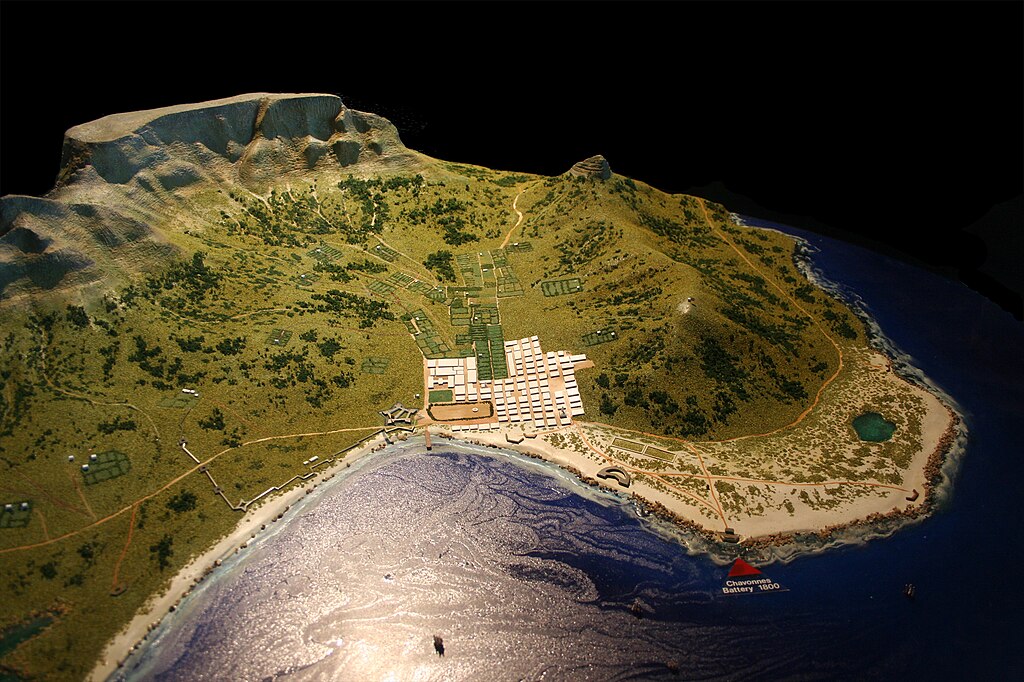
In 1817, a young blacksmith, James Smith from Melsetter, Walls, Orkney, arrived in Cape Town, South Africa. He was one of 200 indentured men taken out to what to them was an unknown land by Benjamin Moodie, heir to the Melsetter Estate. Moodie’s scheme was an economic enterprise to relieve him from the estate debts he was to inherit. What became of the scheme and of the men is an incredible story at a time of Empire and colonial expansion.
After the defeat of Napoleon Bonaparte the Congress of Vienna in 1815 divided up the spoils of war. This resulted in Britain becoming the possessor of all the world’s colonies except for those still controlled by Spain and Portugal. One of those colonies was the Cape which was ceded to the United Kingdom in the Anglo-Dutch Treaty of 1814.
The British Government, still reeling from the loss of her American colonies, and the cost of the war with Napoleon, had lost interest in sponsoring emigration schemes via free passage and land grants. It viewed Cape Town as an important stop over trading post on its lucrative route to India. White settlers had been established in the colony since 1652 as part of the exploits of the Dutch East India Company. When Britain took over it put in place its own Governor, Lord Somerset, and administration.

The Melsetter Estate in Orkney was beset by large debts. An ailing Laird, James Moodie, living in Edinburgh, had handed over the management to his eldest son Benjamin. In 1815 the estate trustees valued it at £47,000 with debts of £23,260. It was put up for sale.
Benjamin Moodie, came up with a venture to take out to the Cape of Good Hope, a place he knew little about, a group of settlers from Scotland. In 1816 he approached the Government to sponsor his scheme.
“His Majesty’s Government have at no time given any special advantages or encouragement to persons proceeding as settlers to the Cape of Good Hope, and consequently cannot deviate in your favour from the established practice.” – Letter from Henry Goulburn, Under Secretary of State for the Colonies, to Captain Benjamin Moodie, October 1816.
He failed to get the support from London but decided to go ahead with his plan. A previous project by Colonel John Graham of the 93rd Highlanders to take Scots from the Glens to the Cape came to nothing. Graham did, however, establish the town of Grahams Town, after a military scorched earth campaign against the indigenous peoples. Moodie was undeterred by the lack of success in Graham’s emigration plan. Moodie’s idea was to take out skilled men who he could hire out to the established settler community.
“The Agricultural classes are the only part of our population fit for colonization, and of them the Scotch Highlanders, from being the least useful in this country and the most inured to hardship, are the fittest….the suppression of the Rebellion in 1748 broke the power of the Chieftains..”
-he reminded Lord Bathurst, and of his family’s role in being part of the Hanoverian forces during the 1745 Uprising and its aftermath.
Benjamin Moodie now began the process of selecting men to take out. He had preferred to choose those from rural areas as he felt they would be easier to control, however, in the end most would be from Leith. The men were mostly aged 18 – 25, the majority were single, and skilled. Out of 1,500 who applied, 200 were chosen. They had to provide references as to their character and having served apprenticeships. They were expected to pay for their own passage to the Cape, including their accommodation, and if they could not that would be deducted from any wages they should earn at double the rate. They were required to sign indenture papers which for the time were considered to be strict.
Three batches of men departed for the Cape. The first group of 52 set sail on 14 March 1817 with the 28 year old Benjamin Moodie on the ‘Brilliant’. The Master of the ship was William Young and the voyage took 11 weeks. The Cape Town Gazette reported that the Brilliant arrived on 4 June 1817. The next two cohorts of men had already departed London by the time Brilliant docked in the Cape : The ‘Garland’ carried 49 and the ‘Clyde’ 89.
As far as can be ascertained the indentured men on the Brilliant included:
- George Anderson
- Robert Anderson
- Colin Bain, single, a Cooper, from Broughton Street, Edinburgh
- William Baxter, a Lawyer
- James Cameron, married with 5 children, a Saddler, from Methrin Street, Perth
- Andrew Clark, single, from Johnston’s Land, Gibbet Toll, Edinburgh
- Robert Crail
- Alexander Cunningham
- Alexander Davidson
- Adam Davidson, a Blacksmith, married, age 17, from Begbie and Dickson’s
- Archibald Dodds, a Blacksmith, married no children, from Broughton Street, Edinburgh
- George Eliot
- James Gordon, a Gardener, single, from Newbattle, Dalkeith
- William Gray, a Carpenter, age 23, from Millar Hill, Dalkeith
- James Hanton (Hauton) a Joiner, age 25, from 10 Port, Dundee
- John Henderson, a Baker/ Cooper, single, Broad Wynd, Leith
- John Hill, a Gardener, single, from Broughton Street, Edinburgh
- Thomas Hunter, a Blacksmith, single, from Davison’s Close, Cowgate, Edinburgh
- William Jarvis, a Cooper, single, from St Andrew’s Street, Leith
- Charles Kincaid, a Saddler, single, from Prince’s Street, Edinburgh
- John Laing, a Surgeon, from Scott’s Close, Cowgate, Edinburgh
- Jeffray Lister, a Millwright, single, from Fell by Leslie, Fife
- William Lyall, a Gardener, single, from the Adelfa Seed Ware Room, Edinburgh
- Donald McDonald, a Blacksmith/Labourer, single, from Fairlie’s Close, 229 High Street, Edinburgh
- Thomas McDonald, a Blacksmith, single, age 28, from Mr Dickson’s Leith Walk
- John McLaughlin, a Jeweller, single, from Leith Walk
- Murdoch McLeod, a Cooper, single, from 34 Charlotte Street, Leith
- Donald McNeil
- Alexander McPhail
- James McPhail
- Thomas Mitchell, a Millwright, single, age 22, from Markinch, Kirkcaldy
- John Murchison, a Blacksmith, single, from Lady Lawson’s Wynd Upper Port, Edinburgh
- George Neilson
- James Parker, a Cooper, single, Broad Wynd, Leith
- Archibald Paterson, a Cooper, single, from Head of Broad Wynd, Leith
- James Reid, a Millwright, married with 3 children from Head of Atholl Street, Perth
- John Sanderson
- James Scoon, a Blacksmith, single.
- Robert Scoon
- James Scott, a Ploughman/Mason, married, from Surgeon’s Square, Edinburgh
- William Scott, single, from Borthwick Brae, Hawick
- Thomas Spence
- James Stevens (Stephens), a Labourer
- Scott Strath, a Cooper, single, from back of Canongate, Edinburgh
- Alexander Tait, a Carpenter, age 25, from Northmains, Ormiston
- Thomas Thater (Tait) a Gardener/Cabinetmaker, single, from Greentree Place, Leith
- John Tester, a Gardener, single, from Broughton Street, Edinburgh
- David Wallace, from Dundee
- John Whitelaw, a Joiner, age 20 single, from Pinkieburn, Musselburgh
- John Wright, a Carpenter, age 24, single, from Fishers Close, Lawnmarket, Edinburgh
What could possibly go wrong? Find out in Part 2.
Fiona Grahame



Leave a Reply