
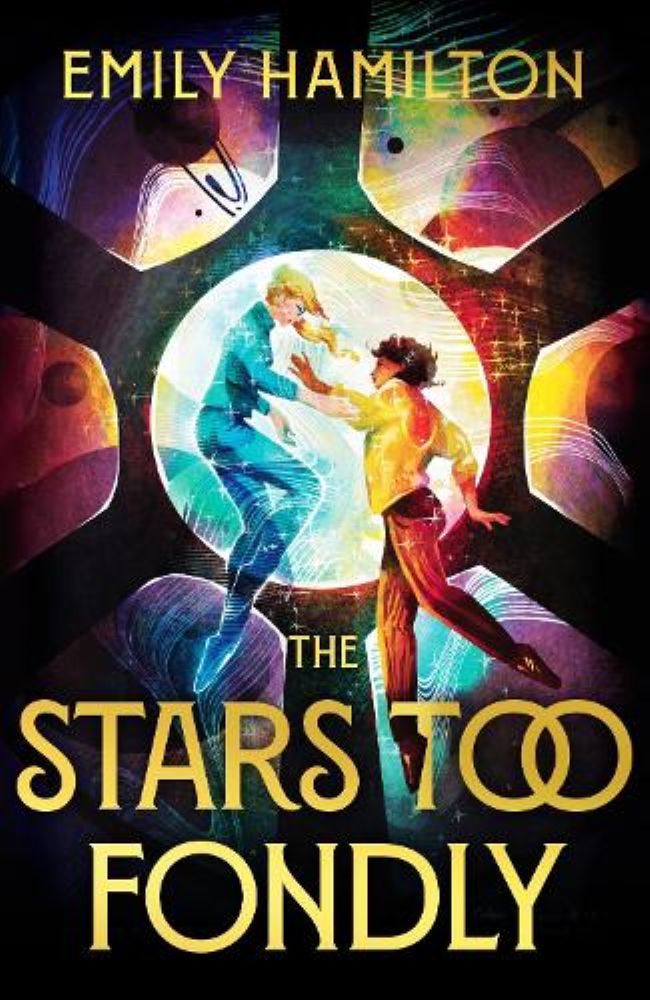

Emily Hamilton, “The Stars Too Fondly”, pbk, 317 +2 pp., £9.99, An Hachette (Orion), 2024.
First published inParSec # 11, July 2024.
The back cover of this book describes it as ‘Part space odyssey, part Sapphic romcon and all spaceship-stealing fun’. I’ll make no bones about it, the first and last parts of that description were what attracted me – sufficiently to see what I made of the rest. Inside the jacket, it says, ‘Lying somewhere in the subspace between science fantasy and sapphic rom-com, The Stars Too Fondly is a soaring near-future adventure about dark matter and alternative dimensions, leaving home and finding family, and the galaxy-saving power of letting yourself love and be loved.’ That’s not a bad description, actually.
Twenty years before, a starship called Providence was about to launch to Proxima Centauri with 203 occupants, the spearhead of an effort to colonise an earthlike planet and begin a new future for humanity. Its propulsion was a dark matter engine whose nature was a closely guarded secret because of possible commercial applications. At the critical moment, there was a flash of light and all the occupants disappeared except for the designer, who clammed up and disappeared himself a year later. As nobody else knew what had happened, the ship was sealed up and ‘abandoned in place’.
Twenty years later, because computing has moved on, the security systems are outdated and a group of space-mad teenagers break into it to see for themselves. Unfortunately the dark matter drive has been left on a hair-trigger, so the mere touch of a hand on the casing starts the launch sequence and the teens are off on a multi-year mission to Proxima Centauri. It would be all too easy for their characterisation and dialogue to become repetitive and boring, but I found it entertaining, and at this stage that was what kept me reading. I have read a very long novel about teenagers in an underground Mars settlement, and I found what goes on here a lot more interesting than that. What did faze me for a while was that one of the characters was invariably referred to as ‘they’ or ‘them’’. I’m old-fashioned enough that first I thought of twins, then multiple personalities, but eventually realised it was just that person’s pronouns of choice.
‘Science fantasy’ is the correct description for what happens. As it happens I read The Stars Too Fondly at the same time as Return of the Dwarves, by Marcus Heitz, and both are set in the aftermaths of disasters. In both, the characters acquire what are in effect magic powers (here called psychic), one through exposure to ancient gems with hidden powers, the other through exposure to dark matter. Both have to overcome enemies who have similar powers (in this case, the missing designer), who intend to prevent their journey, and to gain far greater powers for themselves. The designer’s plans threaten to open a breach between the dark matter universe and ours, and that has more than an echo of Isaac Asimov’s novel The Gods Themselves – but it’s none the worse for that, because I don’t know of anyone who’s tackled that particular idea since Asimov himself in 1972.
All this is complicated by the presence of a holographic projection of the ship’s captain, who has encoded her entire personality into the computer because of her suspicions of the designer. After initial antipathy she forms an increasingly powerful emotional relationship with Cleo, the central character, and a big frustration for them is that they can have no physical contact. There’s also the worry about whether, and how, the real captain can step into the projection’s shoes once she’s released from confinement in the dark matter universe. Emily Hamilton is described in the endpapers as ‘a science fiction author who writes about women kissing in space’ – what the back cover tactfully describes as ‘Sapphic’. As I said, that’s not one of the aspects that first attracted me to the book, but it’s well enough handled that I wasn’t put off by it – even when they do get together.
At that point, all 203 of the Providence crew are on the Proxima Centauri planet, plus the teenage newcomers. But the ship has been destroyed in the battle with its designer, and it’s clear that there will be no rescue from Earth, because it’s now known that dark matter propulsion is not going to be humanity’s key to the stars. Instead they have to find a way home, and to tackle Earth’s problems when they get there. But in the spirit of the book, which is light-hearted throughout, it seems likely to work out all right in the end.
Duncan Lunan’s latest books are available from publishers and through Amazon; details are on Duncan’s website, www. duncanlunan.com.

Leave a Reply