
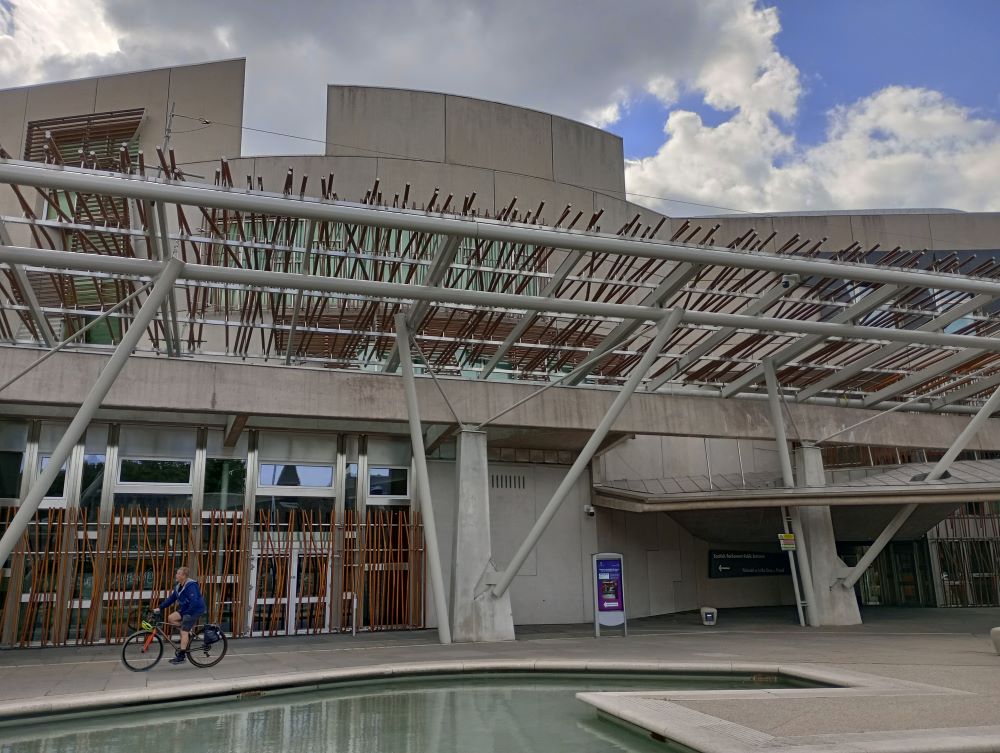
Elections to The Scottish Parliament take place on Thursday 7 May 2026.
There are 129 Members of the Scottish Parliament (MSPs). Everyone in Scotland is represented by 8 MSPs. One is a constituency MSP and the other 7 are regional MSPs. When you vote, you will receive two ballot papers. One is for you to choose your constituency MSP [Orkney]. The other is for you to choose a political party (or independent candidate) for your region [Highlands and Islands]. This is a form of Proportional Representation.
Who can vote in the Scottish Parliament Elections?
To qualify to be registered to vote you must be resident or deemed resident in the registration area and a British, Irish, European Union, Commonwealth or Foreign National citizen with the legal right to remain in the UK.
You must be aged 14 or over to register but you cannot vote until you are 16 and not subject to any legal incapacity. Convicted prisoners serving sentences of 12 months or less are also eligible to register to vote.
Citizens of the European Union and Foreign Nationals may also register to vote.
Deadline for registering to vote in the 7 May 2026 elections
Register by 11:59pm on 20 April 2026 to vote in the following elections on 7 May 2026:
Click on this link to find out more and to register to vote if you have not done so : Register to Vote.

The Scottish Parliament was re-established in 1999 after people in Scotland wanted more powers transferred to Scotland from the UK Parliament in London. It is a Devolved Parliament with major powers retained by London.
If MSPs in the Scottish Parliament pass a Bill, it cannot become an Act until it has received Royal Assent. The Supreme Court might decide the Scottish Parliament does not have the power to pass the Bill.
What can the Scottish Parliament decide?
The Scottish Parliament has power to make laws on a range of issues known as devolved matters.
Devolved matters include:
- agriculture, forestry and fisheries
- benefits (some aspects)
- consumer advocacy and advice
- economic development
- education and training
- elections to the Scottish Parliament and local government
- energy (some aspects)
- environment
- equality legislation (some aspects)
- fire services
- freedom of information
- health and social services
- housing
- justice and policing
- local government
- planning
- sport and the arts
- taxation (some aspects)
- tourism
- transport (some aspects)

What cannot be decided by the Scottish Parliament?
Some issues that have a UK or international impact remain the responsibility of the UK Parliament alone. These are known as reserved matters.
Reserved matters are set out in Schedule 5 of the Scotland Act 1998 (opens in new tab)
Reserved matters include:
- benefits (some aspects)
- betting and gambling
- broadcasting
- constitution (some aspects)
- consumer protection policy
- currency
- data protection
- defence and national security
- equality legislation (most aspects)
- energy (most aspects)
- elections to the UK Parliament
- employment law and industrial relations
- financial services
- foreign affairs
- immigration, asylum and visas
- nationality and citizenship
- postal services
- taxation (some aspects)
- telecommunications
- trade and industry
- transport (some aspects)

This is a series of articles which will cover The Scottish Parliament elections. The Scottish Parliament is now in recess to 8 April. Dissolution begins on 9 April. This is known as the “campaign period”.
Fiona Grahame


Leave a Reply