
By Ian Cooper from his excellent series, Records of a Bygone Age, first published in The Stronsay Limpet, and republished with permission.
Last month’s article ended with the appointment in September 1935 of Miss Frances Drever as teacher at the North School, moving into the Schoolhouse with her sister Lily as her housekeeper.
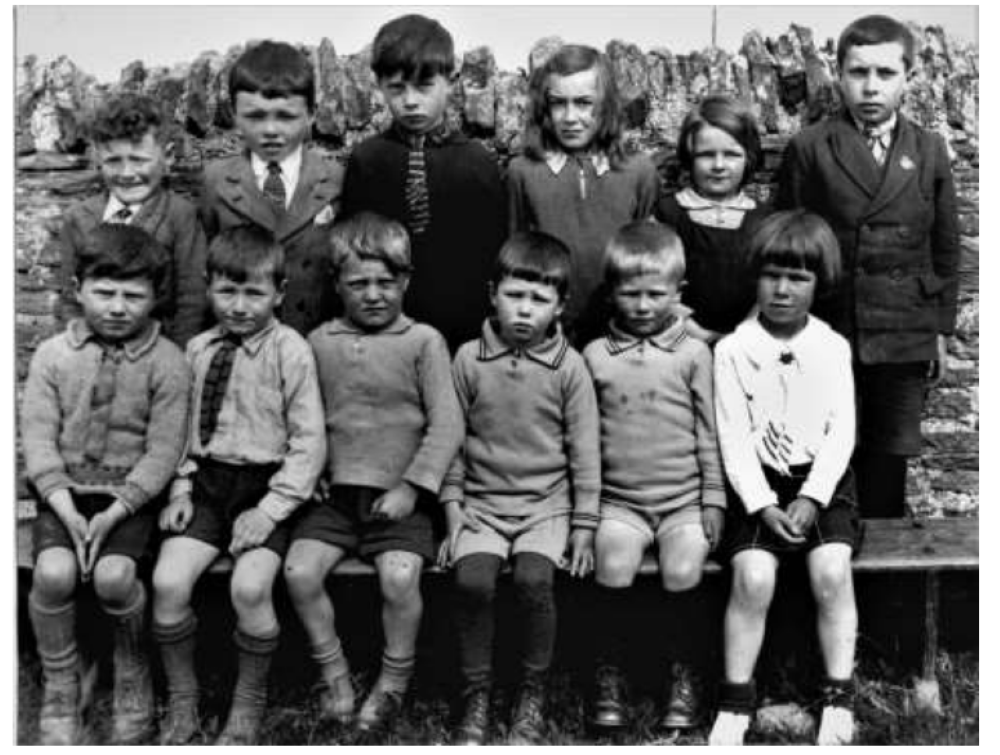
A school photo from around the time of her appointment shows most of the pupils who would have been at the school at that time, the majority of whom seem to be none too excited about having their photo taken!

Miss Drever appeared to record only the bare minimum in the school log book and there is little specific to be found about school activities in that log book for the next 10 years, This was almost certainly due more to the record keeper than to a lack of school activity, with the only items of any note to be found being discussions or events affecting all the island schools.
One of those was an item considered by the Orkney Education Committee and recorded in the Orkney Herald in December 1944 regarding the provision of school meals, the possibility of having to provide transport for some pupils, and the future of the Central School:
‘In Stronsay there are three schools and a side school, staffed by six teachers in all. The total roll is about 110. The Central School, an unsatisfactory building, which prior to the war, was under consideration for reconstruction, is at the top of the island, with no adequate water supply. A considerable number of the island pupils have over two miles to walk to the school. If the new Education Bill becomes law, such pupils, if under the age of eight, will require conveyance. If a school kitchen were erected at the present Central School, meals would require to be conveyed to the other three schools. The subcommittee felt that the question of a kitchen and school meals should be deferred, pending a decision by the Education Committee as to future policy in regard to the provision of Stronsay’s educational facilities. If all the island pupils attended one school, one, if not two, fewer teachers would suffice. The school might be erected in the vicinity of Whitehall Village, where an adequate water supply would be available, and the expense of conveying pupils to and from school would be offset by the saving in not having to convey meals to the other three schools.
In the opinion of the sub-committee several, if not most, of the Orkney schools are already so congested with equipment and fittings that there would be no adequate facilities for serving tables or crockery cupboards. In very few would there be any convenience at all for installation of sinks and draining boards, and the heating of water for washing up.
It was accordingly decided to recommend that the Department should be requested to arrange with the War or other Service Departments, to the end that wooden sectional huts, of which there are many in Orkney, might be transferred to the Ministry of Works, and made available for the school meal service, so as to provide at each school, where necessary, suitable hutting accommodation (as a temporary measure at least) for dining room and scullery purposes’
The hopes for a new school in the vicinity of Whitehall Village never materialised and it was to be a further 13 years before school meals became a reality.

Epidemics continued to sweep the island on occasion, with an outbreak of mumps affecting most of the pupils early in 1945 and, with this only recently past, the schools were all shut for 2 weeks in April due to an outbreak of measles.
On a much happier note, schools were again shut on 8th and 9th May 1945 as Victory in Europe Days and closed once more on 15th and 16th August as Victory over Japan Days.
Two of the last pupils to attend the North School shared some of their memories of the school, with Mary Scollay (nee Shearer) recalling the day she came to school to find an extra seven pupils in the schoolroom. A Newlands family had come to Stronsay on the steamer the day before, camping at the Ayre of the Myres, and had sent all their children to school with no prior warning!
She also recalls that all the pupils took a ‘piece’ to school for their lunch. There was a No 7 stove in the corner, always with a kettle on top, and with the kettle being boiled at lunchtime so that they all got hot cocoa to have with their piece. The stove didn’t really put out very much heat and during the winter months it was very cold in the classroom. There were small toilets, one for the boys and one for the lasses, with 2 buckets in each. If it was a poor day the lasses all used to shelter in the toilet so there wasn’t much privacy if you needed to go! She also recalls the day the school photos were taken; they didn’t like it very much as they were all told they had to look their best and stay perfectly still until the photo was taken.
Another ex-pupil, Austin Horne, was born at Clestrain and went to school for a time from there before he and his family moved to the Village to run the grocer’s shop and butcher shop at Bayview. He remembers well a heavy snowfall in 1947, where the pupils still had to make their way to school through snow knee-deep in places. Another event which was firmly rooted in Austin’s memory he recalls as:
‘I remember at one point the teacher, Miss Drever, was off for some reason so Mrs Ramage, the minister’s wife came to teach us. She was very soft on discipline so a few of us older boys took advantage of this and played up quite a bit; nothing serious, just talking in class (sinful in those days) and generally being showy-off before the girls! We all had to be called out in front of the class one at the time to receive the ‘strap’. She was rubbish at strapping, so we misbehaved even more. At one point I caught the strap as it was being administered and pulled it out of her hands and threw it up to the other end of the room. I didn’t dare tell my mum! However the next day the minister, Rev George Ramage, replaced his wife and he was not a happy man. He absolutely scared the pants off us so our ‘fun’ ended abruptly. We deserved it for sure!’
Austin Horne then goes on to reminisce about the buildings and the equipment they had during his time at the North School:
‘Heating in that huge room was a coal burning fire situated in the south west corner just in front of the first row of desks. Lots of ‘gansies’ were the order of the day. The desks were doubles and we used slate pencils (apparently made of some lead mixture without a wooden covering.) We used them to write on our slates; actually it was more of a scratching process than writing as we know it today.
There were also inkwells for the use of slightly older children to write in their copybooks with the aid of very primitive pens by dipping them in the inkwell and hopefully managing to make good imitations of the lines we had to copy. It was very easy to blot your copy-book, in more ways than one! Been there done that! We all had to take a ‘piece’ with us for lunch , or dinner as it was called back then. My dad, who was born in Runtha’ and also went to the North School, used to say that we were lucky because all he had was a handful o’ oatmeal but he had to bring it back home with him after school! I could have gone home for lunch but preferred to stay and play with my mates. Just a personal note here, there was a sign post just outside the playground, probably a school signpost, and we would hold on to the pole with one hand and run round as fast as we could. Apparently I was good at it because my mates called me ‘pirlie postie’ which stuck with me throughout my young life on the Island. It was my by-name, as it was called by most folk. People like Duffer (David) Reid , Sydney Swanney and lots of others always called me Postie every time I visited the island later in life! Anyway, while we spent a few valuable seconds gulping down our pieces the teacher retired to her peedie cottage for her piece. Supervision, you must be joking. Kids in those days were always let loose to enjoy the freedom of whatever space they felt like, the island was a safe place. We did have sanitation – we called it the lavvies, one lot for the boys and a separate lot for the girls. Ours consisted of a wall to pee up against and a couple of sit-down ‘facilities’ to do other business in. Basically they were a longish box with two holes cut in the long lid with buckets underneath . You could have a conversation with your pal while you both used the facilities. Trying to see who could pee the highest up the wall was part of our fun times! We didn’t know anything about the girls ablution block, as at that stage of our young lives girls were of no interest to us other than to kick a ball at or some other silly stunt. On the whole my time at the North School was a reasonably happy time. I guess there were about 20 odd kids there at that time, I do have a school photo still and can still remember all the kids on it.’
When Austin left school he went off to Wireless College in Aberdeen before going on to make a new life for himself ‘sooth’ but still retained his boyhood memories of Stronsay, returning regularly on holiday to rekindle memories and friendships. Here is his summary of those young and carefree days:
‘I enjoyed my young life up to the age of 15, when I left to go to college, very much and look back and realised how lucky I was to have spent those years with such a great community. We were so free to roam and play. In those days nearly all the sheds and buildings, abandoned, after the fishing industry in Stronsay came to an end, were our adventure playgrounds. Health and safety wouldn’t allow such freedom today!’
As the population of the island fell and with a corresponding fall in the number of children to attend school there was enough capacity at the Central School for the North End pupils to attend there and the decision was taken to close the North School in 1949. Miss Drever was just one year short of reaching retirement at that time so it was agreed to keep the school open for another year, by which time Miss Drever would be in receipt of her pension. The school closed its doors for the final time in December 1950, with Miss Drever and her sister moving to Kirkwall where Miss Drever lived to the ripe old age of 101.

Miss Drever’s last pupils moved to the Central School on 5th January 1951, these final nine being: John and Alexander (Ali) Chalmers, Yearnasetter; Ronald Reid, Red House; Bernard Miller, Verdun; Erling Fiddler, Fagerheim; Charlie Devin, Northcliffe; Patricia Horne, Bayview; Mary Shearer, Cedar Lea and Kathleen Stout, Whitehall Farm.
The school and schoolhouse were advertised for sale in 1953, with my uncle and aunt Dave and Nan Fotheringhame buying it. My Auntie Nan was a Shetlander and when they bought it they named the schoolhouse ‘Holmsgarth’, after a part of Shetland where Lerwick is built and also because it fitted in well with my Uncle Dave for its view of Linga Holm and of Midgarth where his sister Grace (my mother) lived. Uncle Dave was a joiner and the old school building was an ideal store and workshop for him.

When Dave, Nan and their young daughter Mhairi moved to Kirkwall in 1959 my parents bought the house and school for the princely sum of £650. My uncle Dave had previously taken out a garage door in the end of the school building, enabling it to be used as a store for implements and fertiliser, with the schoolhouse being used for a time to house farm workers at Midgarth. When it was no longer needed for farm workers, Holmsgarth had a succession of tenants while the school building continued in use as a machinery store. Arna and I bought it, as part of the farm of Midgarth, in 1978, continuing to use the school building as a store and enlarging the end door to allow access to store a combine harvester. The farm was sold in 2017, with Holmsgarth later being renovated and also offered for sale, along with the old school building. The buildings were bought in December 2020 by a couple from Central Scotland who moved to Stronsay that same month and have made the old schoolhouse their family home.

Leave a Reply