
By Ian Cooper
For hundreds of years the farming ritual of seed time and harvest had remained relatively unchanged when, come harvest time, the oats and bere would have been cut with a sickle or a scythe then bound by hand into sheaves for storing and later threshing.
Then, with the coming of the horse drawn reaper in the mid-1800s, the job became semi-mechanised where the crop was cut by machine but was still gathered and bound by hand.

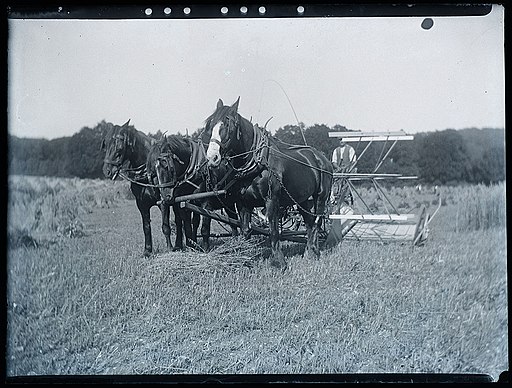
By the 1890s and early 1900s the horse drawn binder began to take over, with this new type of machine cutting the crop and automatically binding it into sheaves.
As time moved on from the early to the mid-20th century, the horses drawing the binder and doing the many other tasks around the farm were gradually being replaced by tractors and the days of the horse, and indeed the horseman, were numbered.
With a difficult and frustrating harvest in Stronsay now nearing completion, I thought this would be an appropriate time to recount one of the many farming anecdotes that the late Jim Work of Holland and Daisybank had to tell. This is set around the time when the heavy horse, although still playing an important role on the farm, was gradually being re-placed by the tractor and this is the tale of the coming of the first tractor driven binder to Holland – probably in the late 1940s or early 1950s.
As a bit of background information, the three Work brothers at Holland each had their individual passions with William being the shepherd and Jim very much the horseman while Robert, being the youngest of the three, took a great interest in all things mechanical.
This is Jim’s story:
“This particular harvest we had made a start to cutting the oats in a field out at the back of Holland. It was a fine standing crop and we were working away with the binder pulled by a team o’ three horse. Before dinner, Robert had gone away down to the pier with the tractor to collect our first brand new tractor driven binder.
He arrived back at the farm and came straight out to the field we were working in with the tractor and the new binder. I was working away with the binder cutting round and round the field, as you could do with a bonny standing crop, while Robert busied himself getting this new binder all set up and ready to go.
Well, when he was ready to get started he came across to speak to me, telling me that was him all set to go and suggesting that, as he would be cutting a fair bit faster than me, I would maybe just pull out of the way every time that he came up behind me so that he could get past and I wouldn’t hold him up.
Now as you ken, I liked my horses and that just niggled me a peedie bit as I felt that the horses were kindo being put down although I ken fine that wasn’t Robert’s intention.
Anyway, to cut a long story short, we both set off cutting, me with the horse binder and Robert with the tractor driven one. I must admit that I made sure I kept the horses going fairly well all afternoon and he never managed to catch up with me that day!
Right enough, the tractor and binder could cut far faster than me with the horse but, as we were going round and round the field, Robert had to stop at every corner and go and move some sheaves out of the way until he could reverse the tractor and binder far enough to start cutting down the next side of the field.
I was able just to stop sharp at the corner, get the horses to come smartly around and then head off right away down the next strip. Come teatime, the horses knew fine they had put in a good day but I was some pleased wi’ myself I can tell you!”
Any stories, information or anything else Stronsay related is always welcome by email to ian.cooper56@gmail.com
This article is kindly published here with permission from The Stronsay Limpet





Leave a Reply