
Winter is always a concerning time for our health services dealing with a rise in medical incidences and staff shortages. 2023 has got off to an extremely concerning start with a huge rise in the number of excess deaths due to respiratory causes. Which we reported on here: #Covid Deaths Weekly Update 12th January 2023
Covid is still affecting many (including long Covid) and in addition we have the pressures of seasonal flu. This results in higher rates of staff absence and the measures placed to limit the spread of Covid within hospitals when patients contract the virus means that our NHS continues to be under immense pressures.
In the latest week ending 08 January 2023, there were 405 new COVID-19 admissions to hospital – Public Health Scotland
The Scottish Government is so concerned about the pressures on both Health and Social care including the numbers of delayed discharges that a meeting of the Scottish Government’s resilience committee (SGoRR) met last week to discuss what can be done.
Delayed discharge happens when someone is declared medically able to go home but cannot because the ongoing support they require is not available in their community.
The latest data from NHS Scotland for delayed discharge was published on 19th of January 2023 but the figures are of course from before then. The next set of figures will be published on 7th of February 2023
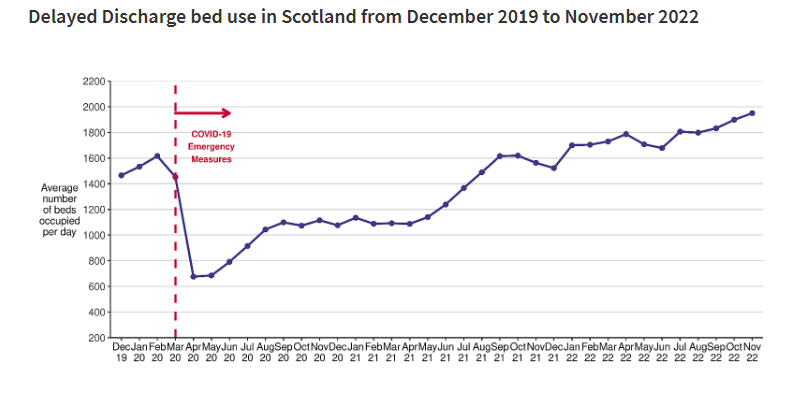
In November 2022, the average number of beds occupied per day due to delayed discharges was 1,950, the highest figure since the current guidance came into place in July 2016. This is an increase of 3% compared to October 2022 when the daily average was 1,898.
This means that people are not able to go home to be cared for there and they are occupying beds in hospital that could be used by other patients..

In November 2022, there were 58,501 days spent in hospital by people whose discharge was delayed. This is an increase of 25% compared with the number of delayed days in November 2021 (46,894).
Delayed Discharges NHS Orkney and Scotland
| Orkney | Scotland | |
| Number of delayed beds occupied (all reasons) | 113 | 58,501 |
| Number of delayed beds occupied (Social care/ patient/family reasons) | 55 | 42,552 |
| Proportion of all bed days attributed to standard delay reasons | 49% | 73% |
| Number of delayed beds occupied (Adults with incapacity reasons, code 9 AWI)) | 58 | 12,277 |
| Proportion of all bed days attributed to code 9 AWI delay reasons | 51% | 21% |
| Number of delayed beds occupied (Adults Non incapacity reasons Code 9) | – | 3,672 |
| Proportion of all bed days attributed to code 9 other delay reasons | – | 6% |
Orkney Health and Social Care Partnership, (Orkney HSCP) is a partnership between Orkney Islands Council and NHS Orkney. It is responsible for the delivery of the full range of the Council’s social work and social services, for all age groups and service user groups, and NHS Orkney’s community based health services since 2011, under joint management arrangements.
Click on this link to find out about Social Care in Orkney and the current list of vacancies which require to be filled is here: MyJobScotland
Commenting after the Resilience Committee meeting, Nicola Sturgeon First Minister of Scotland said:

“It is clear that pressure on the NHS and social care system continues to be very high, and that we need to maintain our emphasis on doing everything we can to help the service through the remainder of the winter.
“The measures set out by the Health Secretary earlier in the week will help to address some of the main issues – easing delayed discharge by purchasing additional care beds for those who are fit to leave hospital, and ensuring adequate resource is in place for NHS24.”
Extra funding of £8 million was announced last week by Humza Yousaf Scotland’s Health Secretary for additional care home beds and to boost NHS 24 capacity. Around 300 additional care home beds will be shared amongst Scotland’s Health Boards to help alleviate pressures caused by delayed discharge. The funding will allow boards to pay 25% over and above the National Care Home rate for beds. This is in addition to around 600 interim care beds already in operation across the country.
Nicola Sturgeon thanked ‘every single person working in the NHS and care system for the tremendous contribution they are making.’
Fiona Grahame






Leave a Reply to S DavidsonCancel reply