
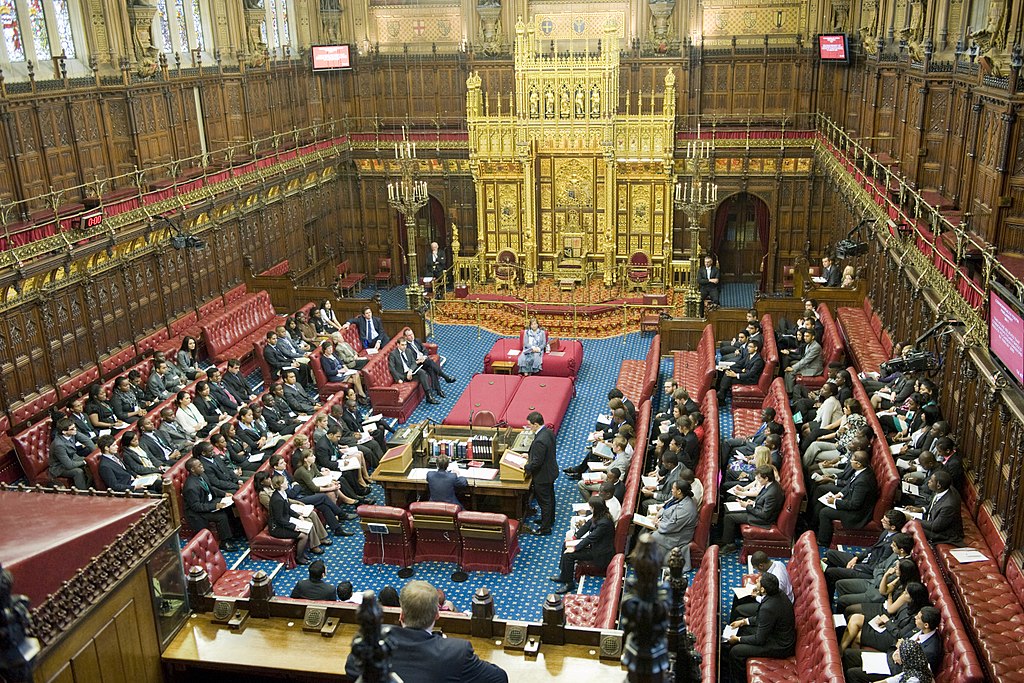
The Electoral Reform Society (ERS) has commented on the appointment of yet more unelected Lords who sit in Westminster’s second decision making chamber.
Willie Sullivan, Senior Director Campaigns for the Electoral Reform Society, said:
“The sight of the bloated House of Lords being stuffed with yet even more peers to hand jobs-for-life to party donors and supporters will only further corrode public trust in politics.
“At around 800 members, the Lords is already the second largest legislative chamber in the world after China’s National People’s Congress.
“This latest honours list only highlights the collapse of restraint we are witnessing at Westminster when it comes to creating new peerages and just how unsustainable the current unelected, unlimited Lords has become.
“The Lords urgently needs to be reformed and replaced with a smaller elected chamber, with a set number of members, where the people of this country, not prime ministers, decide who sits in Parliament making the laws we all live under.”
Donald Cameron, a Conservative Member of the Scottish Parliament for the Highlands and Islands Regional seat, is one of the latest recruits to the House of Lords. This has enabled him to be catapulted into the Scotland Office as parliamentary undersecretary of state. Despite having a devolved Parliament (1999), the UK Government has an expanding Scotland Office, headed by the Secretary of State for Scotland, Alister Jack, and responsible for Scottish affairs that lie within HM Government’s responsibility. The Scotland Office maintains two sites: Edinburgh and London. In 2020 its base in Edinburgh, Queen Elizabeth House, had an estimated 3,000 UK Government civil servants across a variety of government departments.
On his appointment to the Lords, Lord Cameron said:
“I am honoured to have been appointed as a UK government minister and to the House of Lords.
“As part of the Scotland Office team I look forward to continuing our work representing Scotland at the heart of Whitehall, upholding the devolution settlement, and ensuring Scotland continues to benefit from the UK government’s ambitious levelling-up agenda.”
The way the Regional List system works in Scotland means that there will be no need for a By-Election and Tim Eagle will now be moved up the List and become an MSP representing the Highlands and Islands.
David Cameron, who resigned as UK Prime Minister in 2016 and who is not an elected Member of the UK Parliament, was also catapulted into a position of power from the House of Lords. Baron Cameron is the UK’s Foreign Secretary despite not being elected by the British people.

There are 818 Members of the House of Lords. 662 of them are Lords who have been awarded that status by various UK Governments: Conservative, Labour, and Conservative/Liberal Democrats.
- Conservatives: 271
- Crossbench: 183
- Labour: 173
- Liberal Democrat: 80
- Democratic Unionist Party: 6
- Green Party: 2
- Ulster Unionist Party: 2
- Plaid Cymru: 1
- Bishops: 26
Scotland’s largest political party, and the party of Government in Scotland, the Scottish National Party (SNP), does not put forward people to be appointed to the House of Lords.
Only 91 are Hereditary Peers, and the Church of England maintains its say in the UK political system with 26 Bishops.
In contrast, the House of Commons, elected by the ‘First Past the Post’ system has fewer members than the House of Lords, with 650 MPs.
Reforms of the electoral boundaries will be in place for the next General Election, most likely this year, 2024:
| Country | Number of MPs 2019 | Number of MPs next GE |
| England | 533 | 543 |
| Scotland | 59 | 57 |
| Wales | 40 | 32 |
| Northern Ireland | 18 | 18 |
| Total | 650 | 650 |
The franchise of who can vote in a UK General Election is not as wide as for elections for the Scottish Parliament.
Despite the increasing role of the Scotland Office, the unelected Lords, the imbalance in the distribution of seats to nations of the UK, and the clear imperfections of the First Past the Post system: voting can make a difference. That is why it is extremely concerning that the UK Government brought in enhanced Voter ID when there was no evidence of widespread electoral fraud in the UK. Vote ID will make it harder for some citizens to cast their votes.
To check if you are eligible to vote in a UK General Election, and to register click on this link. Register to Vote
Who can register
You must be aged 16 or over (or 14 or over in Scotland and Wales).
You must also be one of the following:
- a British citizen
- an Irish or EU citizen living in the UK
- a Commonwealth citizen who has permission to enter or stay in the UK, or who does not need permission
- a citizen of another country living in Scotland or Wales who has permission to enter or stay in the UK, or who does not need permission
Check which elections you’re eligible to vote in.
You can vote when you’re 18 or over. If you live in Scotland or Wales, you can vote in some elections when you’re 16 or over – check which elections you’re eligible to vote in.
You normally only need to register once – not for every election. You’ll need to register again if you’ve changed your name, address or nationality.

Fiona Grahame



Leave a Reply to berniebell1955Cancel reply