
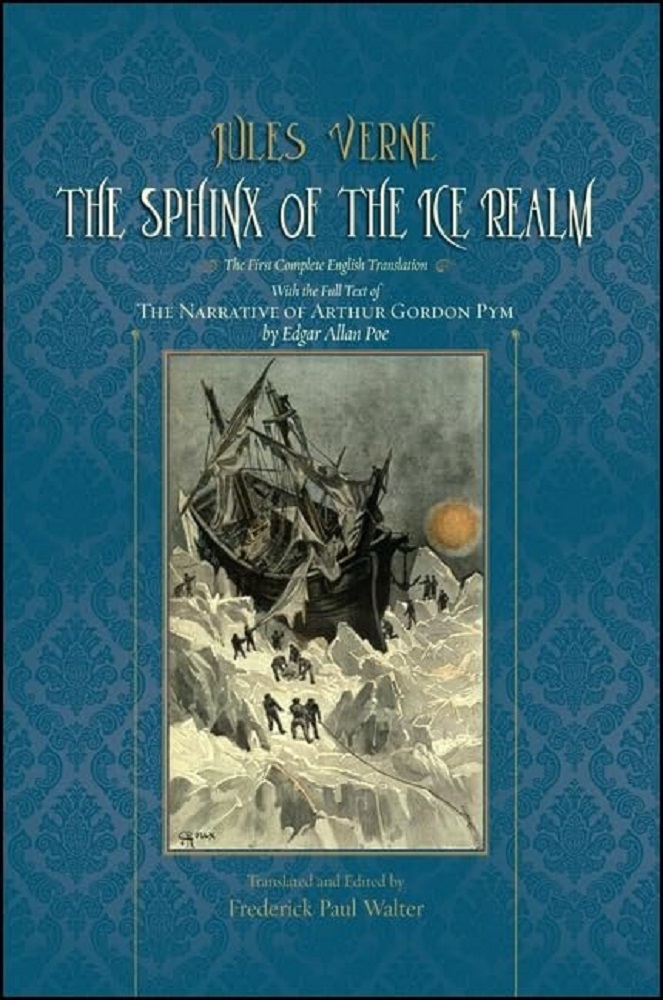

Jules Verne, “The Sphinx of the Ice Realm”, Translated and Edited by Frederick Paul Walter, State University of New York Press, Excelsior Editions, Albany, $24.95, 414 pp.
First published in different form in Interzone # 243, November 2012.

Edgar Allan Poe published his only novel, The Narrative of Arthur Gordon Pym, in 1838 (Fig. 2). Jules Verne reviewed it in 1864, and was as baffled as other critics by the abrupt ending, in which Pym is confronted by a gigantic white shape barring his way to the south pole, and dies on his return to civilisation before finishing his account. In 1896 Verne undertook to complete the story, promising to focus on the characters rather than the mystery. His start point was that Pym’s supposed return was faked, and his journal had been brought back by his companion.
This first full translation has 19th century illustrations, Poe’s novel and Verne’s review as appendices, and textual notes on both, comparing Verne’s manuscript, his amendments in proof, and the inadequacies of previous translations. It’s a lively translation: one clever touch is that Walter has Anglicized Verne’s use of surnames and titles, which can seem heavy-handed to non-French readers.
Verne was impressed by Poe’s insertions of factual material to make the story convincing. Indeed, I shall never forget Poe’s lecture on the relative merits of scudding or lying to in a storm; but as the ship is wrecked regardless, it’s irrelevant to the plot, like the gadgets on the car in the film version of Goldfinger. Verne learned Poe’s lesson all too well: he can’t mention an island without giving us a history of its real-life visits previously and since; as Walter says, “While contributing to the reader’s education, the author undercuts his own narrative”. Walter makes many of the infodumps interesting, but he can’t beat Verne’s preoccupation with the heights of mountains, even if we’re never to see them again. At the novel’s turning point, leaving Kerguelen Island for ever, at sunset, symbolically, his narrator says: “As the afternoon’s last hours faded away, so did the white crests and sharp peaks of Table Mount and Mt. Havergal, the first rising 2,000 feet above sea level, the second 3,000 feet.” He does it again on leaving Tristan da Cunha (“whose snowy, 8,000 foot summit finally faded into the shadows of evening”) and at South Georgia for good measure.


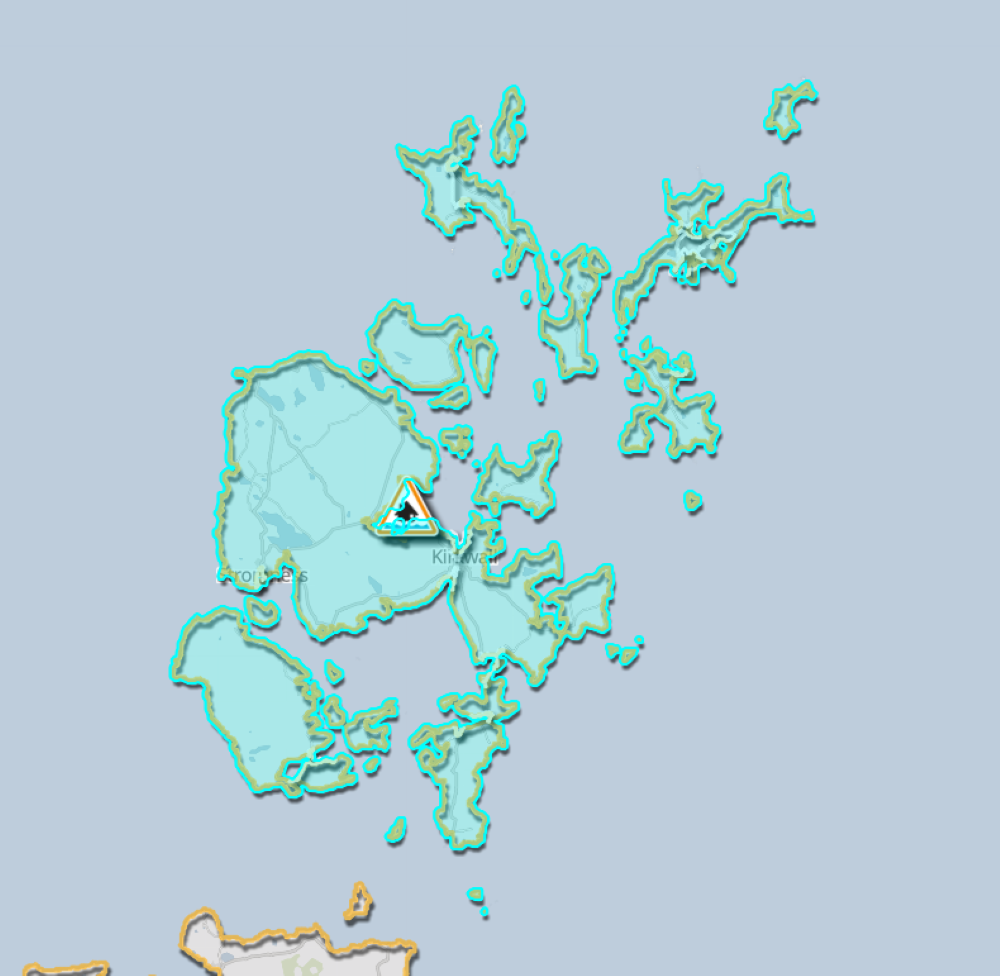
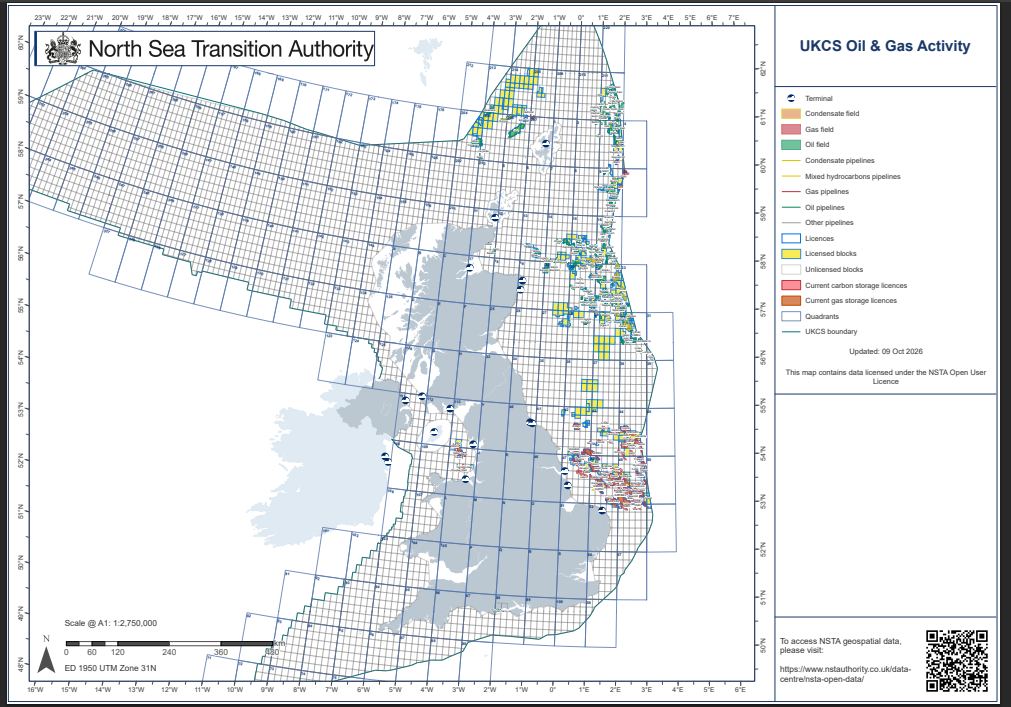
As he promised his publisher (Fig. 3), Verne scrubs Poe’s fantasy elements: since Pym visited it, the island chain with polywater rivers, remains of Egyptian civilisation (Fig. 4) and thousands of inhabitants, has been swept clean by tsunamis, and Pym’s approach to the pole is dismissed as exaggerated or hallucination. Verne keeps Poe’s SF idea, suggested by Weddell’s 1822 voyage, that Antarctica is not a continent but a collection of islands, ice-free for part of the year, beyond a barrier of icebergs in mid-ocean. Verne throws in a magnetic mountain on which he says Pym met his true end, but it’s the wrong shape, the wrong colour and in the wrong place to be what barred Pym’s way – it’s at the south magnetic pole, not barring a channel to the geographic one (Fig. 5). The south magnetic pole does wander, like the north one (Fig. 6), but they never coincide with the geographic ones. And if the magnetic mountain was what Pym saw, then in Verne’s version, he wouldn’t have had time to write it down!


Walter gives us a list of other writers’ opinions as to the meaning of the vision, including the idea that Poe simply got tired of inventing more marvels and couldn’t think of a way out of it. I must admit, I thought of that too. However, it turns out that Poe was experimenting with the serial form (early versions of two segments were indeed published in magazines), and he intended to write a sequel, giving up due to poor sales of the first volume. An important but unexplained message in a bottle was probably to provide the lead to the sequel.
But in his early review Verne spotted a bigger problem. In Poe’s novel, Pym’s faithful Newfoundland dog turns up out of nowhere, having been brought aboard ship without his knowledge. It helps in overcoming a mutiny and then vanishes without trace when the ship is dismasted and capsized. When the survivors are forced to draw lots on the upturned hull and eat one of their number, it seems the dog is not around. Otherwise there would be no problem, at least not so soon, and clearly the dog took no part in the draw which the unfortunate seaman Parker lost.
Verne makes the aftermath of the cannibalism the keystone of his own plot, but he has the dog survive till much later, spreading rabies, so digging huge holes in Poe’s plot and his own. Surely Verne (‘the professional plot devisor’ according to Walter, and ‘one of the best storytellers who ever lived’ according to Arthur C. Clarke, quoted in the notes) was aware of the multiple contradictions he’d introduced? He was in poor health at the time, but he kept writing well for years thereafter, well into the 20th century. The real mystery is not what Pym saw, or didn’t see, but what his two authors’ intentions really were.

Leave a Reply