
By Eamonn Keyes
Preamble
I suppose this piece ties in with my Spartan tales to some extent and provides additional context for the life I lived in the 1960s, so it should be viewed as being contemporary with them and partially explanatory for my damaged psyche in adding the burden of Irish superstition and tradition to the significant impacts the fantasies of cinema and television had on my impressionable years.
It was always the music that did it.
Usually the sound of strings, spiralling slowly upwards and heading for the inevitable point where the entire orchestra would crash in with a deh-deh-dehhhhhn, and either a woman’s shrill scream or a rasping inhuman growl. I’d be maybe 5 steps down the stairs.
I was never allowed to stay up for these old 1930s horror films which were on pretty late by 1960s standards, maybe 10 pm. I’d know they were on, having pleaded for days without any success to stay up, and as soon as I could hear the dramatic minor chords of the title music my imagination then kicked in, filling in the details for a screen I couldn’t see and dialogue I couldn’t really hear. Apart from the screams and growls of course.
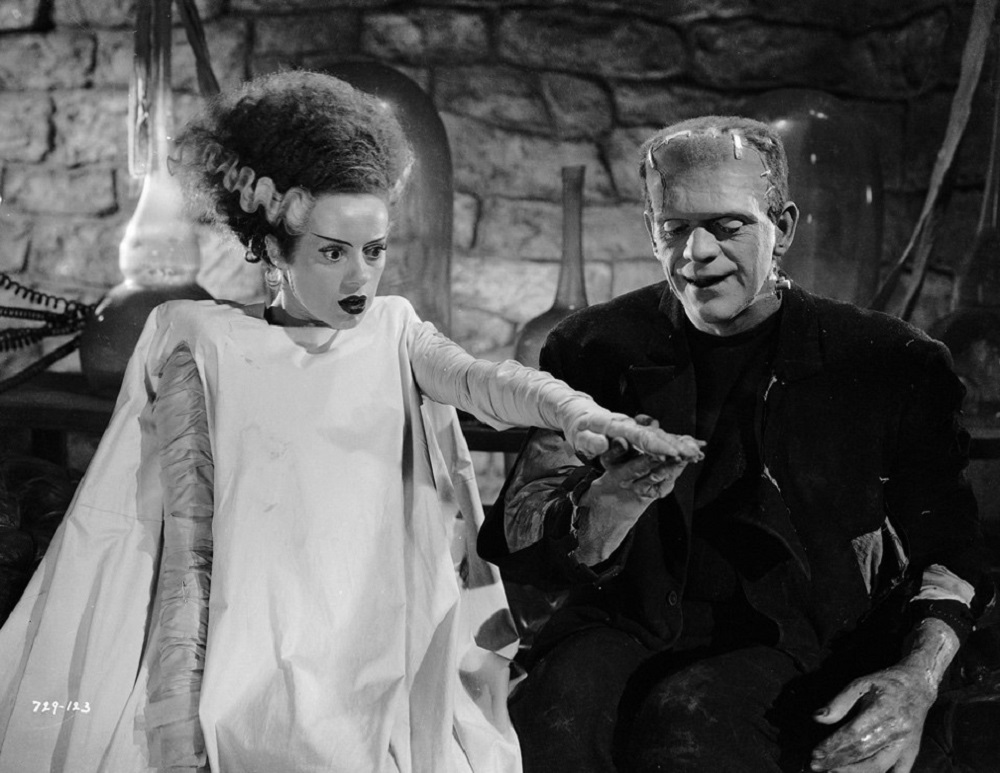
Frankenstein, Dracula, The Wolfman and The Mummy, all movies in that classic smooth black and white, featuring heroes with thin moustaches and exotic heroines who were often also victims, somehow caught by monsters who moved like an arthritic pensioner with several bottles of vodka on board.

The TV would be turned up loud, so I was fairly sure my parents couldn’t hear me as I managed to sneak out of bed, slowly open the door of the bedroom I shared with my siblings and ninja walk to the top of the landing to hear the action better. I knew which stairs creaked, and my feet were almost prehensile as they reached across these potential betrayers to grip a foothold just beyond them as I clung to the bannister rail to minimise any other possible sounds.
I had to get as close as I could to hear what I could whilst allowing room to escape if I was discovered, so I could then deny everything and blame my sleeping brother and sisters.
My dad was no slouch however, and often at the moment of greatest screen tension the door would be suddenly thrown open as he raced out to try to catch me unawares, but two quick leaps and I would be way ahead and he’d be unable to prove his suspicions.
A flawless plan. Until the time I bounded backwards to crash into my brother and sister, who had also crept down ninja style behind me.
The closest approximation to the scene is the TV nature programme clip where a crocodile suddenly jumps out of a waterhole at several drinking wildebeest. The darkened stairs are full of flailing limbs, dodging bodies and howls that almost put the movie itself to shame. Eventually the melee disintegrates into three bodies that reach bed in milliseconds, followed by an exasperated father who once again can only threaten vengeance on everyone instead of enacting any actual punishment.

Yet he is the same father who some years later takes me to my first ‘X’ rated film.
At that time it meant you needed to be 16 to see the film, and as a big thirteen-almost-fourteen I would be able to get away with it, he reckoned. The ‘X’ films came in two types, the ‘dirty’ ones and the horror ones. I was going to see a horror double bill, of course.
Even the ‘dirty’ ones were laughable by today’s Channel 4 standards.
First up in this schlock horror fest came the ‘Attack Of The Crab Monsters’. An awful movie, obviously intended for American drive in release with the usual late 50s scientists, military, single attractive girl and atomic mutation tropes. People ran backwards and forwards as the island they were on shrank because of the action of giant indestructible crabs that like to catch scantily clad girls in their claws, apparently. However, the crabs, which turned out to be telepathic, were eventually killed despite being indestructible when they threatened to have baby crabs and invade other places where they could chase those scantily clad girls to a much greater extent. Can’t be having that sort of thing going on.

This led to the main feature, ‘I Was a Teenage Frankenstein’. The best thing I can say about this is that my brain has erased most of it because it has failed the test of being worthwhile to remember for any reason at all.
I have a vague recollection of a lot of women screaming and a howling bequiffed James Dean character attacking the scientists who seem to have upset him for some reason, which is probably applicable to most teenagers at every time period in history, so that’s probably not much help.
There had been no horror, little in the way of scary scenes, and I was disappointed that this gateway to adulthood had been so disappointing.
However I had been to see not one but two X films. I was now a man, I remembered proudly as I slipped into bed after asking my mum to get my lunch ready for school, and I couldn’t wait to swagger into school and reveal the information to my envious classmates.
There was considerably more frightening stuff in real life, although it had mostly happened back in my Spartan days. The greatest was probably Vinnie. Let me tell you about him.
Vinnie’s On the Run….
Vinnie was Vinnie Smith. He lived almost directly across the street from my house, but we never ever saw him, except when he was ‘on the run’. And absolutely terrifying us.
My parents must have seen him regularly and spoke of him being ‘a bit strange’, but he must have been invisible to kids in daylight, as we only saw him, or only a small bit of him, as night was falling, and he seemed to know when we were there, usually during those long summer twilights.
The word would go around all the local kids that ‘Vinnie’s on the run..’ and we would all go to the top of the entry on Berwick Road. Vinnie’s back door was about 12 down on the right, and the braver kids would slink down three or four houses, tight against the wall and with every one of their senses focused on Vinnie’s back door.
Almost theatrically a large whip would appear, the only human element visible being a solitary hand gripping it, raising it and flailing it again and again as it cracked, the small, sharp sonic boom bringing terror to us and sending the braver kids tearing back up to safety.
Anecdotally he had chased one boy who got too close and had hit him with the whip, inflicting a horrible scarring injury, and nobody knew exactly who the victim was but for us it was all completely true and we didn’t want to be his next victim..
It also appeared Vinnie had been doing this for some time. We all witnessed his activity in the 1964-67 period, but a chant we all knew and sang to goad him may have dated his initial appearances- ‘Vinnie’s on the run, in the 1961’ sung to the music that is always heard when Indians appeared on the skyline in 1940s and 1950s westerns.
Why ‘the 1961’? Perhaps ask the band ‘The 1975’ that question.
We also sang the theme tune from a TV series called ‘Whiplash’, starring Peter Graves in his pre ‘Mission Impossible’ days.
Notably, this series was screened in 1960-61, tallying with the date mentioned in our chant, which we’d learned from older kids. Could this have been the motivation for Vinnie’s spree of child-frightening and his choice of weapon?
I suspect Vinnie was just a little bit bonkers, and that tying either some plastic clothes line or electrical cable to a stick was his one bit of occupational therapy in a boring world.

However, Vinnie did apparently indeed go on the run when sufficiently goaded. Several times he did actually chase us, brandishing his whip, so he continued to gain our respect and fear, mostly the latter, and an undying place in my pantheon of childhood terrors.
I suppose Vinnie is now dead, and I’d like to think they buried his whip with him, like some ancient Celtic chieftain with his sword.
I was probably terrified for half my childhood, and I loved it.
The maternal side of my family was almost entirely to blame, as they chatted about the supernatural as if it was an everyday experience for them. Looking back, I wonder if they were just trying to scare me as adults do, but there seemed to be more to it than that, and there was never a punch line to underline a joke. They just seemed to have that once commonplace Irish acceptance of the paranormal influencing everyday life, and these stories were repeated over and over again to different audiences over the years without change.
This, of course, is classic storytelling that has probably existed for thousands of years before writing was invented, the word-of-mouth tradition that gave us the Iliad, Odyssey, The Táin Bó Cúailnge, the Epic of Gilgamesh and many more epic tales.
My imagination amplified the words to an alarming degree, and I could easily visualise the stories as they were being told, and they were pretty scary to a child aged in single figures.
My Uncle Gerald was the main culprit. He was my hero, a teller of many tales and a hugely influential man for me. He’d joined the RAF at the very end of the war, telling me all about the dreadful state of destruction in post-war Germany and tales of being an armourer with the Mosquito and Vampire aircraft he maintained whilst serving. He wouldn’t have believed that within a few short years the area where he lived would have looked similar to some of those ravaged parts of post-war Germany.
On returning to Belfast he spent most of his time drinking bottles of Guinness and saving Embassy coupons, apart from when he was telling me stories as we walked miles out the Crumlin Road and Hightown Road towards the distant airport on sunny days.
He had also taught me the entrancing first stanza of ‘The Fairies’ by Irish poet William Allingham:
‘Up the airy mountain,
Down the rushy glen,
We daren’t go a-hunting
For fear of little men;
Wee folk, good folk,
Trooping all together;
Green jacket, red cap,
And white owl’s feather!’
This was delivered as an almost whispered rhythmic chant with movements to complement it, and my Uncle Jim would join in with him, as would my other uncles visiting from Dublin and Birmingham if present. This was obviously a well-loved family poem from their childhood in the 1920s and 1930s, and for me the words seemed to have tremendous power, but always with sinister undertones. This also led directly to their insistence that I always avoid damaging fairy bushes and trees, usually hawthorns.
This is an old Irish tradition and exists even to the present day. For example, the tradition held up construction of an Irish motorway as recently as 1999, as reported by The Irish Times.
‘A “Sacred” fairy bush in Co Clare will not after all have to be destroyed in the building of a new bypass motorway, much to the relief of those who attach superstitious beliefs to such features of the Irish landscape. There had even been a warning from a folklorist of a curse on the new roadway and of motoring fatalities if the fairy bush was to fall victim to the £100 million plan to bypass Newmarket-on-Fergus and Ennis.’
I learned the tales of his eldest sister, my aunt Annie, who had seen a banshee sitting on the roof opposite their house, and who had died at a young age in Roscommon after marrying a farmer, as the banshee heralds in Irish folklore – her early death, not marrying farmers, of course. I learned of my grandfather, who on returning home after another drunken night had encountered unknown and unsmiling strangers sitting around his hearth on All Souls Night, a time when the dead are supposed to revisit their homes, and who became teetotal from then on. My uncles told me of the haunted abandoned mansion up the Crumlin Road and how as children they watched at night as lights went on and off inside it for hours.
I sometimes wonder how I ever slept at night.
Back on the streets we were also filled with terror at some simpler and more tangible things, notably the sound of motorcycles and the sight of dead animals.
Motorcycles could be only one of two things, both seemingly intent to get us kids out playing in the streets. As the first motorway had just been built in Northern Ireland by the end of 1963, our first nemesis was the motorcycle policeman.
These were known colloquially as ‘speed cops’, but this was diminished by us to ‘spee cops’, and we knew their actual secret purpose was not to catch speeding motorists, but to catch us unawares whilst playing football in the streets.
The second fear had been instilled in us by seeing bank holiday battles in Southend and Brighton between Mods and Rockers on TV.

These were obviously very violent people, and we were sure to be on their list for abduction or beating up to keep in shape for the next bank holiday ruck. Despite our fears we never ever actually saw a ‘Spee Cop’, Mod or Rocker at any stage. But then we could fairly shift when scared.
Our final terror came from dead animals, usually a cat or dog hit by a car and laid out in whatever pose it assumed as it died, usually pretty horrible. We usually saw these on the way to or from school, and the word went round – ‘disease’.
For us there was always a strong possibility that these animals might have died from some new horrendous infection, and it was just waiting to jump the species barrier and find a new home in the curious children passing by.
Luckily we were fairly adept at infection control and we used one of two methods.
The first just involved holding your breath whilst you went closer to get a better look, but this was a very limiting factor and meant that you couldn’t take part in our usual prayer said for the repose of the soul of the poor animal, so most resorted to a potent early version of PP3, the woollen jumper. This involved pulling your jumper neck right up over your mouth to breathe through or to get your arm down a bit towards your body and use the sleeve to cover mouth and nose. This prevented any invasive viruses or bacteria from getting in and giving us whatever may have killed the cat or dog, but we never ever really relaxed until the animal was out of sight and we could once again breathe fresh, cool uncontaminated air.
The fear of getting disease from one of these animals was always a worry for us, and there was a worry that they might carry that most horrible of diseases, the tapeworm.
We had never seen one but we all knew the stories about dead children who had carried one. How they had gone to bed hungry and pleaded for a sandwich or a biscuit but been denied it, and when their mother went to waken them the next morning they were dead with a tapeworm, also dead, hanging out of their mouths, because it was actually the tapeworm that had been hungry and had gone on to eat the child from within, causing an apparently very silent death that didn’t disturb adults trying to get a decent night’s sleep.
I thought about this a lot, and about the callousness of parents who were prepared to risk their own children’s lives over a sandwich. Just to be certain I always had a biscuit or two before bedtime and that must have done the trick, because I am still alive to tell these tales……..
Postamble
Funnily enough in later years I became a parasitologist as a specialty within my profession as a Biomedical Scientist, attending an intensive course at the Liverpool School of Tropical Medicine and eventually attained my goal of obtaining a real tapeworm from a patient- all 13 feet long of it- in a particularly horrendous and unpleasant situation I won’t describe here.
In making the diagnosis I was unfortunately unable to discover whether the patient had been given a biscuit or two before bedtime as part of his clinical treatment.
You may also like: After the Spartans: The Next Chapter and The Influence of Ancient Spartan Warfare in Mid-1960s Belfast




Leave a Reply to Eamonn KeyesCancel reply