
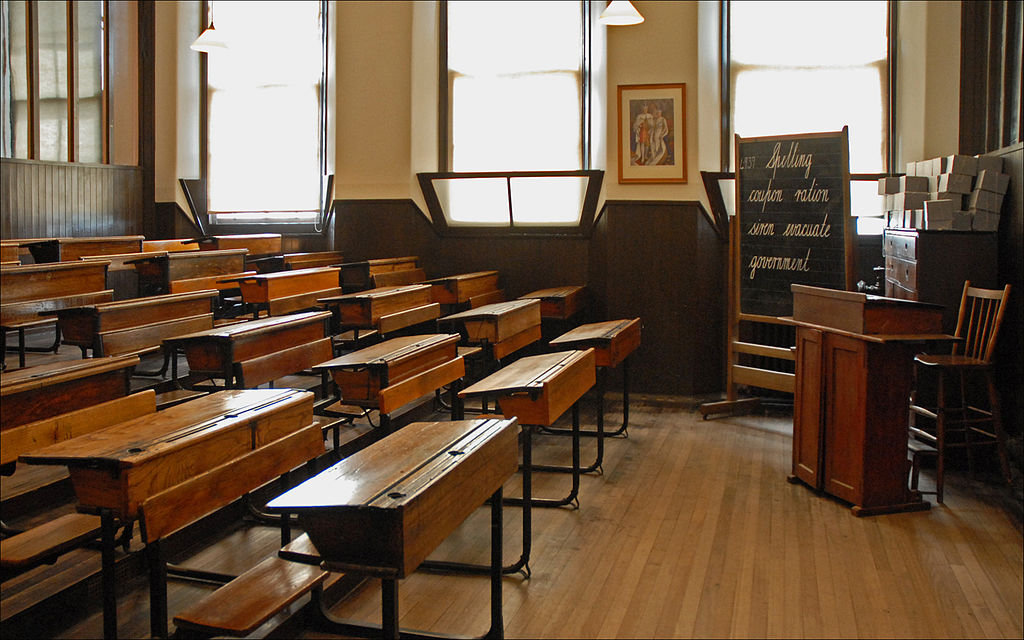
By Ian Cooper and part of his excellent series ‘Records of a Bygone Age’ republished here with kind permission from The Stronsay Limpet.
Part 3 of this story painted a picture of an efficient and well run school under Alexander Learmonth’s headship, but one with an ongoing problem with the poor attendance record of many pupils. We move on now to 1887:
A school holiday was declared on 17th June 1887 in honour of Queen Victoria’s Golden Jubilee, with all the schools on the island also being closed the following Monday where the Jubilee was celebrated by an island picnic at Ward Hill.
More holidays were to follow, with the school closed for the annual United Presbyterian Church picnic on 8th August and then again on the 12th, 13th and 16th, this being deemed as suitable dates for those wishing to experience the joys of the ‘Kirkwall Fair’.
This fair was the annual ‘Lammas Fair’ held in Kirkwall and, at that time, lasted a full week. No doubt a goodly number of islanders would have taken advantage of this opportunity as their annual holiday, with a report of that 1887 Fair recording that:
‘The streets have been more or less crowded at all times of the day. It is believed, indeed, that on no previous year have so many persons availed themselves of the holiday. The Orcadia brought many hundreds from the North Isles, while the Lizzie Burroughs did her best to keep up with the traffic from Rousay, Egilsay, Evie and other place in her circuit.’
The report then continued
‘On the usual stance at Sunnybank peripatetic showmen, with the attendant tribe of hacksters, conjurors and minstrels, mustered in good force.’
A good inspection report was given that year once again, although the inspector noted that ‘A new set of maps, a globe and inkwells for the desks should be procured. The schoolroom, which is large and without a ceiling, is insufficiently heated. The roof is not rainproof above the fireplace and the water runs down the walls. The playground is unenclosed and the offices have no separate access for boys and girls.’
It would seem that either the problem of an unenclosed playground may have been raised before or that the School Board moved remarkably quickly as, very soon after this 1887 report, the Board agreed that each of the three island schools should have their playground enclosed by a stone dyke, subject to the agreement of landowner Colonel Balfour. Mr Balfour was quite happy for this to go ahead but wished to make it clear that he still retained ownership of the flagstaff at the Central School.
In June 1888 tenders were sought for enclosing the playground at the Central School and building two ‘offices’ to be used as toilets. This was fairly specific in its terms, with the area to be enclosed and the specifications of the wall described as:
‘Bounded on the north by the boundary wall of Hunton, passing south around the east end of the school round the flagstaff and westward to the public road, then northward to join on to the wall of the Hunton farm, as the same will be pointed out by the clerk to the School Board. A stone wall 3 feet 9 inches high on the west side, the walls on the remaining sides to be 3 feet 6 inches high, all the walls to have a scarcement 2 feet 6 inches wide and 3 inches thick. Wall 2 feet at bottom and 1 foot 4 inches at top and finished with a rough hammer dressed cope 12 inches high and the full width on the top set in and jointed over with lime, all to be of good sound durable stones and all to be finished in a proper workmanlike manner. An entrance gate 8 feet wide with a pillar 3 feet square and 6 feet high on each side of the entrance gate, the pillars to be covered with a stone not less than 4 inches in thickness and to overslip the pillar 3 inches and finished with a boulder not less than 1 foot in diameter. The foundations to be laid on a hard level square cleared out across and any irregularity in the ground levelled with the general run of the surface. Lime: not more than half sand to be put in lime and the jointing on the top to be mixed with rough sand or fine gravel properly sifted.’
A separate specification for the erection of the two offices then followed:
‘10 feet inside with a wall between 2 feet thick so that each office will have 6 feet clear space inside measurement and have two seats in each. Height of front wall 6 feet inside, clear space, height of middle wall to be 11 feet, all to be built dry and jointed outside with lime and plastered inside. Couples 2 ½ x 5 inches and 20 inches apart, gables with built skew. Doors 2 feet 9 inches by 5 feet. Jambs 2 ½ by 2 inches. Doors 1 ½ inches thick with 4 back bars and ventilators, hinges and handles. Floored with pavement from wall to wall. Courts in front: 5 feet high and 4 feet wide (one end and front), floored with pavement. A cement gutter 2 inches deep and 6 inches wide in a round curve, stone front and wall cemented 3 feet up. Sarked with ¾ inch wood and welsh slate of good quality 18 inches by 10 inches, shouldered in lime mortar. Foundations to be cleaned out level. Scarcement to be sunk 3 inches and the floor on top of the scarcement. All rubbish to be cleared off the premises. Wall from offices to coal shed to be in height level with the coal shed. The whole to be dry built and jointed. Two gates 3 feet wide hung on oak post with jamb on other side between the offices and the boundary wall of Hunton.’
Tenders for the complete job were received from James Chalmers and Caleb Dickson for £75 and Joseph Bews for £54-7/6 while a tender was received from William Moodie to build the stone wall only at 5/- per fathom. Mr Bews’ tender was accepted, with the work being completed by June 1889.
The 1888 HMI report again gave praise to teachers and scholars, stating that ‘The school continues to be taught with vigour and ability; and if the efforts of the teachers were only backed by the enforcement of regular attendance its condition would soon leave little to be desired.’
In what could well have been a response to this criticism and also serves to illustrate the problems of the times, in April 1889 the Clerk was instructed to make public notice that no children would be allowed to go herding unless they had passed the third standard and were over 10 years of age otherwise the parents would be proceeded against.
William Moodie, the Compulsory Officer, was still finding it difficult to persuade some parents of the necessity of sending their children to school. In most instances a visit from the officer was enough to ensure compliance but this wasn’t always enough.
In a specific case soon after Thomas Fotheringhame, a carter in Whitehall Village, was instructed to appear before the Board for neglecting to educate his children, 12 year old Thomas and 10 year old James. The clerk was also instructed to write to the person employing these children to inform him that if they weren’t sent home to their parents he would be prosecuted for employing them illegally. Even this course of action failed to have the desired effect and, after repeated failed attempts to ensure that Mr Fotheringhame sent his two children to school, it was agreed that there was no option but to prosecute Mr Fotheringhame before the Sheriff at an early date. Whether this came to pass or whether Mr Fotheringhame complied by sending his children to school before he went to trial isn’t recorded.
Many of the older scholars took a holiday on 28th June 1889 to attend the annual Review of Volunteers. This review was of the Stronsay unit of the Royal Artillery Volunteers which had been formed in 1865 and, with their Drill Hall built a few years previously right next door to the school, would have meant a very short journey for the pupils.
Also in 1889 salaries for the Central School teachers were clarified to show the headmaster receiving £30 for teaching specific subjects and a further £70 for teaching ‘standard work’ while the assistant teacher and sewing mistress received £12 for standard work and an additional £8 for giving instruction in sewing.
Miss Shearer had resigned from the latter post in August 1889 and, before leaving, was presented with a work box and writing case by her pupils as a mark of their appreciation. The vacant post was quickly advertised, looking for a certificated teacher at a salary of £40, with her role to also include industrial work. With no suitable applicants the post was re-advertised in March 1890, offering an increased salary of £45, and Miss Robina Fraser, fresh from teacher training college in Aberdeen, was appointed to the post. This appointment was quite short lived, with Miss Fraser resigning in December and Miss Barbara Mary Duthie taking up the post in January 1891.
Another landmark in Scottish education, and arguably the greatest ever, was to be reached in 1890 when, with the passage of another Education Act, school fees were abolished. Now, for the first time, all children, regardless of sex or status, were enabled to enjoy free education.
The school report of 1890 was again satisfactory, with the inspector noting that the interior of the school room had been greatly improved by the roof being closed in with a wooden ceiling, adding that if a partition were thrown across the school room to obviate the noise and distraction caused by two teachers in the same room its capabilities would be still further increased.
It seems this recommendation was again acted upon fairly quickly and a division made across the room to separate the two teachers and classes. This was of great benefit to pupils and teachers but also necessitated the installation of a stove in Miss Duthie’s room to provide some warmth in that area.
More changes were to follow when, following a dispute with the School Board, Alexander Learmonth tendered his resignation on a point of principle. This centred around the Board’s wish to provide the teaching of at least four additional specialist subjects to older pupils and Mr Learmonth’s insistence that, unless additional resources were provided and pupil attendance much improved, then teachers had no hope of teaching these subjects effectively and that their priority had to lie with teaching the basics well.
Despite requests from parents to reconsider, Mr Learmonth couldn’t be swayed and moved on in September 1891. Before he left, 12 year old James Gorie, on behalf of all the pupils, made a moving speech before presenting Mr Learmonth with what was described as ’a splendid watch’, with Mrs Learmonth being given ‘a fine gold Albert’ before their departure from the island. Members of the School Board were noticeable by their absence at this presentation.
William Ledingham from Buckie was quickly appointed as his replacement, taking up duties in November that year.
Numbers on the roll are given in February 1891 as being 46 at the North, 104 at the Central, 48 at the South and 8 in Papay, a total of 206 plus several ‘defaulters’ (who weren’t attending school but should have been.) In March the following year numbers were given as being 56 at the North, 93 at the Central, 51 at the South and 7 on Papa Stronsay, a total of 207. It’s unlikely the total roll would ever have been much higher than this, although numbers were seldom given in records still available.
Another Parliamentary election was held in 1892, meaning that the school was shut on 25th and 26th July to allow voting to take place. Mr Lyell, the Liberal candidate and sitting MP, was again victorious.
The log entry on 18th November 1892 notes that ‘Attendance would have been much better had it not been for a sale at Housebay which lasted for 3 days and took many of the children away.’ This sale had been brought about by the Learmonth family leaving the farm of Housebay after being tenants there for almost 50 years and was thought at the time to be one of the biggest farm sales ever to be held in Orkney.

In January 1893 it seems there must have been some dispute over access rights to water as the Clerk reported to the Board that the well belonging to the Central School had been filled up with stones, stating that it had been reported to him that it had been so treated by Mr Meil’s servant. (Mr Meil was tenant of the neighbouring farm of Samson’s Lane and the well would in all probability have been on his property.) The Clerk was instructed to get the Officer to examine the well and find who had filled it with stones, with a further instruction to give notice to the perpetrator that the well must be restored to the condition it was in previously within eight days or legal action would be taken to ensure its reinstatement. These actions must have been successful as no more mention is made of it.
A note in the log for May 1893 records that all the boys who had been studying Latin had given up the subject, leaving 4 girls to continue the course. On being asked why they had given up the course we are told that the universal reason given was ‘Father says’!
After only 18 months in post Mr Ledingham resigned in April 1893, to be replaced by Duncan Macpherson in July that same year.
In another change of staff Barbara Duthie resigned in July 1893 and, after an advertisement for the post drew no suitable applicants, Agnes Tolmie, who had been teaching in Papa Stronsay, was appointed as interim teacher. Miss Tolmie was the daughter of Margaret Tolmie, headmistress at the North School.
The HMI inspection in 1892 had been less than satisfactory, although the inspector was happy to apportion some of the blame to the poor attendance due to an influenza epidemic. This was to be followed by a scathing report the following year with the school inspector identifying failings in just about every department, a situation which he blamed almost entirely on previous changes of teacher, with the work suffering accordingly. Commenting on Reading Writing and Arithmetic he rather worryingly proposed that, ‘if good work in this direction is to be done the instruction should be confined to the more promising pupils.’
By October 1893 Mr Macpherson, the new headmaster, seemed to be breathing new life into the school, where it was noted that a small German class had been formed to add to the Latin and French classes already available and that one boy was currently reading the epic Latin poem, Virgil’s Aeneid.
The following month, on 3rd November, the headmaster noted that ’The disturbing elements this week were rough weather and public roups.’
These public roups (or auctions) would have been taking place at that time of year as it was at Martinmas on 11th November that so many tenancies and contracts ended and tenants and workers moved elsewhere, often selling off much of their stock, equipment and household goods before they moved on. Martinmas was one of the four old Scottish Quarter Days or ‘term days’ and the one where by tradition most terms of tenancy and contracts of employment began and ended. Attendance at such a roup, with all the excitement and camaraderie it entailed, would no doubt have held more attraction than a day’s study for many of the older pupils!
Agnes Tolmie, who had been acting as interim teacher since the summer of 1893, came to the end of her contract in January 1894 when Irish born Miss Jessie Smith, fresh from teacher training college, took up the post.
Attendance figures, as always, were an ongoing concern in 1894, with pupils engaged in farm duties and kelp work through the spring and early summer, followed by harvest work and tattie lifting later in the year where Mr Macpherson recorded that ‘Harvest operations are in full swing; consequently the attendance is but meagre ‘. The log also noted that ‘a boy who played the truant was smartly punished’, while another entry told of two of the boys engaged in reading Xenophon’s Greek classic Anabasis – surely two ends of the spectrum.
The school was to close early one day in July 1894 to allow the walls to be whitewashed and floors scrubbed in preparation for an inspection the following week, an inspection that showed a remarkable improvement from the previous two. The inspector’s report stated that ‘The school, since it came under the charge of the present teachers, has risen very markedly in efficiency.’ before going on to praise the majority of the pupils’ work and praising the tact and intelligence with which Miss Smith was working in the Junior department, her work only being hampered, he stated, by the overcrowding caused by lack of adequate space. He went on to commend the School Board’s early proposals to erect an additional classroom for the younger children. These proposals quickly turned into concrete plans and, with a tender of £220 for the project being submitted by James Chalmers and accepted by the Board, work was soon to commence.
A year on and the 1895 inspection produced another glowing report but again noting the overcrowding, soon to be rectified with the erection of the new classroom which was nearing completion at that time.

The operation of a joint School Board for Eday and Stronsay had, ever since its inception, been causing difficulties for the Board, both through the geographical difficulties of getting members from both islands to meet in one place and with the difficulties in sharing funds and resources in a way that was seen to be reasonable to all parties. For some time past this joint Board had been making representations to the Education Department to split the Board into two separate entities, one for each island, and this was eventually agreed in July 1895, with the first meeting of the new Board specifically for Stronsay being held in October that year.
Among the new Board’s first duties was the appointment of Gracie M Brown of Hillhead in Glasgow to the teacher’s post at the South School at a salary of £55 with a free house, with her sister Elsie being appointed as second Assistant Teacher at the Central School with a salary of £50, with both being granted travelling expenses of £1/17/- (£1.85p).
In February 1896 a letter of resignation was received from head teacher Mr Macpherson. As he was obviously a very able and respected teacher, members of the School Board decided that this letter should be left on the table and agreed that they should meet with Mr Macpherson to offer him an increase of £10 to his salary. By the following month Mr Macpherson had agreed to remain in his present post but drew the Board’s attention to the unsatisfactory state of the schoolhouse. On inspection only minor defects were found and quickly rectified.
The Board’s faith in Mr Macpherson seemed to be wholly justified when the report of the 1896 school inspection was submitted to them. This report, the first since the new classroom and additional teacher were in place, lauded praise on the teachers, on the standard of their teaching and of the pupils’ learning. The report the following year continued in the same vein, stating ‘This is a very fine example of a well-staffed and well taught island school.‘ before going on to say that ‘In Latin, French and Mathematics the training is most valuable, being in point of accuracy and thoroughness distinctly superior to what one finds in the average rural school.’
A whooping cough epidemic again hit the school from October to December 1896, with 63 of the pupils being infected and each one excluded for a full month before being allowed to return to school.
In November 1896 it was noted that Eliza Lennie had been appointed as a monitor, with her salary given as £1. Perhaps the savings from this less than extravagant salary helped offset the purchase of a new piano at a cost ‘not to exceed £20.’
There was to be some welcome news for the pupils when all were given a day’s holiday on 2nd April 1897 in honour of Rev Joseph Caskey’s Golden Jubilee as minister to the Established Church in Stronsay. In a move which may not have found universal favour with pupils the school was then opened on Saturday so that Friday’s work could be completed, although the pupils’ good fortune returned with another day’s holiday granted on 22nd June as part of the celebrations to mark Queen Victoria’s Diamond Jubilee.
Part 5 next month.
See also:
- Stronsay Schools Part 1 – pre 1872
- Stronsay Schools Part 2 – The coming of the 1872 Education Act
- Stronsay Schools Part 3 –Into the 1880s and room for all



_(3816540623).jpg)
Leave a Reply