
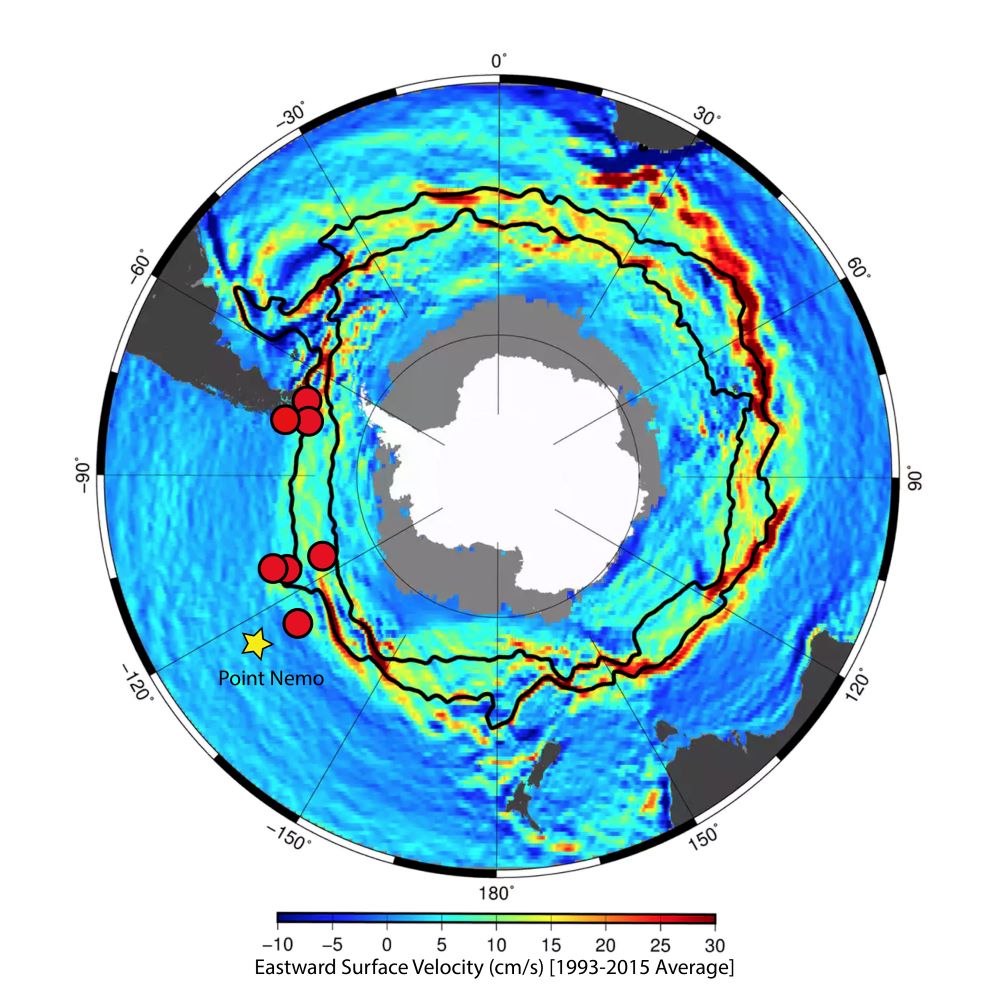
Continuously swirling around the southernmost continent, the Antarctic Circumpolar Current (ACC) is by far the world’s most powerful and consequential mover of water.

In recent decades it has been speeding up, but scientists have been unsure whether that is connected to human-induced global warming, and whether the current might offset or amplify some of warming’s effects.
In a new study, an international research team used sediment cores from the planet’s roughest and most remote waters to chart the ACC’s relationship to climate over the last 5.3 million years.
Their key discovery: During past natural climate swings, the current has moved in tandem with Earth’s temperature, slowing down during cold times and gaining speed in warm ones―speedups that abetted major losses of Antarctica’s ice. This suggests that today’s speedup will continue as human-induced warming proceeds. That could hasten the wasting of Antarctica’s ice, increase sea levels, and possibly affect the ocean’s ability to absorb carbon from the atmosphere.
Gisela Winckler, a geochemist at Columbia University’s Lamont-Doherty Earth Observatory who co-led the sediment sampling expedition explained:
“This is the mightiest and fastest current on the planet. It is arguably the most important current of the Earth climate system.” The study “implies that the retreat or collapse of Antarctic ice is mechanistically linked to enhanced ACC flow, a scenario we are observing today under global warming.”
The Antarctic Circumpolar Current (ACC) carries more than 100 times as much water as all the world’s rivers combined. It reaches from the ocean’s surface to its bottom, and measures as much as 2,000 kilometers across. It connects the Indian, Atlantic and Pacific oceans, and plays a key role in regulating global climate.
Driven by continuous westerly winds, and with no land in the way, it circles Antarctica clockwise (as seen from the bottom of the Earth) at about 4 kilometers (2.5 miles) per hour, carrying 165 million to 182 million cubic meters of water each second.
Scientists have observed that winds over the Southern Ocean have increased in strength about 40% in past 40 years. Among other things, this has speeded the ACC and energized large-scale eddies within it that move relatively warm waters from the higher latitudes toward Antarctica’s huge floating ice shelves, which hold back the even vaster interior glaciers. In parts of Antarctica, especially in the west, these warm waters are eating the undersides of the ice shelves―the main reason they are wasting, not warming air temperatures.
Through a complex set of processes, the ocean waters ringing Antarctica also currently absorb about 40% of the carbon that humans introduce into the atmosphere. It is unclear whether the speedup of the ACC will compromise this, but some scientists fear it will.
Currently much of the West Antarctic Ice Sheet is frozen to land that is below sea level, so it is highly susceptible to invasion by warm ocean waters. Were it to melt entirely, it would raise global sea levels by about 190 feet.
Click on this link to access, Five million years of Antarctic Circumpolar Current strength variability, published in Nature.





Leave a Reply