There are regulations across the whole of the UK about the use of Wood Burning stoves.

England brought in stricter regulations in 2023. In England it is illegal to burn coal (excluding smokeless coal like anthracite) or wet wood in your home. You can burn only kiln dried logs, dried logs, or smokeless fuels. You can only burn logs if you have a DEFRA-exempt stove. 

From April 2024, changes to building regulations in Scotland mean that new homes and buildings will not be allowed to use direct emission (or polluting) heating systems like oil and gas boilers, and bioenergy. 

The NBHS applies to all new buildings and some conversions where  a building warrant is applied for from 1 April 2024. The Standard only applies to systems used for heating and cooling and does not apply to industrial process heat.

The Scottish Government carried out extensive consultations about the proposals for the New Build Heat Standard in 2021 and again in 2022, and there were many discussions in the Scottish Parliament, including at Committee stages about the regulations. Click on this link for The Building (Scotland) Amendment Regulations 2023

Click this link for more documents about Building standards

Most large towns and cities in England are smoke control areas. In these areas, there are stricter limits on the amount of smoke that individuals are allowed to release. Because of this, in smoke control areas, you are not allowed to burn wood in normal stoves. You are only allowed to burn wood in a smoke control area if you have a DEFRA-exempt stove. DEFRA is the UK Government’s Department for Environment Food and Rural Affairs.

Click this link for advice from DEFRA for England : Open Fires and Wood-Burning Stoves

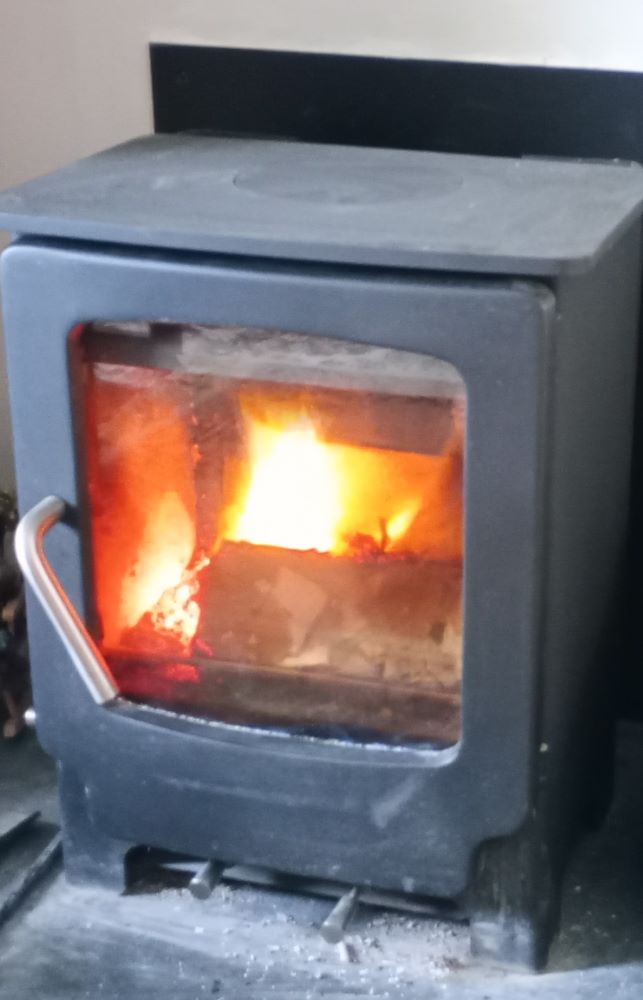
a wodd burning stove with a fire in it

Fiona Grahame

4 responses to “Wood Burning Stoves: What you need to know”

  1. briannugent9a3659c357 Avatar
    briannugent9a3659c357

    Most of above to do with regulations in England.
    What is the situation in Orkney, Scotland?
    On line discussion and regulations unclear on whether woodburners can be installed in renovation/conversions.

  2. Any students reading this?
    Well, there’s a suitable dissertation project.
    I wonder… if someone were to calculate on a regional basis (i.e. Western Isles, Orkney, Shetland) whether – under certain conditions – the emissions could actually be lower when stoves are being used as a source for the combination of heating and cooking.

    There are many things to consider, not only that you might find youself in the cold during power cuts (we do get our fair share of those). As studies from other countries have shown there are valid concerns whether the grid could cope with significant expansion of heat pumps. Also, I am yet to be convinced of the longevity of the parts that are outdoors in a maritime northern climate. If the climatic condition actually do limit the lifespan then production, shipping etc. for “early” replacements must all be factored in when calculating emissions.
    Stoves however, can have an extraordinarily long lifespan, well over 100 years if properly looked after. A cleverly designed source for heating and cooking plus possibly a gravity-fed hot water system could – for some regions, particularly isles – be an asset and not a burden when seen from the perspective of emissions.

    I used to live in a house where a large (historic) stove as a single source did provide such benefits. Heating more than one room, never needed a kettle because there was always hot water available, slow cooking, bread baking… you name it… all provided by this single stove that needed just a few well dried logs. And the ash from the wood could be used as a fertiliser. That was in continental Europe.
    Later I lived in a house in the Western Isles where an open fire in the kitchen provided hot water for kitchen and bathroom too. Needless to say that the over a week long power cut in the winter of 1995 (I think that was the year) had no impact on us at all. We could cook, bake, the house was cosy and we had warm water and so forth.

    Surely, this could in fact be far more sustainable than some modern households with a heat pump? Since not all energy is “green” and from renewables, the question must be asked how it can be that Orkney produces a lot of wind-generated energy, only to send it to the grid and “buy back” at market prices (always some gamble!) energy that might have been generated in a coal fired plant down south. Or generated with liquid gas shipped over from across the pond…
    And has anybody ever calculated the vast amounts of “hidden emissions” in processed foods (including any ready meals) from the beginning to the end? Foods that then need a fridge or freezer to be stored, an oven, cooker, hob, microwave, slow cooker, air fryer and whatnot to be prepared for consumption? All those items need energy to function and energy is also needed to manufacture and distribute those appliances that are often not designed to last longer than a few years.

    In this light, wood-burning stoves must be considered as a truly sustainable heating and cooking source. This is what the Germans call the “eierlegende Wollmilchsau”. An expression that literally describes a sow that provides milk and wool and lays eggs… sure you get the drift.

    Since the government seems to struggle to actually provide any properly conducted studies which prove that the Co2 balance of wood-burning stoves is worse than the one of heat pumps… and as I have described this could be disputed particularly when considering the whole context, the additional focus is then on the argument of particulate matter.
    Well, again someone has not done their homework because there are solutions for this problem too. And they are not new.
    In Bavaria for example (where wood is considered a sustainable heating source) particle filters, active or passive type, have to be installed by law in wood burning appliances to avoid particulate matter ending up in people’s lungs.
    And people are fined if they burn wood that has not be stored and dried properly. You can tell by the smoke that comes out of the chimney whether this is the case… and not necessarily need the expertise to decipher whether a pope has been elected successfully…

    We need to fight for our stoves in the isles. They can be very sustainable and we may just need to create a suitable and sensible(!) regulatory framework for their use.

    1. berniebell1955 Avatar
      berniebell1955

      Our stove…

      https://theorkneynews.scot/2018/11/10/stove-and-wind-people/

      I remember my mother’s family home in Ireland – a two room thatched cottage with a big stone chimney at one end – one of those with a ‘crane‘ in it, on which to hang pots and the griddle – and a fire which never went out….

      https://theorkneynews.scot/2018/06/25/talking-thatch/

  3. […] Wood Burning Stoves: What you need to know […]

Leave a Reply

Trending

Discover more from The Orkney News

Subscribe now to keep reading and get access to the full archive.

Continue reading