
One remarkable feature of ASTRA, Scotland’s national spaceflight society for 50 years, was that during its history, it had four branches in England – including two London branches at different times. ASTRA itself had been the Scottish Branch of the British Interplanetary Society for its first 10 years, before becoming independent in 1963, following the example of the Glasgow Branch of the British Astronomical Association, which became the Astronomical Society of Glasgow in May 1954, soon after the formation of the BIS Scottish Branch. To what extent these developments foreshadow ones in the larger political sphere remains to be seen.
To my surprise, some years ago I was invited to a Zoom meeting held by former members of ASTRA-London and other societies meantime, and was then asked to join their weekly Sunday sessions. On April 21st, one of the topics was the scene in Oppenheimer where he mentions that it’s ‘almost certain’ that the Bomb won’t ignite the Earth’s atmosphere. But how real was the danger? I always understood that the risk was that oxygen and nitrogen could be made to combine explosively with a sufficiently high triggering temperature. The analogy was with thermite, whose aluminium and iron oxide components usually need burning magnesium to set them off. On January 29th 1959 there was a tragedy in Glasgow when an aluminium-bodied tramcar collided with a lorry, and a spark from the fusebox started a blaze which killed two passengers and the driver. (Keiran Fleming, ‘Remembering the horrific Glasgow tram fire which took the lives of three people’, Glasgow Live, online, 28th January 2024 – Fig. 1).

It was said at the time that the lorry was carrying iron girders, and perhaps they had a patina of rust, but the electrical spark alone might have been enough to ignite the aluminium. It’s virtually certain that the aluminium-based paint of the airship Hindenburg was ignited by static electricity, conducted by rainwater, rather than its hydrogen cells being fired by lightning as originally believed. In the Falklands conflict, the aluminium superstructure of HMS Sheffield was ignited by the solid rocket motor of the Exocet missile which struck it – the warhead didn’t explode, otherwise the loss of life would have been far worse.
Oxides of nitrogen do form in volcanoes and in lightning strikes, forming ‘laughing gas’ and other oxides, but the chemical reaction of nitrogen and oxygen is endothermic, consuming energy rather than releasing it, so there’s no chance of it spreading. The risk which Oppenheimer and his colleagues were considering was actually a nuclear fusion reaction between nitrogen atoms. Del Cotter, formerly of ASTRA-London, sent me an informative link to a Welch Labs podcast, available on YouTube (Oppenheimer’s Apocalypse Math (youtube.com), which clearly explain it all in just five minutes. The triggering temperature for the reaction is so high that it could only be found inside giant stars, far more than the Bomb could create. But at the time of the Manhattan Project, the uncertainties were higher than they are now.

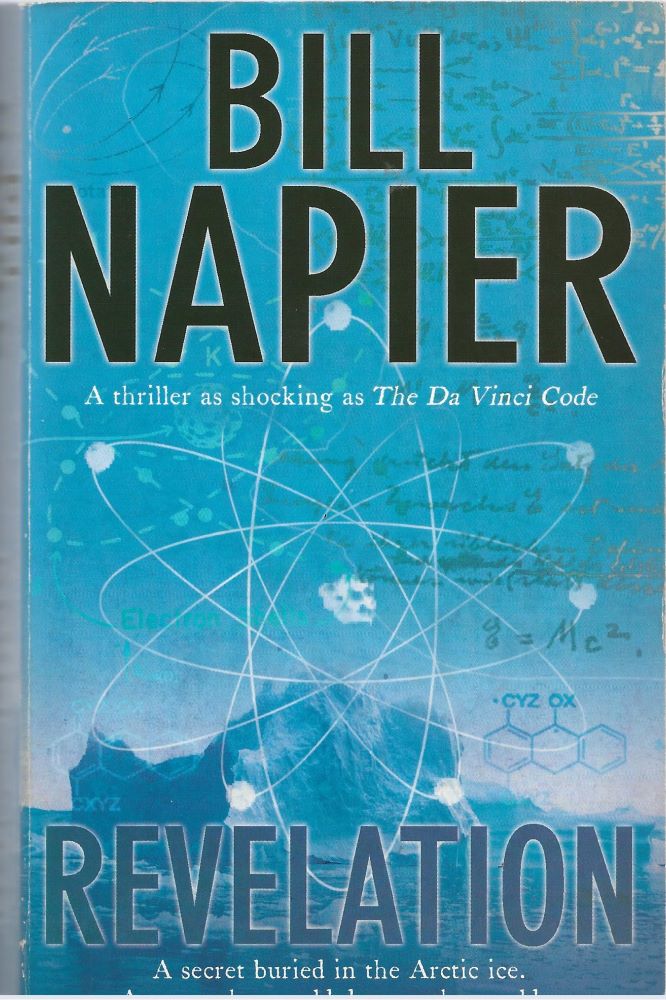
After the discussion, it came back to me that in the novel Revelation, by astronomer Bill Napier from Dundee (Headline, 2000 – Fig. 2), an émigré Armenian scientist comes up with a proof in the 1940s that nitrogen fusion is possible. He’s induced to return to the USSR, but his aircraft is shot down over the Arctic, and when it reappears from an iceberg in the present day, there’s a race between the superpowers to get hold of his papers. The Revelation jacket describes it as ‘A thriller as shocking as The Da Vinci Code’, and the common factor – the bigger danger – is a religious sect who want to make it happen, in fulfilment of the prophecy in the Second Book of Peter, Chapter 3, verses 6 & 7, which Peter, Paul and Mary summarised in Well, Well, Well as ‘God said “A fire not a flood next time”’ (Fig. 3). I used that prophecy in my 100-word ‘Drabble’ story ‘Poe pour E = MC2’, which appears with three similar ones in my collection The Other Side of the Interface (Other Side Books, 2021).


I thought that the concern in Oppenheimer’s time concerned combustion rather than nuclear fusion, but I may have confused it with a passage in the book V2, the first-hand account of its development by Major-General Walter Dornberger (Fig. 4). Describing the first successful launch of an A4, the V2 prototype, as it climbed into the stratosphere, he was reminded of a hypothesis that the upper layers of the atmosphere were a combustible mix of oxygen and hydrogen. If so, he wrote, we would soon find out! When I first read that as a teenager, I thought for a moment that it was incredibly irresponsible, until I realised that if it were true, meteors would detonate it on a regular basis.

In the title essay of Arthur C. Clarke’s collection Report on Planet Three and other speculations (Gollancz, 1972 – Fig. 5), Martian astronomers supposedly assess the possibility of life on Earth (while being careful to distinguish their comments from the fantastical ideas of imaginative writers). Apart from the problems caused by the high gravity, high temperatures and high atmospheric pressure, producing storms of unimaginable ferocity, there’s the problem that large areas of Earth are covered in deadly poisonous water, perhaps even feet deep, and the influence of Earth’s very large moon would cause it to scour the surface in deadly tides. Nevertheless, some writers have speculated that the lights seen on the dark side of the Earth might be cities. Attractive as the notion is, the high content of poisonous oxygen would give rise to a terrifying phenomenon, known only in laboratory conditions on Mars, known as ‘fire’. The presence of that alone is enough to rule out life on Earth altogether. A translator’s footnote adds that only three millennia later, the speculator’s idea would have been correct, and the permanence of the lights might have caused the scientists to change their minds. As they were writing, before the nuclear war which wiped out civilisation on Mars, the Greeks were storming Troy.
In the science fiction short story competition which I ran for the Glasgow Herald, 1986-92, there were quite a few stories which made the short list because of particularly good ideas, even if the writing didn’t pull them through. One such was about how the first human whom extraterrestrials met was a drunk, who asked them for limitless quantities of cigarettes and whisky. Like Robbie the Robot with the drunken cook in Forbidden Planet, they obliged him, so much so that the lit cigarette in his hand started a blaze which consumed all the oxygen in the atmosphere, and only humans on the Moon survived.

There has been one definite case of global conflagration, in which the sky was effectively on fire. As the ejecta from the Chicxulub impact off Yucatan spread around the world, 65 million years ago, the heat they generated re-entering the atmosphere would have been enough to ignite anything flammable below, even before the white-hot or molten rock came down (Fig. 6). Within the iridium-rich layer of powdered which is found worldwide at the Cretaceous-Tertiary boundary, there’s a thinner layer of soot which bears witness to the global wildfires. Samples of air trapped in amber and other materials show that beforehand, the oxygen content of the atmosphere was unusually high. That was good for the pterosaurs, enabling them to grow to huge size and still fly, but it made the wildfires that much worse when they happened. As David Attenborough pointed out in one of his documentaries, crocodiles and other water-dwellers were among the few animal species to survive, and even so, 90% of them died out – the mammals who survived lived below ground, High oxygen content can be deadly, as the Apollo 1 tragedy proved; in Kim Stanley Robinson’s Red Mars, an entire pressurised city is murdered by turning up the oxygen content until everything ignites.


There were spectacular images of a burning sky in the 1961 film Voyage to the Bottom of the Sea (Fig. 7), though unfortunately the reasons for it were absurd. You could tell the depth of scientific knowledge early on, when the first warning a submarine in the Arctic gets is that the melting ice above it sinks (Fig. 8). The supposition was that since the inner Van Allen radiation belt is composed of hydrogen nuclei, it could catch fire. The inner Belt is indeed composed of protons, captured from the Solar Wind by the Earth’s magnetic field, but they’re ‘hydrogen nuclei’ only because hydrogen is the simplest of atoms, with a single proton in the nucleus. Without a surrounding electron shell they’re incapable of any chemical reaction, let alone combustion.
Rather surprisingly, given his intellectual reputation, Theodore Sturgeon wrote the book of the film and tried to make sense of it by supposing the upper layers of the atmosphere had expanded due to solar activity. He was right on two counts: such atmospheric expansion does occur, and was responsible for the fall of Skylab, two years before the scheduled Space Shuttle mission to raise its orbit. There is monatomic oxygen at those heights, causing the characteristic green glow in the aurora borealis, and it was responsible for the glow which would build up round the Space Shuttle on the night side of the Earth (Donald E. Hunton, ‘Shuttle Glow’, Scientific American, Nov. 1989 – Fig. 9). From a distance, in the ultraviolet, the Earth is surrounded by a halo of monatomic oxygen, which was photographed from the Moon by the Apollo 16 astronauts from the shadow of the Lunar Module (Fig. 10). But it doesn’t explain where the electrons came from, to turn the protons into hydrogen atoms, and anyway the inner Van Allen Belt is more than 400 miles up at its inner edge, much too tenuous to burn.


Almost unbelievably, however, during the Cold War the Belts were brought closer to Earth, as part of a programme of high-altitude nuclear tests conducted in secret by the US military.

Tests in the upper atmosphere turned night briefly into day over the North Pacific with man-made aurora (Fig. 11), and the flashes melted the retinas of rabbits exposed to them. (Mark Wolverton, Burning the Sky, Operation Argus and the Untold Story of the Cold War Nuclear Tests in Outer Space, Overlook Press, 2018 – Fig. 12). The ‘Peter Simple’ column of the Daily Telegraph printed that story without comment, except for the one-word headline ‘Progress’. The tests were conducted first with X-17 sounding rockets, then with Thor missiles, from the USS Norton Sound, which had been used for launch of a sounding rocket to 106 miles in 1950, among other missile tests. (Milton W. Rosen, The Viking Rocket Story, Faber, 1956).

Among the larger-than-expected effects, they revealed that Electro-Magnetic Pulse from high-altitude explosions could cripple advanced electronics. Soviet designers generally took this more seriously than Western ones, and when a defector landed one of the latest MIG-25s in the West, it was found that its electronics still used valves. The first reaction was derision, until it was remembered that valves were less vulnerable to EMP. Whitney Strieber and James E. Kunetka’s novel Warday (Holt, Rinehart & Winston, 1984) depicts the USA five years after an EMP nuclear exchange. Britain, where electronics are taken to be less advanced, has begun on a new campaign of global domination. Although most cover illustrations show a mushroom cloud (Fig. 13) the EMP detonations would actually be too high up for that (Fig. 14).


The intended effect was to produce a radio blackout caused by particles injected into the lines of force of the Earth’s magnetic field, and that did indeed happen. It was anticipated that artificial satellites might be damaged by line-of-sight radiation effects (Fig. 15), but what wasn’t expected was that the ‘trapped’ particles would spread laterally, forming a new radiation belt inside the natural ones (Fig. 16).


Satellites such as Ariel 1, Britain’s first (Fig. 17), and Canada’s topside ionosphere sounder Alouette, hadn’t been hardened against such a radiation flux and simply dropped dead. In response to an international wave of protest, less about the loss of the satellites than about the ethics of large-scale uncontrolled experiments, a multinational Partial Test Ban Treaty was negotiated and signed by President Kennedy in October 1963 (Fig. 18).

Although it took time to have full effect, the long-term result has been an end to nuclear testing not just in space, but also in the atmosphere and underwater, ending some of the most environmentally damaging activity of its kind. It also put an end to Freeman Dyson’s ‘Project Orion’ plan to explore the Solar System with nuclear pulse rockets driven by controlled nuclear explosions – but better and less controversial versions, not breaching the Treaty, have been designed since. (See for example ‘Project Starseed’, ON, November 20th 2022.)
In his final chapter, Mark Wolverton writes:
“In the twenty-first century, it might seem incredible that something such as Argus or Fishbowl could ever have been contemplated, much less actually carried out. Surely such an enterprise, one nation deciding to conduct experiments that could conceivably affect the entire planet in unknown and perhaps dangerous ways, without the knowledge or consent of the rest of the world, was nothing less than the height of arrogance and hubris… But consider the historical sequence of events. Argus was hastily conceived, organised, and executed in perhaps the most absolute secrecy attainable at the time, and would quite possibly have remained classified to this day, but for the efforts of some enterprising journalists and scientists who finally forced its revelation.”
He could have mentioned other non-nuclear examples, such as the 1961-63 Project West Ford, aka Project Needles, to place 430 million copper needles in orbit as communications reflectors, disrupting radio astronomy, some of the failed clumps of them still contributing to space debris to this day; 1970s anti-satellite tests by the USA and USSR which made the latter worse; and more recent Russian and Chinese tests which have made it worse still. Wolverton concludes, quoting a 2003 report on military space policy:
“Krepon and his co-author Christopher Clary also emphasise that while a military presence in space remains a fact of life, ‘the crucial distinction between the militarization and weaponization of space remains in place.’ At present, that distinction still holds, but is becoming ever more tenuous. If we allow it to dissolve whether through casual indifference or conscious intention, the sky may yet again burn with nuclear fire,”




Leave a Reply