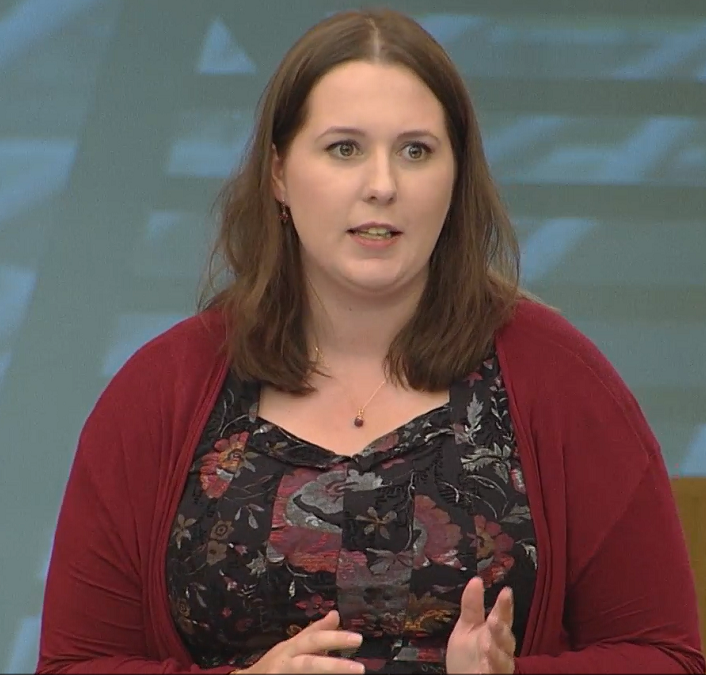
head and shoulders image of Emma Roddick giving a speech in the Scottish Parliament

If we needed another reason for Scotland to have all the powers of a normal, independent country it came on Friday as the latest change in the UK energy price cap was announced, covering three months from 1st July – so just before the General Election date.

Although prices will come down slightly this time, the forecast for the coming winter is for another rise, with electricity prices likely to remain some 60% higher than in 2021 before the massive price spikes that have seen folk ration their usage significantly.

Fuel poverty rates have remained high across Scotland, but especially in areas such as Orkney, where longer winters, wetter and windier conditions and older housing stock make it more difficult to keep the increasingly expensive heat in.

But it doesn’t have to be like this for energy-rich Scotland.

The UK’s energy prices are among the highest in the world right now, around three times the price of the United States for example.

And within the UK those households off the mains gas grid – everybody in Orkney – are likely to spend up to £1000 more for their energy this coming winter than average households, while using around a third less energy than those houses that have access to gas.

This is because electricity is currently over four times the price of gas per unit and including standing charges. It means households on electricity only are rationing their energy usage more than anyone else.

For households in Orkney this has become a glaring inequity as generation of clean, green electricity far outstrips demand.

That is why the SNP is calling at this election for a social tariff for electricity, and for all households off the gas grid to be categorised as vulnerable so that they would qualify for price parity with folk who heat their homes with the much cheaper mains gas.

The Tories at Westminster dragged their heals on this during the parliament that is now coming to an end, but the SNP will renew calls for the introduction in the next term to ensure that the existing energy inequity is removed.

Of course the whole UK energy market is ripe for overhaul, and in an independent Scotland energy would be in the people of Scotland’s hands, making it work for householders, not shareholders.

Another cause that I am delighted to see the SNP backing is for the recognition of Palestine as a state. I am always heartened to see the Orkney News coverage of the vigils at St Magnus Cathedral each Saturday. The great turnouts show there is great strength of feeling and empathy in Orkney.

The people of Palestine have suffered enough. Each of us has a duty to do whatever we can to bring about a fair and lasting peace.

John Swinney has written to Rishi Sunak and Keir Starmer urging them to join him and other EU nations in recognising Palestine as a state in its own right.

That is the kind of leadership that Scotland needs.

This is a regular column by SNP MSP Emma Roddick. All Highlands and Islands MSPs have been offered the same space in The Orkney News to share their personal views.

5 responses to “Emma Roddick MSP: We need ‘a social tariff for electricity’”

  1. Energy equity is a very important part of addressing poverty , so this approach makes absolute sense. Scotland is energy rich, and this differentiates us from the rest of the UK . This kind of issue is just one where an independent Scotland could make different decisions that reflect the specific needs of the populations using the specific strengths of its economy and infrastructure . .

  2. It was Kenny McAskill MP and the Alba Party who started the campaign for a social energy tariff last year, even securing debates on the reserved matter of energy in Westminster.

    https://www.albaparty.org/its_time_to_push_for_an_energy_social_tariff_for_the_benefit_of_all

    That the SNP are now wholesale plagiarising Alba’s policies reeks of desperation from a tired party with ideological agendas that are antithetical to the social fabric of traditional Scottish values.

    1. The calls for a social tariff have come out of areas such as the housing associations in rural Scotland for years, as they are at the frontline dealing with fuel poverty and the inequity of pricing. Gillian Martin was the first politician that I know of to call for a Gas Equivalent Tariff, but I really don’t care what colour of politician calls for it. At the moment the key issue is that the Scottish Government spent £30 million mitigating unsustainable electricity prices, but the UK holds the powers to change a pricing structure that is no longer fit for purpose. Independence would solve that.

  3. Politicians and energy companies are lying to us about renewables heralding in cheap, green electricity at the same time as shutting down North Sea oil production.
    Renewable electricity will always be expensive for the end consumer. This is why Sturgeon’s promise of a state energy company was quickly and quietly dropped.

  4. Always makes my day… to read Mr Sharp’s uninformed comments… they are always good for a laugh. Or should we weep? Because there are more sharps out there then could be fitted in a sharps’ box at any surgery.

    Anyway, I don’t like the wording “social tariff”. This has a taste of handouts, of generousity expected from others, in some form of “benefits”. It implies that there are regions for which the UK taxpayers would be expected to provide some form of subsidy.
    Considering where actually a lot of the renewable energy is produced (highlands and islands), it is pretty clear that calls should be made for “local tariffs”, not for social ones. Isn’t it somewhat absurd that Joe Bloggs from Orkney participates in the cost burden to export green energy to the National Grid, thereby subsidises lower energy costs elsewhere (where there is also gas available) when the only ones that directly benefit from the opportunity to feed into the grid are not the ones who struggle with fuel poverty?

    Local tariffs could be calculated based on a range of factors, including (but not limited to) the renewable generation volume of the region(s), the environmental price “paid” by the region for large developments, built environment (housing stock) factors predominant in the region, regional climatic factors and so forth.
    This would technically not be difficult. You could work this out in an undergraduate dissertation project.
    It appears therefore that it is not the feasibility but simply the (political) will that is lacking.

    It would also appear that Shetland has learned from the Orkney mistakes… calling for their own tariff well in advance of future large developments becoming operational.

Leave a Reply

Trending

Discover more from The Orkney News

Subscribe now to keep reading and get access to the full archive.

Continue reading