
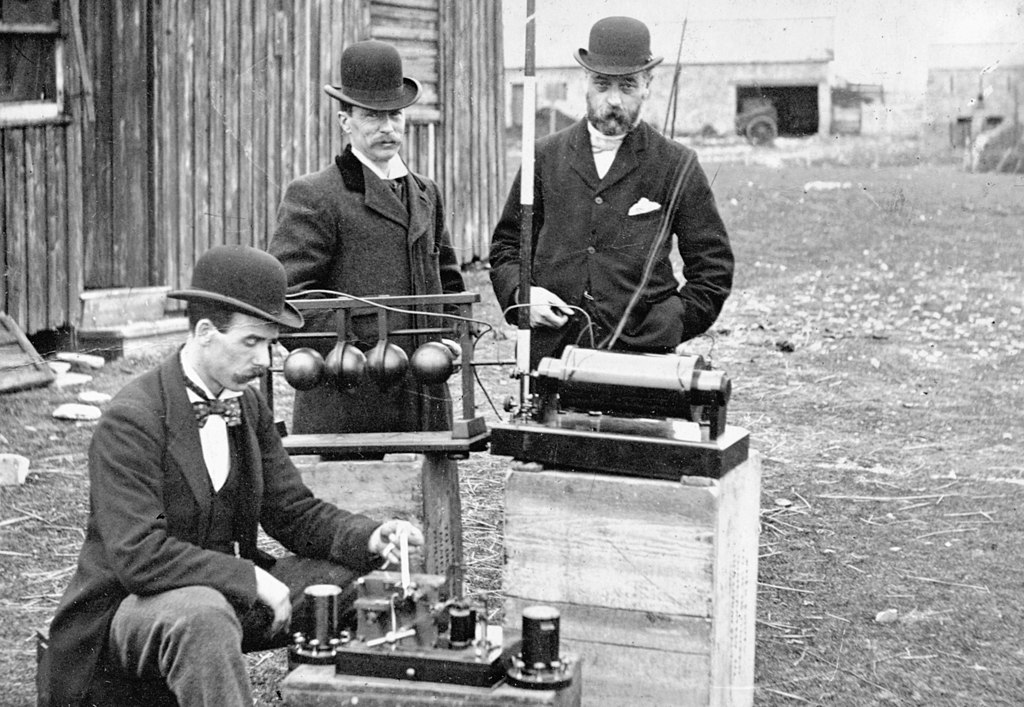
On 2nd June 1896 Italian engineer and inventor Guglielmo Marconi applied for the first ever patent for a system of wireless telegraphy in the United Kingdom.

Guglielmo Marconi was encouraged to come to Britain where it was suggested he would receive a better response to his experiments and the much needed finding he required to progress them. He arrived in Britain early in 1896 with his mother. He was 21.
When he arrived at Dover and the Customs Officer saw the range of equipment in his luggage, the officer contacted The Admiralty. He also had the support of William Preece, the Chief Electrical Engineer of the General Post Office (the GPO). During this time Marconi decided he should patent his system, which he applied for on 2 June 1896, British Patent number 12039 titled “Improvements in Transmitting Electrical impulses and Signals, and in Apparatus therefor”, which became the first patent for a communication system based on radio waves.
On 17 December 1902, a transmission from the Marconi station in Glace Bay, Nova Scotia, Canada, became the world’s first radio message to cross the Atlantic from North America. A regular transatlantic radio-telegraph service was finally begun on 17 October 1907 between Clifden, Ireland, and Glace Bay, but even after this the company struggled for many years to provide reliable communication to others. The Marconi Co. wireless operations became important in maritime rescues.
Marconi’s political views were as a Fascist. In 1923 he joined the National Fascist Party. In 1930, Italian dictator Benito Mussolini appointed him President of the Royal Academy of Italy, which made Marconi a member of the Fascist Grand Council. During his time at the Royal Academy of Italy not one Jew was permitted to join.
Marconi died in Rome on 20 July 1937 at age 63, following the ninth, fatal, heart attack, and Italy held a state funeral for him. At 6 pm the next day, the time designated for the funeral, transmitters around the world observed two minutes of silence in his honour. The British Post Office also sent a message requesting that all broadcasting ships honour Marconi with two minutes of broadcasting silence. His remains are housed in the Mausoleum of Guglielmo Marconi in the grounds of Villa Griffone at Sasso Marconi, Emilia-Romagna, which assumed that name in his honour in 1938.




Leave a Reply