
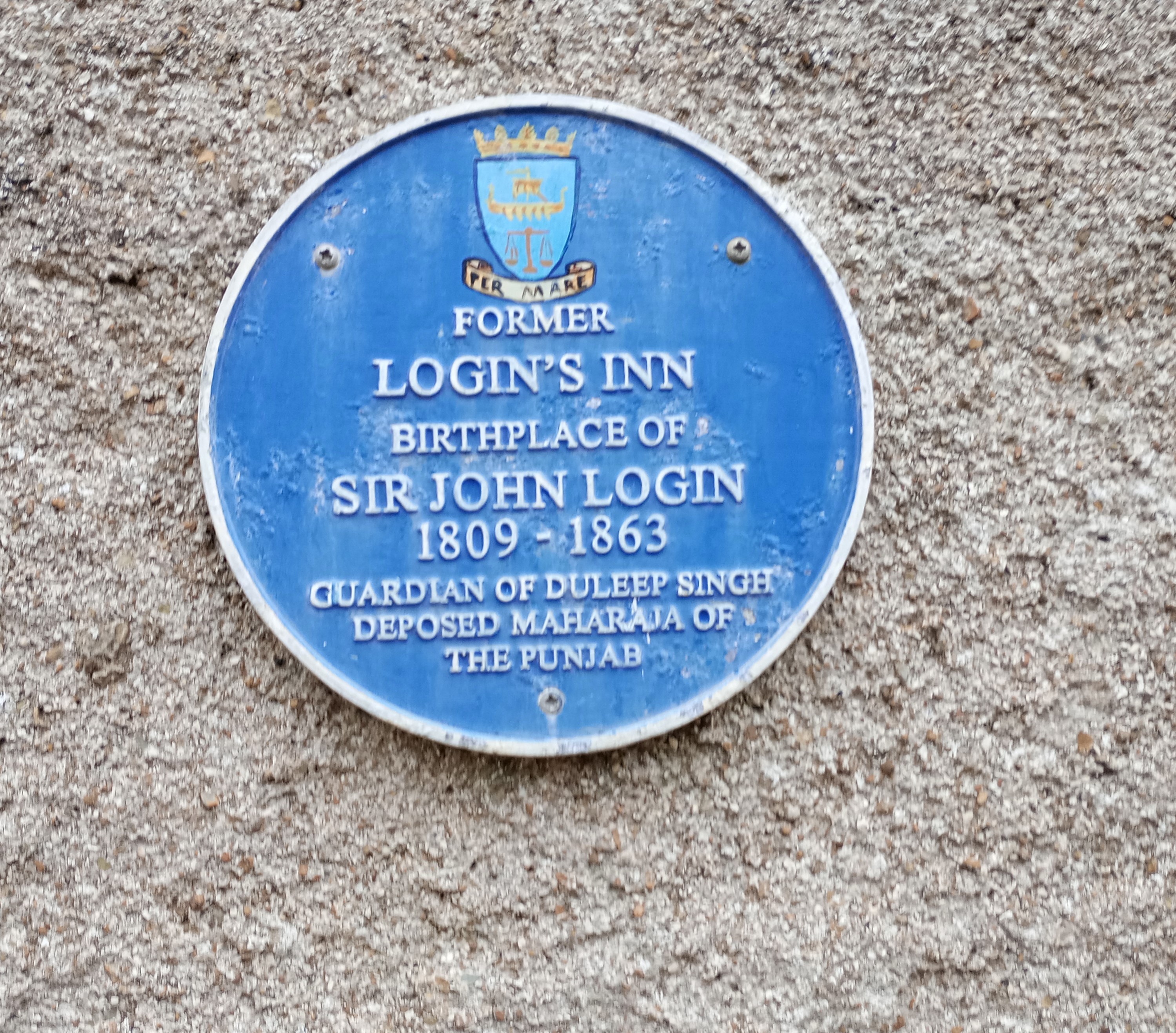
Always look up when strolling through Stromness and you will find a fascinating selection of blue plaques many of which tell of the town’s international connections.

One such plaque is on the former site of Login’s Inn. The birthplace of Sir John Login (1809 – 1863) – ‘Guardian’ of Duleep Singh, deposed Maharaja of The Punjab.
What is the story?
John Spencer Login was born in Stromness on 9th November 1809 and went to study medicine at the University of Edinburgh. One of his tutors was John Liston and Login qualified at the age of 19. This was the age of Empire and after qualifying he was appointed to the East India Company. The East India Company was much more than a company trading in India and across Asia – it was a law unto itself, including its own army and with great power over the people of any area it operated in.

John Login arrived in Calcutta in July 1832. He was posted to the Buffs and accompanied the regiment to Dinapore in October. He was appointed to the Bengal horse artillery in the same year. In 1834, he was appointed to the Nizam’s army and in 1836, to the staff of Lord Metcalfe, Lieutenant-Governor of the North-Western Provinces. In 1838, he was appointed medical charge of the horse artillery in the Afghan campaign. He was then appointed to the Resident Surgeon at Lucknow in 1838 as well as physician to the court of Oudh and Postmaster General of Oudh.
It was here he met the woman he was to marry, Lena Campbell in 1842.


The image on the left depicts a miniature of Lena, Lady Login (née Campbell; 1820 – 17 April 1904), Scottish courtier and author.
The image on the right shows their children depicted in a miniature on ivory by an anonymous Indian artist in 1846. The scene shows their oldest son Edward William Spencer Login (born 1843) on a rocking horse, their daughter Lena Margaret Campbell Login (1845) in a blue dress, and the infant Louisa Marion d’Arcy Login (1846) held by the children’s ayah. The ayah and the Indian child in the picture are unidentified. The couple had six children
The Scots were very much part of Empire building and the exploitation that went with it, finding jobs and wealth in the furthest of its parts.
Maharaja Sir Duleep Singh, GCSI (6 September 1838 – 22 October 1893), also spelled Dalip Singh, and later in life nicknamed the “Black Prince of Perthshire”, was the last Maharaja of the Sikh Empire. He was Maharaja Ranjit Singh‘s youngest son, the only child of Maharani Jind Kaur.

At the age of only 5 he was thrust into power in September 1843. As a minor, his mother ruled on his behalf. On 13 December 1845 the British East India Company declared war on the Sikhs and, after winning the First Anglo-Sikh War, retained the Maharaja as nominal ruler, but replaced the Maharani with a Council of Regency and later imprisoned and exiled her. Over thirteen years passed before Duleep Singh was permitted to see his mother again.
Duleep Singh was deposed by the British at the age of 10 and put into the care of Sir John Login. There were tight restrictions on who could visit him and his education in the charge of Lena Login removed him from his culture. This included converting him to Christianity. In May 1854 the British exiled him to the UK.
In the UK he was sent to the court of Queen Victoria and was paid generous allowances. In 1855 he was given an annual pension of £25,000 a year (approximately £3,000,000 in today’s value) provided he “remain obedient to the British Government,” and was officially under ward of Sir John Spencer Login and Lady Login, who leased Castle Menzies in Perthshire, Scotland, for him.
As the years passed Duleep Singh was eventually permitted to travel to continental Europe but was only able to visit his homeland twice. He became disaffected and embittered with the British, and he reverted to Sikhism. Attempting to return to India on 30 March 1886 he was arrested by the British and detained.
Maharaja Duleep Singh died in Paris in 1893 at the age of 55. He had only been able to visit his homeland twice both in tightly controlled visits by the British. His dying wish for his body to be returned to India was not honoured. Instead he was given a Christian funeral and is buried in Elveden Church, Thetford, England beside his wife and son. Sir Duleep Singh married twice, first to Bamba Müller in 1864, and then to Ada Douglas Wetherill (1869-1930) in 1889. He had eight children in total.
A film titled Maharaja Duleep Singh: A Monument Of Injustice, was made in 2007, directed by P.S. Narula.
A 2017 film, The Black Prince, by the Indian-born film director Kavi Raz told the story of Duleep and his relationship with Queen Victoria.
Fiona Grahame







Leave a Reply