
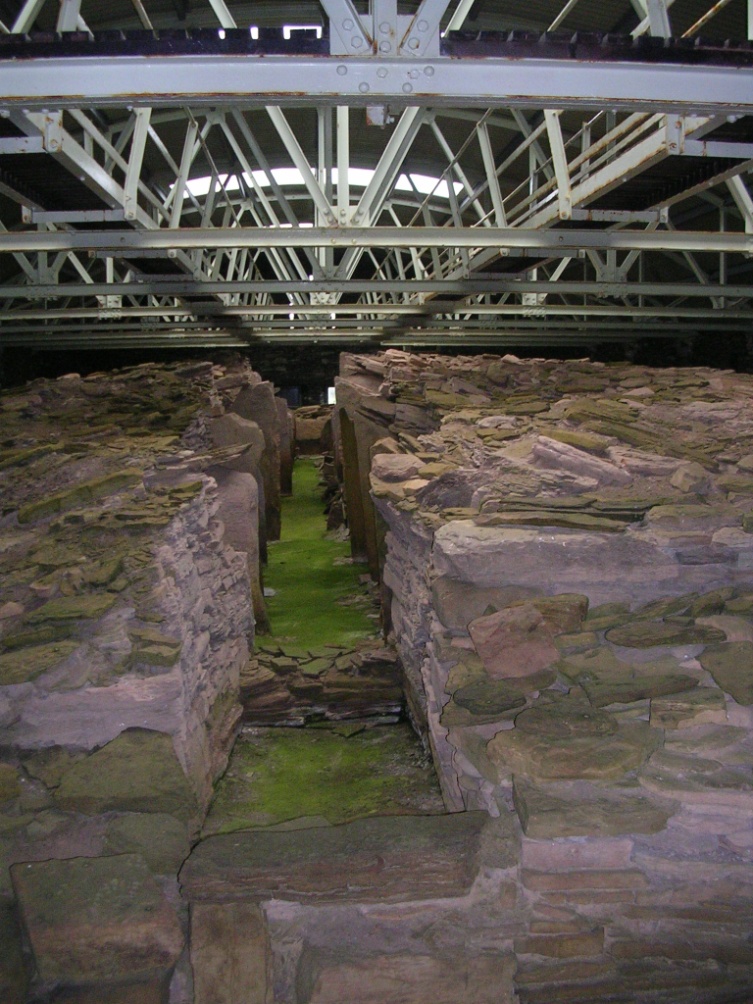
The Neolithic burial site, Midhowe Chambered Cairn, in Rousay was first excavated in the 1930s. Appearing at a meeting of the Society of Antiquaries of Scotland in March 1934, Dr J Graham Callander and Walter G. Grant, described it as ‘a long cairn of neolithic times’.

They reported that ‘the mound consisted of stones encircled by drystone building, the sides being practically straight and parallel.’
The roof had collapsed and the debris had fallen into the tomb. Once that was cleared out ‘ there was seen a long narrow gallery with vertical walls running nearly the whole length of the mound, and divided into 12 cells by large upright slabs projecting from the sides.’
Callander and Grant said that two human skeletons were found 4 feet above the floor of the 4th cell. They summarised that this was a later burial after the collapse of the roof. They also reported the discovery of 26 human skeletons in 5 cells and 2 human skulls in another cell.
‘All these remains with the exception of one skeleton, which lay on the west side of the gallery, were deposited on the east side, not on the floor, but on a shelf or platform of small flags, less than 1 foot high…They had been placed in crouching positions, but in one case the bones had been collected into a heap and placed at the back of the stall to allow another burial in it.’
The human remains were taken to Aberdeen University’s Professor Low. He concluded that they represented 21 adults, 7 individuals aged 14 to 20, and two children under 4. Low also examined 3 complete skulls – 2 were of men and 1 was a woman’s. He described them as being ‘dolichocephalic‘ or long headed.
Low also reported that the men were no more than 5 feet 5 inches and the women, 5 feet. The teeth were in good condition but well worn.
It is estimated that Midhowe Chambered Cairn dates to between 3500 and 2500 BC. Radiocarbon analysis of two human skulls produced dates of 3415-3365 cal BC and 3370-3320 cal BC respectively.
Midhowe is one of sixteen known chambered cairns in Rousay (not all are publicly accessible), but this is an exceptionally high concentration of such monuments. Shortly after its excavation it was enclosed within a stone-built ‘hangar’. Visitors can walk around and over the tomb inside the hangar.
Graham Callander and Walter Grant excavated other tombs in Rousay including The Knowe of Ramsay at Hullion in 1935. The Knowe of Ramsay was in a poor condition when it was excavated as the tomb had been robbed of stone to construct nearby homes and dykes. Human remains were also recovered from the tomb.
There was a variety of animal bones which were identified as: ox, red deer, sheep, duck, cormorant, gannet, bittern, goose, swan, sea eagle, and great auk.
Today the Knowe of Ramsay is a low turf-covered mound, with a hollow in the centre in which a number of flagstones are visible.
You can read about Professor Callander and of the archaeologists of the past here: The Scottish Antiquarian Tradition: Essays to mark the bicentenary of the Society of Antiquaries of Scotland 1780-1980
Rousay Remembered includes a piece about Walter Grant who resided at Trumland House in the summer months. It includes a photograph of him as a young man.
Fiona Grahame

The Rousay Clearances are covered in ‘Rebel Orkney, Tales of insurrection from Orcadian history’ by Fiona Grahame and Martin Laird.
‘The Rousay Clearances: Exodus from the Egypt of the North’, text by Fiona Grahame, photographs by Martin Laird, from their Northlight Exhibition, is available as an ebook. A link to that is on The Orkney News website.

Leave a Reply to berniebell1955Cancel reply