
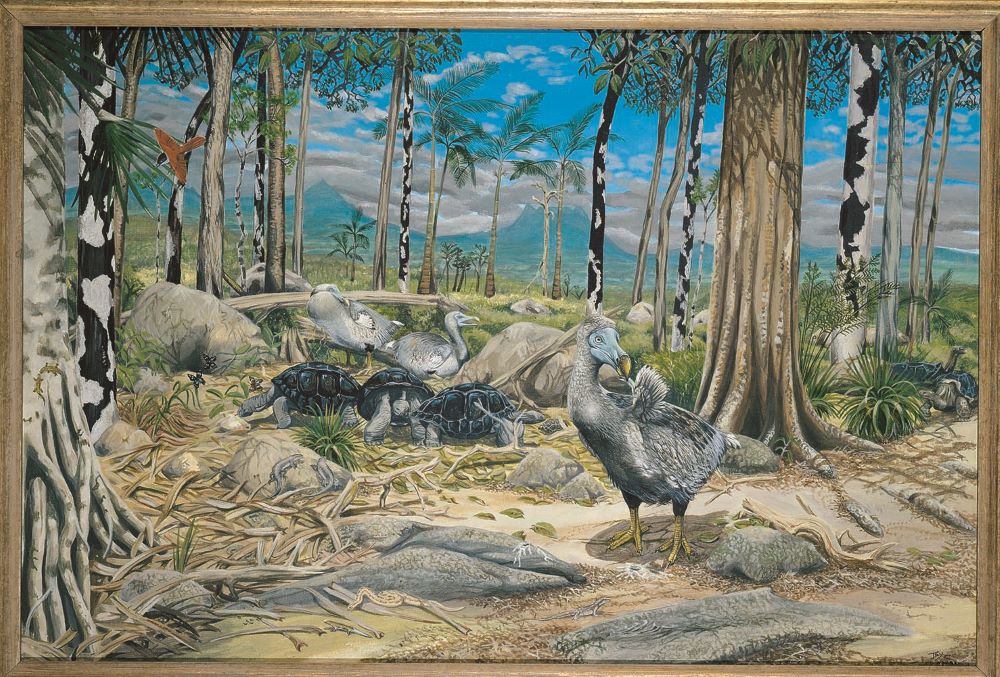
Researchers from the University of Southampton, Natural History Museum (NHM) and Oxford University Museum of Natural History have undertaken the most comprehensive review of the taxonomy of the Dodo and its closest relative, the Rodriguez Island Solitaire. The results are challenging much of the views we have around the dodo.

The researchers trawled through 400 years’ worth of scientific literature and visited collections around the UK.
Dr Neil Gostling from the University of Southampton, supervising author of the paper explained:
“The Dodo was the first living thing that was recorded as being present and then disappeared. Before this, it hadn’t been thought possible for human beings to influence God’s creation in such a way.
“This was a time before the scientific principles and systems we rely on to label and classify a species were in place. Both the Dodo and the Solitaire were gone before we had a chance to understand what we were looking at.”
Correcting the record

Much of what was written about the Dodo and the Solitaire was based on accounts from Dutch sailors, representations by artists, and incomplete remains.
The lack of a definitive reference point (type specimen) or convention to label species (zoological nomenclature) led to a series of misidentifications in the centuries following their extinction. New species such as the Nazarene Dodo, the White Dodo, and the White Solitaire were named, but the paper confirms that none of these creatures existed. Still, these erroneous ‘pebbles’ sent ripples through the waters of zoological literature.
Dr Mark Young, lead author of the paper from the University of Southampton commented:
“By the 18th and early 19th centuries, the Dodo and the Solitaire were considered to be mythological beasts. It was the hard work of Victorian-era scientists who finally proved that the Dodo and the Solitaire were not mythological but were giant ground doves.
“Unfortunately, no one could agree how many species there had been. Throughout most of the 19th and 20th centuries, researchers thought there were three different species, although some people thought there had been four or even five different species.”
To unpick this confusion, researchers went through all the literature on the Dodo and Rodriguez Solitaire encompassing hundreds of accounts dating back to 1598 and visited specimens around the UK, including the world’s only surviving soft tissue from the Dodo, in the Oxford Museum.
“More has been written about the Dodo than any other bird, yet virtually nothing is known about it in life,” says Dr Julian Hume, an avian palaeontologist at the Natural History Museum and coauthor of the paper.
“Based on centuries of nomenclatural confusion, and some 400 years after its extinction, the Dodo and Solitaire, continue to prompt heated debate. We’ve gone from where the first statements were made, seen how these have developed, and identified various rabbit holes to correct the record, as best we can.”
Through this work, researchers were able to confirm that both birds were members of the columbid (pigeon and dove) family.
“Understanding its wider relationships with other pigeons is of taxonomic importance, but from the perspective of conservation, the loss of the dodo and the solitaire a few decades later means a unique branch of the pigeon family tree was lost,” says Dr Gostling. “There are no other birds alive today like these two species of giant ground dove.”
Challenging our misconceptions
The researchers believe the popular idea of the Dodo as a fat, slow animal, predestined for extinction is flawed.
“Even four centuries later, we have so much to learn about these remarkable birds,” says Dr Young.
“Was the Dodo really the dumb, slow animal we’ve been brought up to believe it was? The few written accounts of live Dodos say it was a fast-moving animal that loved the forest.”
Dr Gostling added:
“Evidence from bone specimens suggests that the Dodo’s tendon which closed its toes was exceptionally powerful, analogous to climbing and running birds alive today. The dodo was almost certainly a very active, very fast animal.
“These creatures were perfectly adapted to their environment, but the islands they lived on lacked mammalian predators. So, when humans arrived, bringing rats, cats, and pigs, the Dodo and the Solitaire never stood a chance.
“Dodos held an integral place in their ecosystems. If we understand them, we might be able to support ecosystem recovery in Mauritius, perhaps starting to undo the damage that began with the arrival of humans nearly half a millennium ago.”
Learning ‘valuable lessons’
The study marks the beginning of a wider project to understand the biology of these iconic animals.
“The mystery of the Dodo bird is about to be cracked wide open,” says Dr Markus Heller, Professor of Biomechanics at the University of Southampton, a coauthor on the paper.
“We have assembled a fantastic team of scientists to uncover the true nature of this famous extinct bird. But we are not just looking back in time – our research could help save today’s endangered birds too.”
Dr Heller explained:
“Using cutting-edge computer technology, we are piecing together how the Dodo lived and moved. This isn’t just about satisfying our curiosity. By understanding how birds evolved in the past, we are learning valuable lessons that could help protect bird species today.”
“It’s like solving a 300-year-old puzzle, and the solution might just help us prevent more birds from going the way of the Dodo.”
The project will include work with palaeoartist Karen Fawcett, who has created a detailed, life-size model of the Dodo to bring the words on the pages of books and journal articles to life.

She commented:
“This work has been the merging of science and art to achieve accuracy and realism so that these creatures come back from the dead, real and tangible for people to touch and see.”
The work is supported by the University of Southampton’s Institute for Life Sciences. The Institute Director, Professor Max Crispin, said: “
The Institute was delighted to support this exciting work which exemplifies Southampton’s strength in interdisciplinary research and advanced scholarship.”
The systematics and nomenclature of the Dodo and the Solitaire (Aves: Columbidae), and an overview of columbid family-group nomina is published in Zoological Journal of the Linnean Society.





Leave a Reply