
The Rev. Dr. Charles Clouston was one of the most prolific antiquarians in 19th century Orkney. He excavated and reported on many of the ancient sites in Orkney.
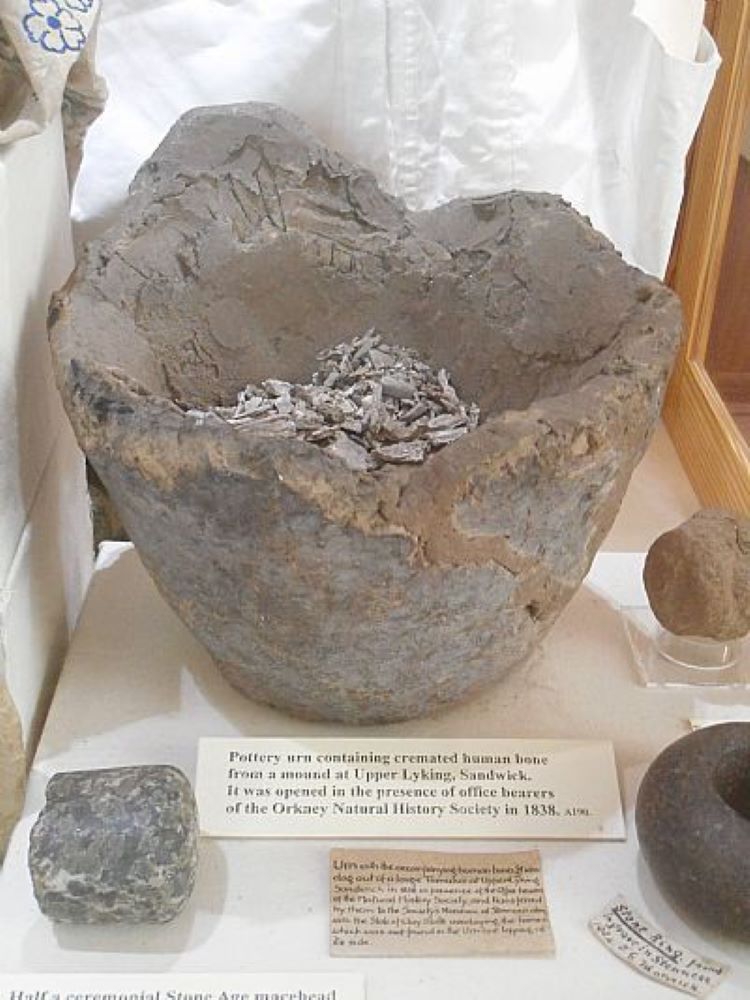
Last week Bernie Bell wrote about Pre-history in The Stromness Museum. In that account she mentioned the “Pottery urn containing human bone from a mound at Upper Lyking, Sandwick. It was opened in the presence of office bearers of the Orkney Natural History Society in 1838.”

Readers of The Orkney News might be interested in what The Rev Dr Clouston wrote himself about the urn.
Charles Clouston wrote about this and other finds in The Statistical Account of 1841 for The Parish of Sandwick
Barrows or tumuli are particularly numerous in Sandwick. I believe there are more than one hundred, though it would be neither easy nor useful to count them. Eight of these, situated on the common, have been opened during the last year. A minute description of each would be tedious; but a brief account of the most important, which I opened in company with most of the other office bearers of the Orkney Natural History Society, must be interesting to the antiquarian.
The first, which was the largest of a numerous cluster between Voy and Lyking, was 50 yards in circumference and about 7 1/2 feet high. It was formed of a wet adhesive clay. On reaching the centre, we found a large flag which formed the cover; and on raising it up, the grave appeared as free from injury, and the pieces of bone as white and clean, as if formed only the preceding day.
At its end which lay north-east by east, was an urn inverted, shaped like an inverted flower pot; and at its other end, about a hat-full of bones, unmixed with ashes, which had been burnt and broken small, none being more than two inches long and one broad covered by a stone of an irregular shape, about one foot across. It was sprinkled with a peculiar mossy looking substance, of a brown colour, and white ashes, which seemed, from the smell when burnt, to be animal matter.
The surface of the urn is dark, not unliked burnt cork, and seems to be rude earthen-ware, into the composition of which, bits of stone enter liberally. It contained nothing that we could perceive, and soon fell to pieces; but I put them together with Roman cement; and it is now in the Society’s museum with part of the bones.
Fiona Grahame



Leave a Reply