
By Eamonn Keyes
September 7th. The Orkney Club, Kirkwall

Saturday night’s talk at the Orkney Club was somewhat different from what I had been expecting.
Billed as a talk on the orchards of the Clyde Valley with song from two speakers and a guitarist, the appearance of 4 talkers/singers and 4 guitars caused momentary chaos during a soundcheck, but eventually I managed to resolve it to most people’s satisfaction despite the limitations of the equipment.
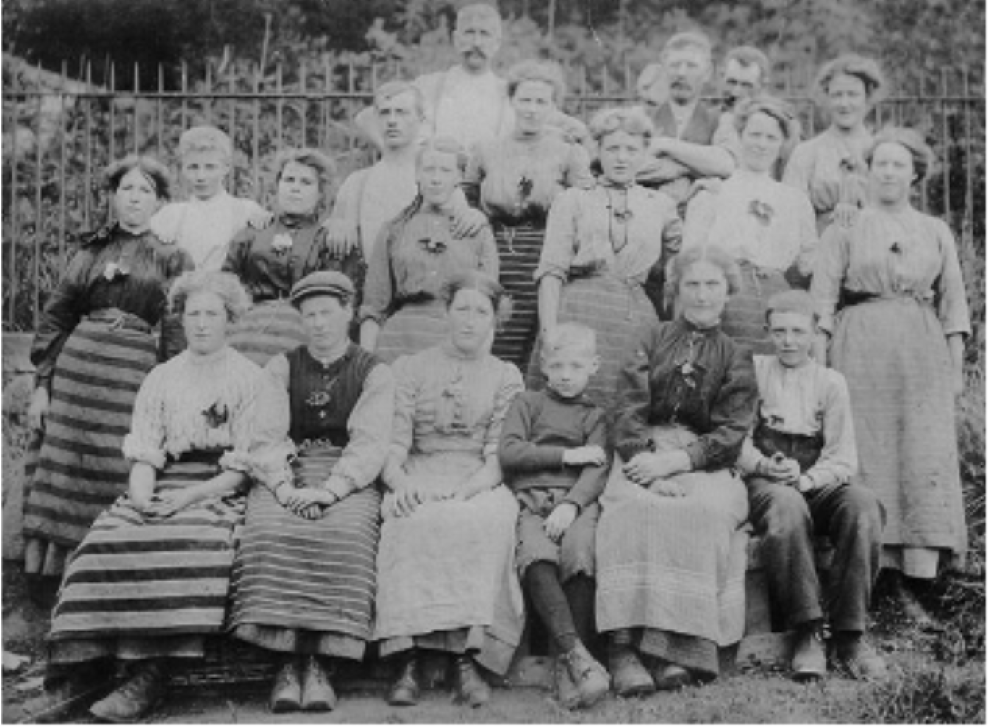
Harking back to those days when the Valley was the fruit basket of Scotland, three members of the Lanarkshire Songwriters Group have gathered memories from the growers and pickers of those days, including some of their family members, and turned them into songs with schools and members of the community. The three musicians, Billy Stewart, John Young and Wilf Yule, tell the story in words and music aided by Andy Munro, taking a break from his yearly role as the OISF’s ‘Mr Boom”, and who had been involved in the recording and production of the Lanarkshire. Songwriters “Fruits Of their Labours’ album recorded in 2017.
Local musicians were also billed as providing accompaniment, but more of that later.

The Orchards of the Clyde Valley have a long history probably extending from the 5th century and the establishment of local monasteries right up to the industrial development of the Central Belt, when the area became one of the major fruit producers in Scotland. Since that time, local fruit production has declined dramatically due to competition from global markets such as that of South Africa and supermarkets selling cheaper and more readily available foreign fruits. As a result, many of these orchards have not been effectively managed for some years, others have been converted to pasture, lost to property development or reverted to scrub and woodland.

It is estimated that by the end of the 18th century, over 300 acres of Lanarkshire were devoted to horticulture with around 75% of this on the steep banks for the Clyde. An entry in the New Statistical Account states that, at about this time, over sixty varieties of apples and twenty-four of pears were grown in the Clyde Valley. Orchard fruit was generally grown with an understorey crop such as shrub fruits, potatoes, oats, beans, and barley. These, plus the pasturage, was usually retained by the landowner but the trees were sometimes managed and utilized by others.
Until the late 19th century, apples, pears and gooseberries were common but very few plums, which initially were grown on their rootstock. By the middle of the 19th century plums were becoming increasingly important commercially. Scott’s jam factory opened in Carluke in 1879. Soft fruit, particularly strawberries, were starting to develop as a commercial crop.
As the population and industry increased in Glasgow and the Central Belt there was a growing demand for local fruit. Between the mid-19th century and the early 20th century the Clyde Valley was probably the largest commercial orchard area in Scotland.
As well as the orchards the Valley included huge glasshouses from the early 1900s onward, as growers diversified partly due to disease wiping out most of the outdoor strawberry crops in the lower fields of the valleys and cheaper imported orchard fruits affecting sales.

Glasshouses were heated by a network of pipes from coal, and later, oil fired boilers, and were used to grow various crops, including although not exclusively: tomatoes, cucumbers, lettuce, mushrooms, leeks and cut flowers. The Clyde Valley was famous for ‘Clydeside Tomatoes’, which were sought up and down the country due to their distinct aroma and flavour.
From around 1920, the fruit industry went into decline. Local orchards were generally stocked with large and tall ‘standard’ fruit trees that were difficult and costly to manage and harvest and could not compete with foreign supplies and cheap supermarkets. In addition, various diseases were causing loss of local fruit, including a new strawberry disease, red core root rot.
The significant loss in the commercial value of local fruit has resulted in the neglect of the orchards and conversion to other enterprises, including the many garden centres in the area. Many of the orchards along the valley have not been effectively managed for some years, others are converted to pasture, lost to property development or revert to scrub and woodland. Where they remain, owners often lack the incentive and resources for their management.

It is estimated that over 50 hectares of orchard has been lost or abandoned in the Clyde Valley area over the last five decades. This leaves around 124 orchards with an area of 73 Hectares that could still be described as productive with the fruit being used by the owner or sold in local farm shops and delicatessens.
However, over the last five years almost 2000 new apple, plum and pear trees have been planted in privately owned, school and community orchards. Funding has been provided in the past by Clyde and Avon Valley Landscape Partnership (CAVLP) to carry out restoration work and, most importantly, in planting new trees for the future. This is something Clyde Valley Orchards Limited would like to continue in the future using the income from product sales to support these initiatives. With an eye to the future, most of the new trees are apple varieties. This provides a greater opportunity to use the fruit for commercial purposes as the apple season can extend from August through to December in a good season.

The four musicians had families involved in this work, and they told their stories and then sang their songs in turn. The songs continued the stories in musical form, and were all excellent, falling into the Scottish folk tradition and poignantly telling of pride, hard times, struggles trying to maintain a dying industry and the effect it has on those who depend on the work for a living.

Billy Stewart’s rousing ‘Did You Really Want To Work On The Land, Dad?’ was very memorable, it was a singalong success whilst telling of the question he’d asked his father who worked in the industry, and who tried to ensure his son did not follow in his footsteps. A memorable night where the Science Festival succeeded in its aims to both entertain and educate, whilst telling a forgotten tale of Scotland’s past.
Afterwards, as I put away the equipment, including the two wireless head microphones that unintentional Luddite John Young had managed to reduce to their constituent atoms in about 5 minutes, I heard the unmistakeable sound of a lively music session happening in the bar in the next room, so I thought the local musicians must have arrived and joined in, but that was not the case. It was just the musicians from the talk doing their thing, and being shovelled pints of beer at a rate that the stokers on the Titanic couldn’t have managed. Not wanting to let Orkney down, I joined in, and very soon the heaving bar was alive with everyone singing along, and so it continued into the night. Another Scottish tradition still very much alive.
I hope to see these guys again very soon, and I will shortly do a review of their “Fruits Of Their Labours’ CD for the Orkney News. It’s well worth the listen and a purchase.




Leave a Reply