
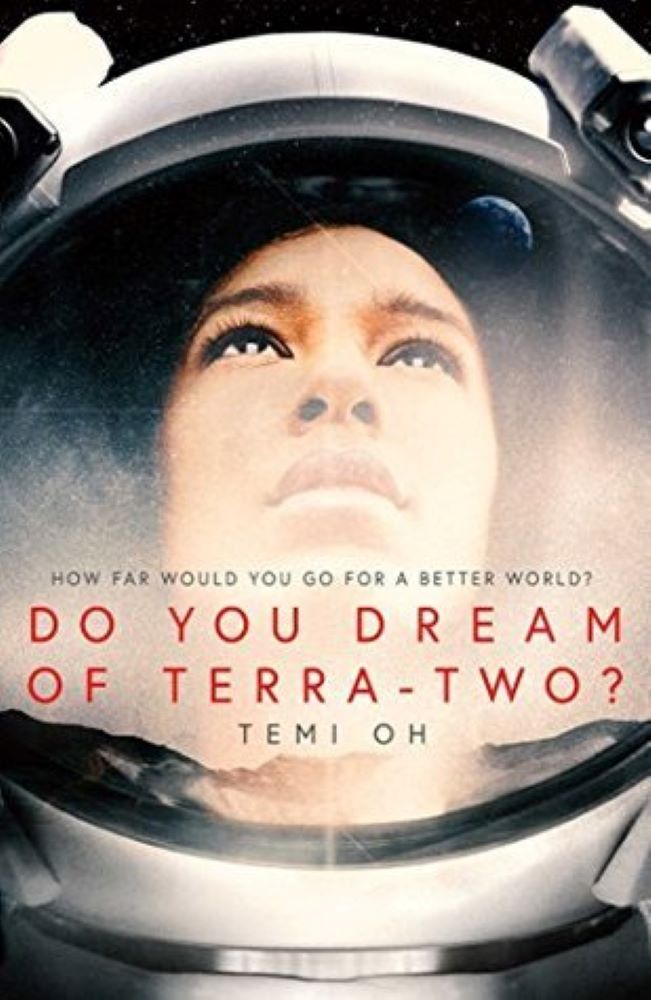

“Do You Dream of TerraTwo?”, by Temi Oh, £14.99, hbk, Simon & Schuster, 518 pp., 2019.
First published in Interzone # 281, May 2019.
Robert A. Heinlein’s Orphans of the Sky and Brian Aldiss’s Non-Stop are both set in multi-generation starships whose occupants have forgotten their origin. Arthur C. Clarke’s Songs of Distant Earth features suspended animation, most of the possible variants of that were explored during the years of New Writings in SF, and the film industry has finally latched on to it with Passengers. In Kim Stanley Robinson’s Aurora (Orbit, 2015) and James Dunham’s The Helena Orbit (Rogue Star Press, 2017), everyone stays awake and in both there are major problems mid- voyage, so the big issue is whether or not to turn back.
The occupants of Temi Oh’s Damocles face that issue sooner, on a shake-down cruise to Jupiter, before turning on the main drive during a Saturn slingshot. The necessity is never explained: a Jupiter slingshot would provide a bigger start-up velocity if that’s required, e.g. for a Bussard ramjet. They’re delivering supplies en route to a US base orbiting Europa, but it turns out that the Mars settlement has ships which can reach Jupiter a great deal quicker. The slow first leg is really for the personality clashes to develop, because they are what this novel is all about.
The mission is British, in the near future, because in this alternative history the British Interplanetary Society was founded by Congreve during the Napoleonic War rather than by P.E. Cleator, Clarke and others in 1933. With that early start, unmanned missions have studied an earthlike, life-supporting planet orbiting another star in enough detail to prove that it’s habitable. We aren’t told which star it is, but unless we’re in an alternative galaxy, it has to be Alpha Centauri at 4.3 light-years or one of the other candidates 10 or more light-years from here. (The cover artist for the paperback edition has opted for Alpha Centauri).

It makes a big difference, or should do, because the transit time for this mission is 23 years – no more, no less – so a trip to Epsilon Eridani, Tau Ceti or Epsilon Indi would need to reach about half of the speed of light, rather than 0.19c for Alpha Centauri, about 50% higher than the BIS’s pulsed fusion Project Daedalus concept of the 1970s, and conceivable with a very close Jupiter slingshot, or electromagnetic boost, which Freeman Dyson envisaged for his pulsed fusion starship.
The crew includes four elderly adults, including the first man to land on Mars and the inventor of the unspecified drive, who’s secretly dying of cancer. The other six are British teenagers, with mixed ethnic backgrounds, trained intensively as a group but not allowed to have children until they reach Terra-2, when they will mostly be too old and will be supplanted by the next wave of colonists. It’s a recipe for disaster which goes wrong even before launch, when the most popular girl in the crew commits suicide and is replaced by a backup who’s socially inadequate. Nevertheless the launch is rushed through and when the shortcomings, vicious streaks and other personality defects of the rest of the crew become apparent, it seems that it might all be a public relations exercise, planned to fail once the public has lost interest in the mission.
As they approach the Europa space station it explodes, due to a hydrazine leak which its crew had become too complacent to spot. The starship is critically damaged but nevertheless forced to go interstellar by one of the teenagers, who belongs to a religious cult convinced that Terra-2 is the new Eden. With much of the plot driven by the youngsters’ bad decisions, it’s like the first volume of Game of Thrones: when I reviewed that book’s reissue for the launch of the TV series, I said that children and teenagers affect so much of the action that it might be a Young Adult novel, except that they’re clearly not meant to be rôle models. Nor, very clearly, are these damaged products of over-training and competition – Lord of the Flies meets Ender’s Game.
SPOILER WARNING. In Arthur C. Clarke’s classic story ‘Breaking Strain’, “the deus ex machina solution… the arrival of a convenient spaceship which happened to be matching your course and speed” is dismissed as “almost impossible”. Nevertheless it happens here, with a previously launched Chinese mission which had literally ‘gone off the radar’. Presumably (because no other explanation makes sense) they’d decided on a longer shakedown cruise while waiting for the same launch window via Saturn. Nevertheless their interstellar journey is going to take longer – “Maybe one day, when we too reach Terra-two, the crew of the Damocles will remember our kindness and embrace our children and grandchildren”. (If it takes 23 years with the faster Damocles, whether Terra-2 is 4 light-years away or 12, say, is going to make a big difference.) For a 3-generation voyage the Chinese ship is obviously much bigger, so it has spare components and personnel available to repair the Damocles – backups which the British expedition doesn’t have.
Acquiring the Chinese shuttlecraft renews the option of returning to Earth – presumably by a very tight Saturn slingshot, though that too isn’t explained. As in Robinson’s Aurora, the issues can’t be reconciled and the crew has to split. Dunham’s answer to that was that his crew should have kept talking until they reached agreement – try that with Brexit and see how well it works!




Leave a Reply