
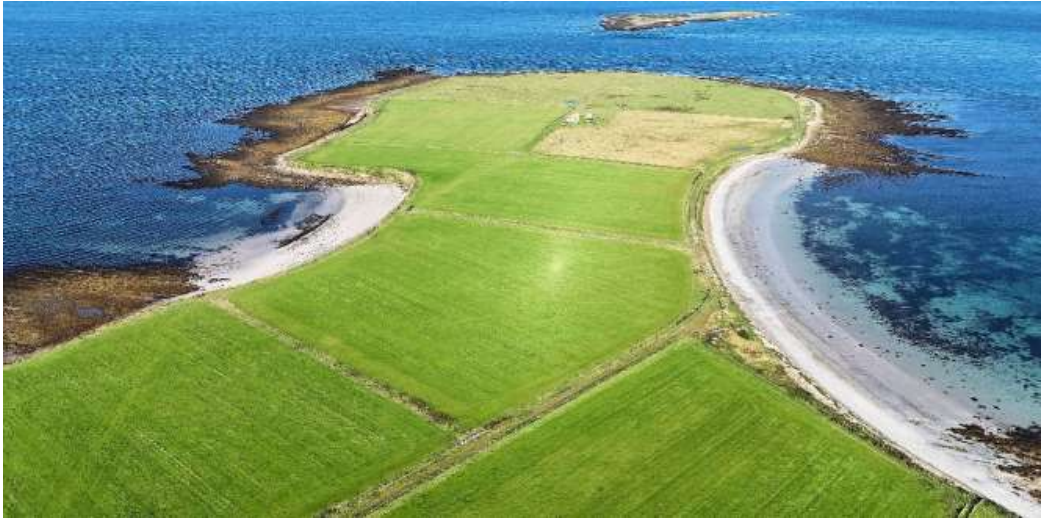
By Ian Cooper from his excellent series, Records of a Bygone Age, and republished in The Orkney News with the kind permission of The Stronsay Limpet.
Last month we left Stronsay’s agricultural future in the hands of the newly formed Agricultural Society but it seems that even before Rev Anderson’s 1795 Statistical Account and the formation of Stronsay’s Agricultural Society in 1783, some of the more forward thinking landowners had already been prepared to invest some of their new kelp-generated wealth into the land.
The first we hear of is Thomas Balfour of Huip, who closed off 50 acres at Linksness to make a grain farm. This peninsula, with accessible shores all round and an abundance of seaweed washed ashore by winter gales, enabled him to fertilise the land with copious amounts of this seaweed to try to increase its fertility but his project was to fail miserably. One of the reasons for this failure appeared to be that much of the land had previously been stripped of its top fibrous turf for fuel, a common practice when there was no peat available. Added to this was the desire to follow past local practice of having the land permanently growing grain, with no crop rotation in place to rest the ground. Also, as Thomas spent most of his time at his townhouse in Kirkwall, his reliance on an inexperienced manager/tenant to carry the project through only added to his problems. Undeterred, Thomas tried again by enclosing an area of around 50 acres on the side of the hill near Huip with faelie dykes, again aiming to have the area cropped continually with grain. Although this land was originally in better heart, there was no easy access to seaweed or other fertiliser and again his plans failed.
A document in the Archives detailing some of Thomas Balfour’s finances shows that, by 1795, rent arrears of £4,700 had been accumulated by one Edward Sinclair as tenant of Huip, and perhaps a part of the failure of the grain enterprise may have to be laid at his door.

It seems that other enterprises were more successful as, turning again to Rev Anderson, we find that:
‘Robert Laing, another merchant in Kirkwall, did also purchase an estate lying partly in Stronsay and partly in Eday, about 24 years ago. He gave some encouragement to his tenants in North Strynzie and Stronsay to make improvements; this he did by engaging to pay part of the expenses of inclosing certain parcels of the farm with stone dykes. These materials being more valuable than turf, and the grounds thus enclosed of a superior quality to such as were inclosed by Mr Balfour, rendered the benefits thus arising from including grass fields greater and more permanent. This tenant indeed, in some degree, perhaps, by the example and advice of his neighbour the minister, began lately to include a few acres of laboured land, which he intends to prepare, without delay, for laying down with grass seeds for hay and pasture.’ [Note: the minister showing the example and giving advice would have been Rev Anderson himself!]
This tenant was Edward Chalmers and, although he had been enclosing some of his fields with stone dykes, it seems that this 8 or 9 acre field of his best land was still enclosed by means of faelie dykes. The main purpose of this trial was apparently to grow a better quality grass for the production of grass seed to be sown on the lands he was in the process of reclaiming from rough pasture and hill.
The Robert Laing mentioned above had a family of at least 16 and, by the time of his death in 1803, his son Malcolm owned South Strenzie and son Samuel was the proprietor of Rothiesholm while another son, Gilbert, owned Papa Stronsay.
It seems that these sons all shared their father’s enthusiasm for progressive agriculture, with 200 acres recorded as being put to the plough at Malcolm Laing’s farm of Hunton (part of South Strenzie) by his tenant Donald Hume.
On Papa Stronsay too, famed for its fertility and grain growing capacity since it was first colonised by monks some 1,000 years earlier, Gilbert’s tenant was steadily ploughing out some of the best land and enclosing it with drystone dykes.
Meanwhile Samuel, the same Samuel Laing who was later to be the instigator of the herring fishing industry in Stronsay, was also putting plans in place to improve both his property and the lot of his tenants. He had acquired the Rothiesholm estate through a relative and had, it was said, broken out and enclosed 100 acres of hill ground there. Whether this enclosure was by turf and earth wall or stone dyke isn’t clear.
By now the greater part of the in-by land was regularly under the plough, growing grain or better-quality grass grown from seed. Much of the land which lay outside the hill dykes though still lay as it had for centuries, growing only rough natural grass and heath interspersed by clumps of heather, and it was to this land that the more progressive farmers were now turning their attention.

Returning again to Rev Anderson’s 1795 report, he states that on some of the larger farms a number of substantial stone dykes had been erected within the last few years.
Strangely, in P Neil’s 1806 visit to Stronsay recorded in his ‘Tour Through some of the Islands of Orkney and Shetland’ he made no mention of these fields enclosed by dykes. There were stone enclosures that did catch his eye though, which he recorded:
‘Upon the shores of Stronsa I first saw the small inclosures for raising cabbage plants called planty-cruies. They are merely little square pens, or bughts, inclosed by a dry-stone wall; black mould, or more frequently a mixture of clay and ashes, is laid on the inclosed area, and here cabbage plants are raised, to be set out in the spring. These planty-cruies are always situated on the flattest part of the shore close by the sea, where frost is best avoided.’
In another report of a visit to Stronsay, this time by Rev Dr Barry in 1808, he records that:
‘Agriculture is in much the same state as in other places. One exception ought to be noticed. A female proprietor has had spirit to bring a man from England to inclose and improve such of the waste lands on her estate as were before of little utility. The attempt is unquestionably laudable, and merits the thanks of every friend to improvement; but how far it may succeed, or whether it be conducted with the skill necessary to secure success, are points which time alone can determine.’
Sadly, there is no indication who this proprietor may have been so we are left to ponder whether this may have been spinster sisters Helen and Barbara Fea who took on the running of the Airy estate upon the death of their father Patrick in 1796. Another contender could be the widow or possibly the daughter of Thomas Balfour of Huip, who had died in 1787. We are told later that 350 acres were reclaimed at Huip within a period of fifteen years, although there is no indication of which years this refers to.
We now return once more to Malcolm Laing, the proprietor of South Strenzie which would have included Clestrain, Hunton, Whitehall and the whole of the area where the Village now stands. He was probably the laird most renowned for his introduction of new ideas and farming practices both in Stronsay and on his estates at Stove in Sanday. He and his younger brother Samuel were among the first to give complete freedom from forced service to their tenants and cottars and it was Malcolm who experimented with the introduction of Merino sheep to Orkney, one of his less successful ventures. He died in 1818, leaving his properties to Samuel. Samuel, who himself had been making improvements on his Rothiesholm estate, sold that Rothiesholm estate soon after to concentrate his time and money on the estates left him by his brother
By 1822 he was well advanced with ploughing out the lands between Whitehall and Hunton and enclosing the fields with stone dykes, much to the displeasure of the Established Church minister at the time, Rev John Simpson. Rev Simpson’s Manse was located in that area, and his only source of water was the Bleaching Well at the Ayre of the Myres, owned by Samuel Laing. It seems that during these improvements to the farm, the roads and access to this well had been destroyed by ploughing and the building of dykes to partition off the fields. Rev Simpson, who felt he had a right to the water from this well and was being denied open access to it apparently considered taking Mr Laing to court to gain a right of servitude to the well. On seeking a legal opinion, he was advised that, although he would probably win a court battle to gain access to the well, this would be expensive and it was suggested that, as Mr Laing was one of the wealthier Heritors of his church, every attempt should be made to reach an amicable agreement. It seems diplomacy must have won the day as no more is heard of this dispute.

Staying with Rev Simpson for a moment, his Manse was the same one which had been occupied by Rev Anderson some 40 years earlier and which the good Reverend had declared totally unsuitable accommodation for a minister, threatening to take the Heritors to court over the matter.
Although there is no record of Rev Simpson being unhappy with his accommodation, we learn that in 1834 the Heritors, perhaps finally paying some heed to Rev Anderson’s demands 50 years previously, took decisive action. Whether they were feeling blessed by the high prices achieved in what had been a boom period for their kelp or grateful for a period of good prices for their agricultural produce they proceeded to build a most impressive and capacious three storey Manse, complete with a range of ‘offices’ (outhouses and farm buildings) suitable for the farming of the Glebe land. Not satisfied with that, they enclosed the glebe fields with dry stone dykes of the highest quality, complete with stone gate pillars that wouldn’t have looked out of place at a mansion house. This must have pleased Rev Simpson greatly as it seems he was a keen farmer and, like many of his ilk who farmed their glebe lands (including his predecessor Rev Anderson) was an enthusiastic agricultural reformer.

Some years later his farming prowess was to attract the attention of a visitor to the island who recorded in a report in the John o’ Groat’s Journal dated 30th November 1849 that:
‘The lands of Strenzie are well inclosed and well farmed, and the glebe of the clergyman situated in this district is quite a gem – so highly cultivated and everywhere showing abundance and substantiality. This gentleman has improved a very extensive portion of waste land behind his manse, and the fine crops of all kinds gave ample evidence of the high capabilities of the soil, as well as judicious management. Such an example as is here set must have had its influence, and must yet tell for good on the farming population of Stronsay.’
Part 3 next month

Leave a Reply