
A project is being developed to restore native oysters in the Bay of Firth. North Bay Innovations Ltd has been awarded a grant from the Scottish Government’s Nature Restoration Fund for the project which is in its early developmental stage.
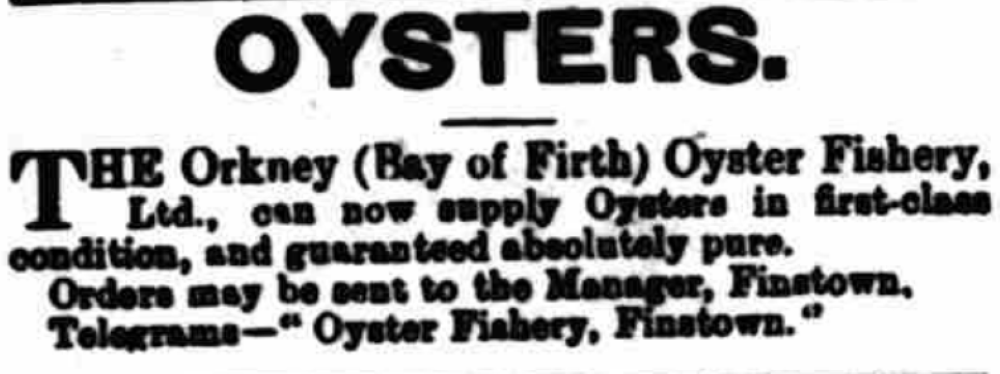
Finstown once did a regular trade in oysters from the Bay of Firth as this advert from the local newspaper The Orkney Herald of 30th November 1921 shows:

North Bay Innovations Ltd must first establish the suitability and feasibility of restoring the Native Oyster beds which were a major feature of the Bay of Firth area for centuries up until they were finally fished out between the wars in the 20th Century.
Signs of the fishing effort and shipping of oysters for export can still be seen on the shores and on the two islands, where many in the local population where involved in the fishery for decades.
If there is enough interest in the project it is hoped to set up a Local Native Oyster Restoration Group (LNORG) of stakeholders and interested parties such as: Representatives of National and Local environmental agencies; Local government including OIC and community councils; Local fishery groups; Academia; Local interest groups such as Sea Search (Sub-aqua): Local Nature groups and interested members of the public.
Northbay Innovations Ltd (NBIV) was formerly known as Northbay Shellfish Ltd established in 1995.
The sea area Bay of Firth is designated (since 2000) by SEPA under the Water Framework Directive as Shellfish Growing Waters WFD code UKS7992323 with an area of 8.04km2. It is also part of the ‘Pilot Pentland Firth & Orkney Waters (PFOW)’ designated a Shellfish Water Protected Area. The bay is also identified as such in the Orkney Islands Council ‘State of the Marine Environment Assessment (2020)’.
The work in the Development Phase will gather information including new underwater surveys of targeted sites, where, from historical records, large beds of oysters were fished, by local people, on a commercial basis up until 1930’s. Oyster were sold not just in Orkney but shipped to markets south, like Edinburgh and London.
The aim will be to identify the best places to deploy the oyster spat (settled out baby oysters) and the most effective methods to safely put them into a place on the seabed where they can form a bed (natural reef ) with help from the hatchery over the subsequent years. Part of the work will involve looking at potential donor populations in Scotland, since the original population has been extinct for decades, and, subject to agreement of the owners of the population and under strict rules of uplifting including disease free-status and quarantine to choose the likely best match for Orkney.
The Hatchery Module would be located very near to the desired site for restoration at Bay of Firth (near Finstown).

Oysters were once the food of the common people being a cheap and plentiful street food. Overfishing and pollution drastically affected the oyster catch, and as they became rarer, they also became expensive. No longer for the common people but reserved for those who could afford the price of a fancy restaurant.
Many projects in Scotland are hoping to re-establish the native oyster to where it was once prolific. NatureScot today provides advice for efforts to reintroduce native oysters to areas where they have become extinct in Scotland, as well as to protect and expand the species in areas where they retain a foothold. NatureScot has published guidance on the restoration of the native flat oyster.
People have harvested or cultivated the native oyster for centuries. It once supported abundant fisheries in several parts of Scotland, most notably the Firth of Forth. At its peak, at the turn of the 19th century, this fishery produced 30 million oysters per year. Many of which were exported to England and even continental Europe. NatureScot
Fiona Grahame



Leave a Reply