
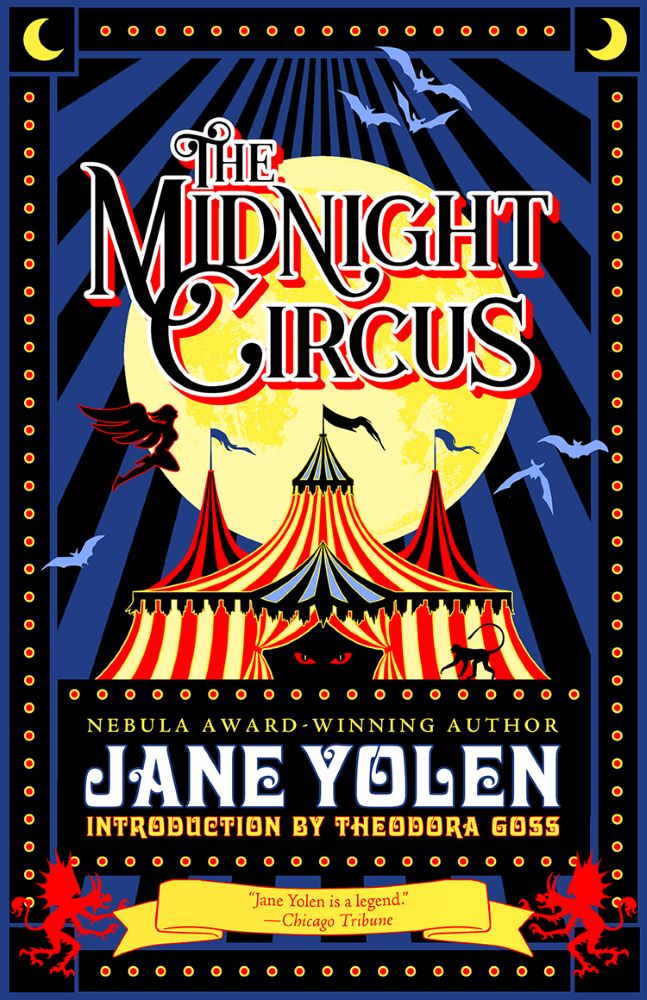
Review by Duncan Lunan

Jane Yolen, “The Midnight Circus”, $16.95 paperback, 235 + 7 pp., Tachyon Books, San Francisco, 2020.
Review first published in Shoreline of Infinity, 21st March 2023.
In The Jungle Book, and also in his anthology Twenty-one Tales, Rudyard Kipling followed each story with a relevant poem. They’re all effective, and ‘Jane’s Marriage’, which follows ‘The Janeites’ in Twenty-one Tales, has a showstopper of a first verse which I’m having to force myself not to quote here, when reviewing the work of another Jane. The Midnight Circus also has a poem to accompany each story, but they’re collected at the end of the book, along with notes on the stories, robbing the poems of the chance to make a similar impact. In reviewing them together here I’ll have to jump to and from the appendices, which I hate doing, but I think it’s necessary. For example, ‘The White Seal Maid’ and its ‘Ballad of the White Seal Maid’ (which has been set to music elsewhere) are both simple retellings, lyrically written, of the basic selkie legend – without the tragic, foreshadowed ending of the traditional ballad Sule Skerry. The characters will never be reunited, but the story and the poem would be happier together, not 184 pages apart. ‘Winter’s King’ and the poem ‘If Winter’ have similar structures, with the changeling boy drawn fatally to forest and ice rather than to the sea. ‘The Fisherman’s Wife’ and its poem ‘Undine’ tell much the same story about a mermaid, but the Notes are prefaced, ‘I like strong women’, and in the story the heroine gets her man back from the sea and the mermaid’s clutches.
‘Become a Warrior’ features another archetypal strong woman: the daughter who survives the conquest of her kingdom, and lives first in disguise and then in the wild while waiting for her revenge. Jane Yolen’s Notes say that this one started as a very different story (I keep thinking of Lessa in Anne McCaffrey’s Dragonrider), but what started as ‘a positive, uplifting story’ for an anthology called Warrior Princesses, ‘went darker, and then darker still’.
‘The House of Seven Angels’ and its poem ‘Anticipation’ retell another traditional story, this one from Yolen’s own Jewish background. In her preface, ‘Who Knew I Was a Writer of Dark Stories?’, Jane Yolen half-apologises for finding that there were so many of them when she put this collection together, but ‘The House of Seven Angels’ isn’t one of them. Similarly ‘Night Wolves’ and its poem ‘Bad Dreams’ are about a growing boy beating the terrors of a house in darkness, be they real or imagined, and the story ends happily.
‘The Weaver of Tomorrow’ is set in that fantasy world which I’ve characterised elsewhere as ‘England before the Black Death’ (and with magic that actually works). Like the Norns, the Lady of Shalott, and the hostage of Glun the Unavoidable in Jack Vance’s The Dying Earth, the Weaver’s tapestry not only portrays but determines the present and the future, including her own death – and when it comes, someone must take her place. The poem, ‘The Wheel’, describes the process.
When I was in New York, the thing that amazed me about Central Park was the number of people there after dark, thronging the pavements if not the areas between. I mentioned it to my taxi driver, who replied that he didn’t understand it either: “If the car breaks down, I’ll just wind up the windows and wait until daylight”. ‘The Wilding’ (taking the name of a real-life gang) is about the underlying violence, wrapped up in a story of shape-changing, but the real killer is an unchanged human, and the poem is about the innocence of being an animal. The story and the poem have a lot in common with their counterparts, ‘Great Gray’ and ‘Remembering the Great Gray’, which struck a chord with me because I’ve twice had memorable experiences with big owls in the USA. ‘Dog Boy Remembers’ is another variation on the same human-into-animal theme, a precursor to a story and novel published elsewhere.
‘Requiem Antarctica’ (a collaboration with Antarctic expert Robert J. Harris) has the premiss that Captain Scott was a vampire, and Oates took to the ice rather than continue to feed him. It’s a great idea, and very well written, as is the poem, but it’s not too easily reconciled with Scott’s dying wish for his son Peter: “Teach the boy natural history, it is better than games”. That would sit better with ‘Deer, Dances’, the poem which follows ‘The Wilding’. ‘Little Red’ and its poem ‘Red at Eighty-one’ have themes similar to both ‘The Wilding’ and ‘Requiem Antarctica’, but the twist is that they’re alternative versions of Little Red Riding Hood.
‘Inheritance’ is prefaced and supposedly inspired by a poem on one of the Callanish stones, on the island of Lewis. but there’s no mention of it in the Notes. Jane Yolen’s poem is about the stones, but there’s little about them in the story, which is about a Hebridean love-charm which goes wrong and leads to murder.
‘An Infestation of Angels’ is one of the most unusual stories of the book. The twist is that the last plague in Egypt, persuading ‘the Faró’ to let The People go, is a blight of cannibalistic angels with other unclean habits. The Notes relate it only to the Exodus, but there is another, possibly related myth. The Red Sea, where ‘Pharaoh’s army got drownded’, in the words of the spiritual, and where The People are heading at the end, was where the angels Senoy, Sansenoy and Semangelaf had their confrontation with Lilith, Adam’s first wife, who had become a vampire with a particularly evil power over male children – as the ones here carry off the two firstborn sons of the Faró. If the angels in the myth hadn’t subdued her, the angels in this story could well be her offspring.
‘The Snatchers’ by contrast is set in the real world of Tsarist Russia, with its indifference to the plight of Jewish boys conscripted into the army, and the mutilations inflicted by their parents trying to save them from that. There’s a supernatural element to the Snatchers, who colluded with the authorities to abduct boys before they could be made unfit to serve, and in the story they have resurfaced in 1960s America to force pacifists into the Vietnam war. But what it’s really about, as the poem implies, is the effect on the parents. ‘Names’, the last story in the book, is another post-Holocaust story, a simple account of surviving children who have memorised the names of the dead, rather like the talking books of Fahrenheit 451. Its poem, ‘What the Oven Is Not’, is one of the shortest poems in the book, and the most powerful of them.
To sum it up, the stories are compelling, the poems are good – some of them excellent – and the book is well worth reading. But just to say it again, the poems belong with the stories, to back up their messages, and not tucked away at the end of the book, which would work much more effectively if they had been printed together.

Leave a Reply