
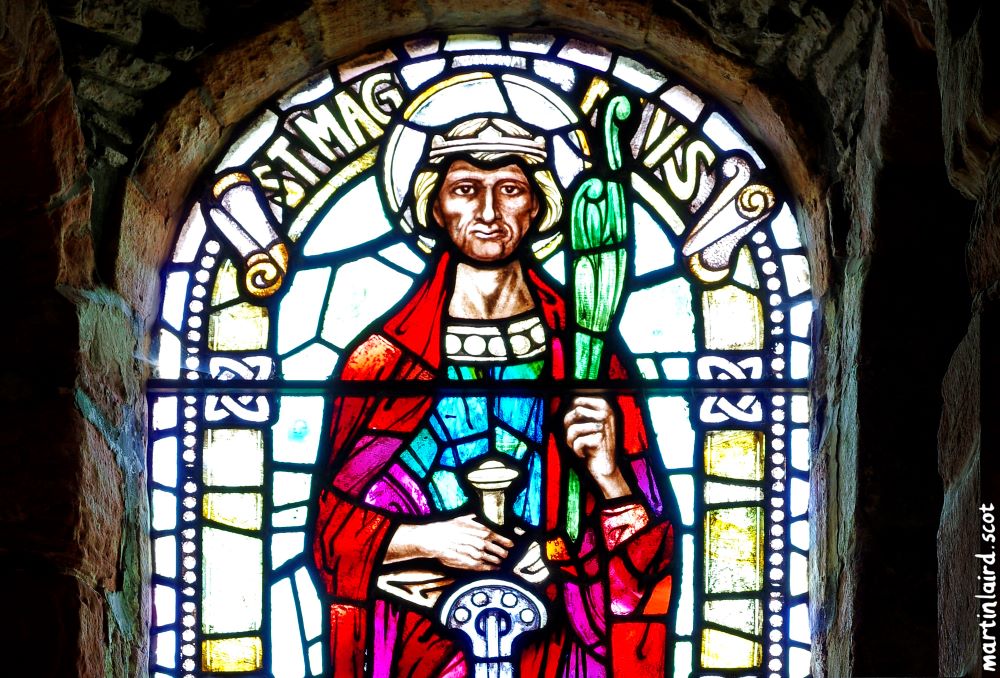
By Fiona Grahame

In the 11th century two brothers ruled Orkney, Paul and Erlend,twin sons of Thorfinn the Mighty and Ingibiorg Finnsdottir. They did so successfully for 30 years.
Paul married a daughter of Earl Hakon Ivarsson, part of the Norwegian aristocracy, and they had a son Haakon.
Erlend married Thora, daughter of Sumarlidi Ospaksson, linked to the Icelandic Norse families, and to the nobility in Scotland, England and Wales. They had a son Magnus.
The thirty years of the joint rule of Earls Paul and Erlend was ripped apart with the violent appearance in Orkney of King Magnus Barelegs of Norway who captured both men in 1098, removing them to Norway. There they died that same winter, Paul in Bergen and Erlend in Trondheim.
King Magnus proceeded to abolish the Earldom of Orkney and set up his own son, Sigurd, as the nominal ruler. Haakon with his strong links to the Norwegian court was given a role in his advising council.
The Norwegian King was not only interested in the Orkney Earldom but went on a campaign rampaging down the coast. He took with him the sons of the Earls, Magnus and Erlend.
Gruffyd ap Cynan, a mixter maxter of Welsh/Norse/ Irish lineage had returned from exile in Ireland and taken possession of Angelesey after forcing out the Normans led by Earl Hugh of Chester and Earl Hugh of Shrewsbury. Into the Menai Straits arrived the Norse ships led by King Magnus Barelegs and a battle ensued. Earl Hugh of Shrewsbury was killed by an arrow said to have been shot by the King himself. It was at this battle that a defining event took place which was to mark the young Magnus Erlendsson out from the rest of the Norse warriors. With arrows flying all around Magnus refused to fight. He also refused to take shelter and while the fighting took place all around he was not hit once as he sat in the open boat singing psalms.
His refusal to kill those he had no quarrel with incurred the displeasure of the mighty King Magnus Barelegs and the young Magnus hastily left the Norse contingent. Haakon, on the other hand, continued to be favoured.
It all went badly for King Magnus Barelegs who was killed in Ulster in 1102. On his death his son, Sigurd, was recalled to Norway to become joint ruler with his brothers. For two years Orkney was ruled directly from Norway. Haakon, being in favour, and with his links to the Norwegian court, was given the title Earl of Orkney.
Magnus, however, pursued his claim and travelled to Norway to make his case which was successful. From 1105 – 1114 Orkney again had a joint Earldom and the two cousins seemed to be working well together.
Earl Magnus strengthened his links with Scotland even more through marriage and it is possible that he joined in the campaigns against Gruffyd ap Cynan, pursued by both Alexander, King of Scots and King Henry I of England in 1114. It meant that he was away from Orkney for some time. It wasn’t unusual for an Earl of Orkney to be away from the islands for periods of time but a return would always be fraught with difficulties for while they were away the remaining Earl, in this case, Haakon,had consolidated his hold in the islands.
It was clear that the two Earls would no longer be able to work together without conflict. It had ever been the case that they ‘could not be in each other’s company without the risk of a quarrel.’
The situation in Orkney became intolerable but there was a way forward, through discussion and compromise. A ting (meeting) was held to resolve the situation and it decided that a meeting would be held between the two earls to sort out the differences. Conditions were attached to the meeting in 1117: the island of Egilsay was chosen where Bishop William was resident, and the Earls were only permitted to bring with them a limit of two ships.
Earl Magnus arrived in Egilsay first with his two ships. Earl Haakon, ignored the conditions, and arrived with 7 ships. His men hunted out Magnus who it is said was at prayer in the church. Haakon’s next action was to define him and blight his legacy as an Earl of Orkney.
Coming before Haakon, Magnus put forward three offers to his cousin. That he be sent on a pilgrimage to Rome; that he be imprisoned in Scotland; and lastly, that he be maimed, blinded and imprisoned.
These offers were objected to by the other leading men in attendance who demanded that one of the two must die. Haakon was not going to let that happen to himself and ordered his standard bearer, Ofeig, to kill Earl Magnus. Ofeig refused. Haakon then ordered his cook, Lifolf, to do the deed, which he reluctantly did. The bones of St Magnus discovered in the pillar of the Cathedral which was built to honour him as a Saint are evidence of the crushing blow on his skull that ended his life.
Haakon had always considered himself higher born than his cousin Magnus, but the miracles that started to be reported soon after the murder cast Magnus in a much brighter light than Haakon would ever achieve. The rumours of miracles spread rapidly throughout the Earldom with Magnus’ links through the Erlend line to Shetland, Iceland and across into Scotland. Bishop William, supporting the winner, Earl Haakon, tried to stifle them, but to no avail.

After his murder of Magnus, Haakon travelled to Rome and the Holy Land on pilgrimage c1120.
The conflict which started between the two cousins continued down the competing lines of their descendants for generations. It was Magnus, however, who had a cathedral built in his honour. The cult of St Magnus reached far and wide with pilgrims travelling from the far north and south to honour the martyr of the Erlend line. There are 21 churches dedicated to St Magnus in Europe including in London, and in The Faroes. His life and sacrifice has continued to inspire artists, writers and musicians. He also became the warrior saint who emerged before battles including appearing to the Orkney men who travelled to support the cause of Robert the Bruce King of Scots at Bannockburn.

This article first appeared in iScot Magazine
Leave a Reply to Radiocarbon Dating of St Magnus Reliquary – “it may be Scotland’s earliest surviving wooden reliquary” – The Orkney NewsCancel reply