
Uncovering texts telling the stories of people in their own words is one of the most exciting and rewarding elements of historical research.
It is particularly interesting when these are from voices seldom heard.
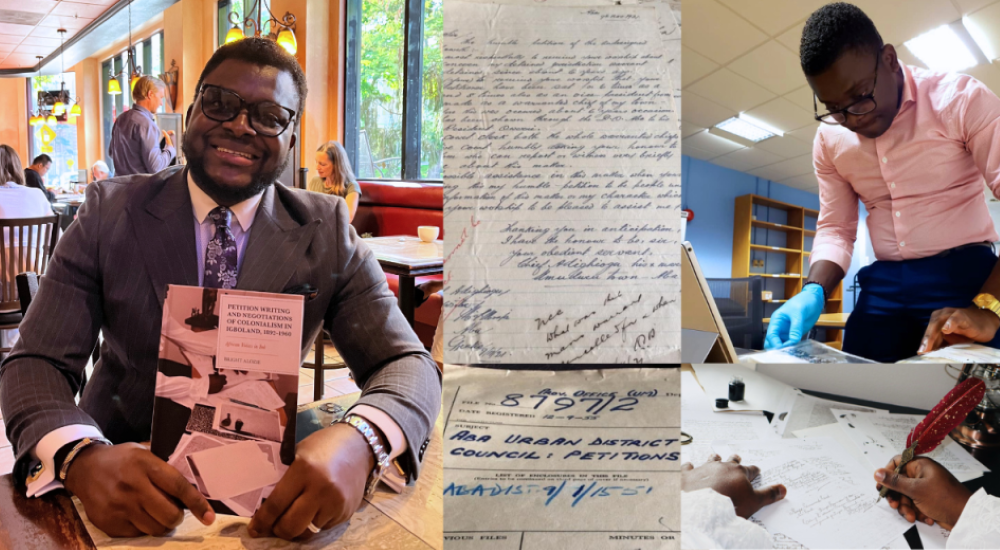
Dr. Bright Alozie of Portland State University has recently published a book which explores petitions and the trend of petition writing by Igbo individuals to British officials in colonial southeastern Nigeria. Through this book the reader can gain a sense of what it was like to live under colonial rule.
The book, published in 2024 by Rowman & Littlefield, is called Petition Writing and Negotiations of Colonialism in Igboland, 1892–1960: African Voices in Ink.
Dr. Bright Alozie with hand-written petitions and a copy of the book, African Voices in Ink. Image credit: Bright Alozie

Born in Nigeria, Alozie is an assistant professor in Black Studies at PSU whose core research focuses on colonial and postcolonial Africa and the African diaspora. He has always been interested in how African communities resisted, negotiated, and generally interacted with the colonial state. He explained:
“Growing up in Nigeria and hearing stories about the colonial period, I was always fascinated by how much agency was omitted from traditional colonial narratives.
“As a child, I always listened to my grandmother. She experienced the Aba Women’s War of 1929 (erroneously called the Aba Women’s Riots by the British in order to downplay the women’s opposition to colonial rule), which was the first successful, all women-led revolt against British colonialism in West Africa. She told me those stories.
“I was really fascinated then. Later, as a researcher, I had the privilege of interviewing her and getting deeper insights into accounts such as this.”
These first-hand stories from his grandmother and others spurred Alozie on to see what else he could find. In search of more original sources, he traveled to each one of the four main national archives in Nigeria. He went to the national archives in Ghana. He explored national archives and libraries in England, and delved into institutions and archives here in the United States as well.
The search eventually led him to uncover over 4,000 petitions from people in Igboland, all articulating the individual and collective needs and concerns of their writers. This was a very rich but unexplored body of letters; many of the documents that he found had never even been opened. In sorting through them, over time and with a magnifying glass, he learned to decipher the different styles of handwriting and even came to recognize certain professional petition writers who wrote frequently on others’ behalf.
Alozie said:
“What struck me the most was that these petitions were not passive documents at all. They represented a form of agency and resistance.”
Knowing their audience, the petitioners framed their demands in ways that the colonial authorities would understand, using words that were used to justify colonial rule like justice, rights, and equity.
He continued:
“By understanding the historical roots of these issues, we gain valuable insights into current global conversations around decolonization, around human agency, around social justice. So for me it was also kind of a personal mission, because the history I am researching resonates today,”
In World War II, Nigeria contributed an estimated 100,000 conscripts to the Allied victory, along with vast amounts of resources. During the postwar economic boom, and especially after the 1948 signing of the Universal Declaration of Human Rights, Alozie noticed a change in the tone of petitions as people showed more awareness of their rights. This demonstrated how global events also shaped petition writing during this period.
“It was very beautiful to see how the tone changed from being too humble, and begging, to saying: Look now, this is a negotiation. We have given you resources. We have given you our time. We have killed, we have died on the battlefield for you. Now you have to repay us.”
Alozie is now working on his next book about African immigrants in Oregon 1970 – 2024.




Leave a Reply