
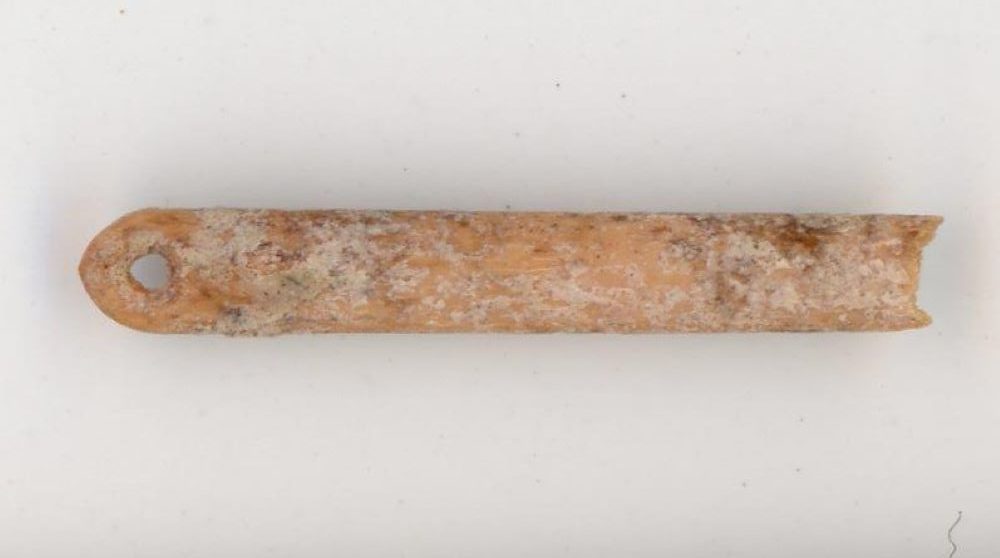
Palaeolithic humans made needles from the bones of fur-bearers — including foxes; hares or rabbits; and cats such as bobcats, mountain lions, lynx and possibly even the now-extinct American cheetah.

Research by the University of Wyoming has suggested that 13,000 years ago the needles were used to create garments from the animals’ furs to keep the early foragers warm in what was a cool climate.
Being able to make clothing suitable for colder climates meant that humans could live in areas which needed warm sewn together furs and skins.
At the LaPrele archaeological site in Converse County, Wyoming, are the remains of a killed or scavenged sub-adult mammoth and an associated camp occupied during the time the animal was butchered almost 13,000 years ago. Also discovered in the archaeological excavation — led by UW Department of Anthropology Professor Todd Surovell — was a bead made from a hare bone, the oldest known bead in the Americas.

Identification of the origins of both the bone bead and bone needles was made possible through the use of zooarchaeology by mass spectrometry, also known as ZooMS, and Micro-CT scanning. Collagen was extracted from the artifacts, and the chemical composition of the bone was analyzed.
The researchers examined 32 bone needle fragments collected at the LaPrele Mammoth site, comparing peptides — short chains of amino acids — from those artifacts with those of animals known to have existed during the Early Paleondian period, which refers to a prehistoric era in North America between 13,500 and 12,000 years ago.
The comparison concluded that bones from red foxes; bobcats, mountain lions, lynx or the American cheetah; and hares or rabbits were used to make needles at the LaPrele site. This is the first such analysis ever conducted.
Previous research has shown that, in order to cope with cold temperatures in northern latitudes, humans likely created tailored garments with closely stitched seams, providing a barrier against the elements. While there’s little direct evidence of such garments, there is indirect evidence in the form of bone needles and the bones of fur-bearers whose pelts were used in the garments.
“Once equipped with such garments, modern humans had the capacity to expand their range to places from which they were previously excluded due to the threat of hypothermia or death from exposure,” Wyoming State Archaeologist Spencer Pelton and his colleagues state.
“Our results are a good reminder that foragers use animal products for a wide range of purposes other than subsistence, and that the mere presence of animal bones in an archaeological site need not be indicative of diet.
“Combined with a review of comparable evidence from other North American Paleoindian sites, our results suggest that North American Early Paleoindians had direct access to fur-bearing predators, likely from trapping, and represent some of the most detailed evidence yet discovered for Paleoindian garments.”
Click on this link to access, Early Paleoindian use of canids, felids, and hares for bone needle production at the La Prele site, Wyoming, USA, published in PLOS ONE.




Leave a Reply