
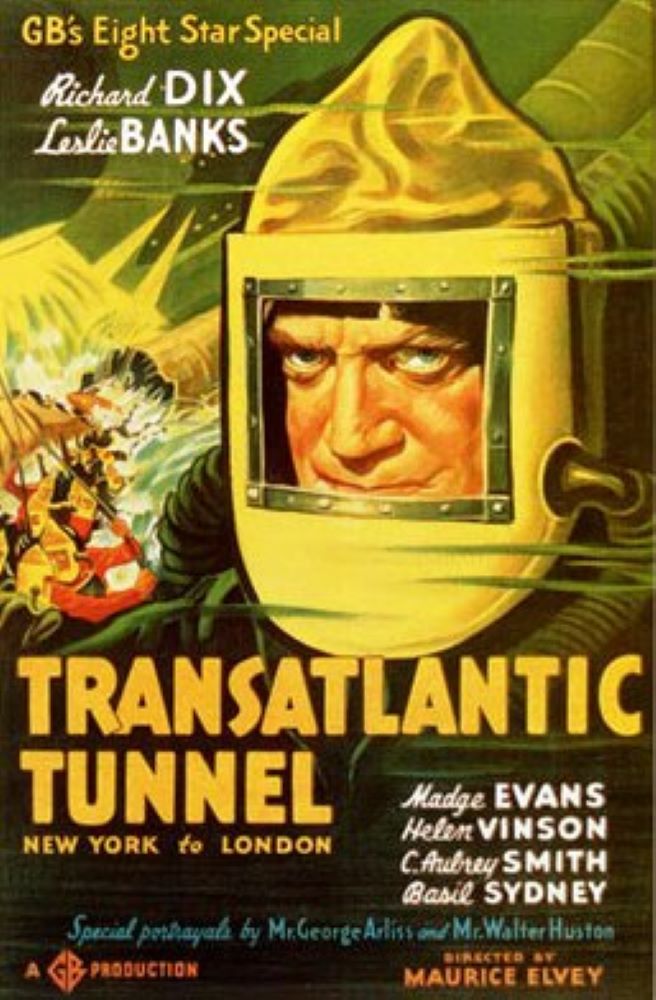

The 1935 British Film The Tunnel, released in the USA as Transatlantic Tunnel (Fig. 1), is based on a 1913 novel by Bernard Kellarmann, about a tunnel between New York and London, which is supposed to bring about world peace by unspecified means – like the alterative idea of ‘Seadromes’, floating aerodromes on which transatlantic airliners would land and refuel, which persisted well into the 1950s, long after Boeing Constellations and Stratocruisers were doing it without one. The one thing the film really gets right is the mid-Atlantic obstacle of a volcanic region, which is penetrated by four volunteers who somehow withstand the heat and break through to the American side, which miraculously solves the problem.

The idea next surfaced significantly in Harry Harrison’s novel, A Transatlantic Tunnel, Hurrah!, serialised in Analog, starting in April 1972 (Fig. 2), subsequently published as Tunnel through the Deeps, Putnam, 1972. It’s set in an alternative present in which both the French and American Revolutions failed, and the central character is a descendant of George Washington, who’s still trying to live down the family disgrace of the arch-traitor to the British Empire. Although I didn’t know it at the time, his Washington descent would have given a connection at least by marriage with the Shirley family, descended directly from Agnes Barre, whom I have have circumstantially identified as the ‘Green Girl’ of the mediaeval mystery of the Green Children of Woolpit (DL, Children from the Sky, Mutus Liber, 2012, Fig. 3).

One of the nostalgic touches in the novel is that at one point he makes a transatlantic flight on a British Black Knight booster. Black Knight was a ‘sounding rocket’ flown from Woomera in 1958-65, casually smashing the altitude record for a single-stage rocket on its first launch. Its high-altitude flights were mainly to develop warheads for the Blue Streak Intermediate Range Ballistic Missile to follow. A Black Knight and Blue Streak were preserved together at East Fortune Museum of Flight until they were moved to make way for Concorde, after which the Black Knight was moved to the Royal Scottish Museum in Edinburgh (Fig. 4).

A Black Knight redesigned by the late Geoffrey Pardoe would have formed the upper stage of the Commonwealth Booster, the satellite launcher we might have had and which might still be flying today (Fig. 5). Black Arrow, the satellite launcher derived from Black Knight, launched the UK’s one and only all-British satellite, on 28th October 1971 (Fig. 6). Recently Mark Hempsell and Alan Bond of the British Interplanetary Society have suggested that Black Arrow was actually an IRBM which was intended as a backup to Polaris, both begun in 1962 and with an identical diameter, able to carry the British-designed warhead for Polaris and able to hit Moscow (Fig. 7; Bob Stanton, ‘Nuclear Arrow’, Spaceflight, January 2025). Convincing as the circumstantial arguments are, they fail to tally with the subservience to US interests of which Geoffrey Pardoe accused the British governments of the time (private communication, 1990).


The big obstacle to the transatlantic tunnel is the central rift of the volcanic Mid-Atlantic Ridge, which has recently been mapped in unprecedented detail by NASA and the French space agency CNES, with the first year’s results from the Surface Water & Ocean Topography satellite, launched in 2022 (Fig. 8 – Skyler Ware, ‘Satellites reveal stunningly detailed maps of Earth’s seafloors’, Live Science, online, 13th December 2024.)

The appearance of a very large cleft in the seafloor out there is the first of the weird events in Martin McInnes’s novel In Ascension (Atlantic Books, 2023). The rift’s rate of seafloor spreading is only 2-3 inches per year, roughly the rate at which fingernails grow, but it’s enough to destabilise any engineering structure trying to bridge it. The answer in A Transatlantic Tunnel, Hurrah! is a floating underwater tunnel, with positive buoyancy, tethered to the bottom and with expansion joints at each end – which leads to the idea of an underwater floating tunnel all the way, forgetting about all that tiresome drilling. Another idea considered was a bridge above the surface, whose towers would also be vulnerable to geological shifts, to say nothing of the difficulty of moving traffic up and down in elevators.


Similar alternative designs were considered for the Channel Tunnel before it was finalised, and I discussed them in my notes for ‘Pharaoh’s Army Got Drownded’, one of the stories which I wrote for Sydney Jordan’s Lance McLane strip (Fig. 9 – Daily Record, January-May 1985, reprinted in Jeff Hawke’s Cosmos Vol. 10 No. 2, August 2017). Of the four proposals in 1985, two illustrated in Fig. 10, we settled on the one with no bridges and only the towers, which would provide ventilation and an escape route in the event of serious trouble. That option wasn’t preferred, because of the risk of collision in some of the world’s busiest sea-lanes, plus the occasional very bad weather like 1953’s or 1978’s. Escape if necessary would be provided by the Service Tunnel, between the two main railway ones, whose drilling machine was built by James Howden & Company, and visited in December 1988 on the 35th anniversary of the Scottish spaceflight society ASTRA, hosted by Howden’s in the boardroom of the plant they then had in Glasgow (Fig. 11). The service tunnel was indeed used as the escape route during a major fire in November 1996 (Colin Randall, ‘Well-drilled for Disaster as the Heat Hit 500o C’, Daily Telegraph, November 20th 1996). Andy McNab has portrayed a terrorist attempt to destroy the main tunnel, forcing the takeover of a train when it begins to go awry, in his novel Red Notice (Bantam, 2012, Fig. 12).


Sydney Jordan was not asked to illustrate A Transatlantic Tunnel, Hurrah!, but he might have been, because he and Harry had been friends (Fig. 13) since Harry contributed the story ‘Out of Touch’ to Sydney’s Jeff Hawke strip in 1957-58 (Fig. 14, JHC reprint June 2009). Now that the concept is back in the news, (Anna Rahmanan, Senior National News Editor, TimeOut, online, ‘A $20 Trillion Tunnel Could Link New York and London in 54 Minutes’, December 11th 2024), and Elon Musk has stated that his Boring Company could do it for 1000 times less, who knows what will come next?


‘Pharaoh’s Army Got Drownded’, my 1985 story for Lance McLane, was set like all the McLane stories 100 years after the historical present, and like all the McLane stories, was set in the aftermath of a global disaster in 2076. The story was a collaboration with Jim Campbell, then weapons training officer for the Glasgow Viking Re-enactment Society. In it receding ice had cleared the French end of the Channel Tunnel, and a terrorist group was reopening it to retrieve a bomb in a cargo of nuclear waste, which had been discovered and stopped in the tunnel when the disaster happened. In September 2007 a report strongly urged the government to increase security measures at Britain’s existing storage facilities for separated plutonium waste, in fear that it could be used in a ‘dirty bomb’ attack, as we envisaged, or stolen to make nuclear weapons.
The train was immobilised by the intervention of Israeli commandos, who attacked and blew up both ends of the Tunnel less than 24 hours before C (Collision) Day (Fig. 9). Although the Israeli action would undoubtedly enrage the French and British governments, by taking it the Israelis would actually be protecting the British public and others downwind from the UK. The precedent for it was the Israeli air raid in 1981 which destroyed Saddam Hussein’s Osirak nuclear reactor. In late September 2007 it was revealed that it had happened again, on September 6th, when Israeli F-15s attacked and destroyed a site in northern Syria. The Israelis put a complete news blackout on the story and so did the Syrians, not wishing to highlight whatever they were importing from North Korea (the 1700-ton Al-Hamed had docked in Tartous on September 3rd, having reflagged itself as South Korean). Nor did they wish to advertise that their ‘much-vaunted, Russian-built air defence system failed to detect, much less repel, the intruders’. (Con Coughlin, ‘The Israelis Have Unearthed a New and Deadlier Axis of Evil’, Daily Telegraph, Sept. 21st 2007.)
Napoleon Bonaparte approved plans for a Channel Tunnel in 1802. Col. Ernest Beaufort began to dig one from England in 1880, but was ordered to stop two years later on grounds of national security. A second attempt in 1975 was abandoned on the orders of the Wilson government, and the restart in December 1987 was from the previous workings. The English and French tunnels met on October 30th 1990 and tunnelling was completed in June 1991, more than 80 years earlier than our story anticipated. £20 million was spent on making the Tunnel ‘terrorist-proof’, with optical fibre communications embedded in steel cables (Steve Connor, ‘Attack-proof Signal System for Chunnel’, Daily Telegraph, 8th August 1989), and electric shocks and traps were set up to stop stray animals from carrying rabies through it (Anthony Looch, ‘Chunnel “Will Repel Rabies”’, Daily Telegraph, 19th January 1993), but there was a furore in 1995 when it emerged that passengers were being subjected only to random checks (Toby Moore, ‘Minister to Investigate “Lax Security for Tunnel”’, DT, January 30th 1995).
In 1994 “The British Army yesterday achieved what Napoleon could only dream of almost 200 years ago – sending combat forces through a tunnel under the Channel. Twenty-seven Scimitar armoured reconnaissance vehicles arrived in central Bosnia, making history by travelling all the way by train from Willesden, north London.” They arrived at Rijeka in just three days, where it would have taken four days by road and ferry to Antwerp or 11-14 days by ship through the Mediterranean to Split. However “Unlike Napoleon, the Army has as yet no plans to send whole armies rushing through the tunnel in emergencies. For one thing Eurotunnel has a 44-ton weight limit, which rules out Challenger tanks. For another, Eurotunnel, which opened for regular transport business on July 25, refuses to allow ammunition to be carried.” (Peter Almond, ‘Dream of Napoleon Is Reality for Army, Daily Telegraph, 2nd September 1994). Tracked Reconnaissance Vehicles from the Household Cavalry Regiment returned from Bosnia by the Tunnel, without ammunition, the following year (‘Our Tanks Take the Tunnel’, DT, March 3rd 1995).
As all of the transatlantic tunnel’s engineering problems are just those of the Channel Tunnel writ large, a first reaction would be to ask if the security problems would be similarly scaled up. Meanwhile, what’s suggested makes Boris Johnson’s proposed £300 million tunnel to Northern Ireland (rejected by British Rail) seem minor, even though you can see Northern Ireland from Carrick (South Ayrshire) and Pladda (South Arran). St. Columba went all the way to Iona to get out of sight of it. And the Irish end of the Giant’s Causeway was originally built for their military purposes, according to legend, though they seem to have got well off course by ending up at Fingal’s Cave on Staffa. Perhaps we should leave it broken, as the French did with the Bridge of Avignon in 1669.
Duncan Lunan’s Children from the Sky and other recent books are available from the publishers or from Amazon; for details see his website, http://www.duncanlunan.com.




Leave a Reply