
“Today’s (10 January 2025) assessment from the World Meteorological Organization (WMO) proves yet again – global heating is a cold, hard fact,” – UN Secretary-General Antóno Guterres.
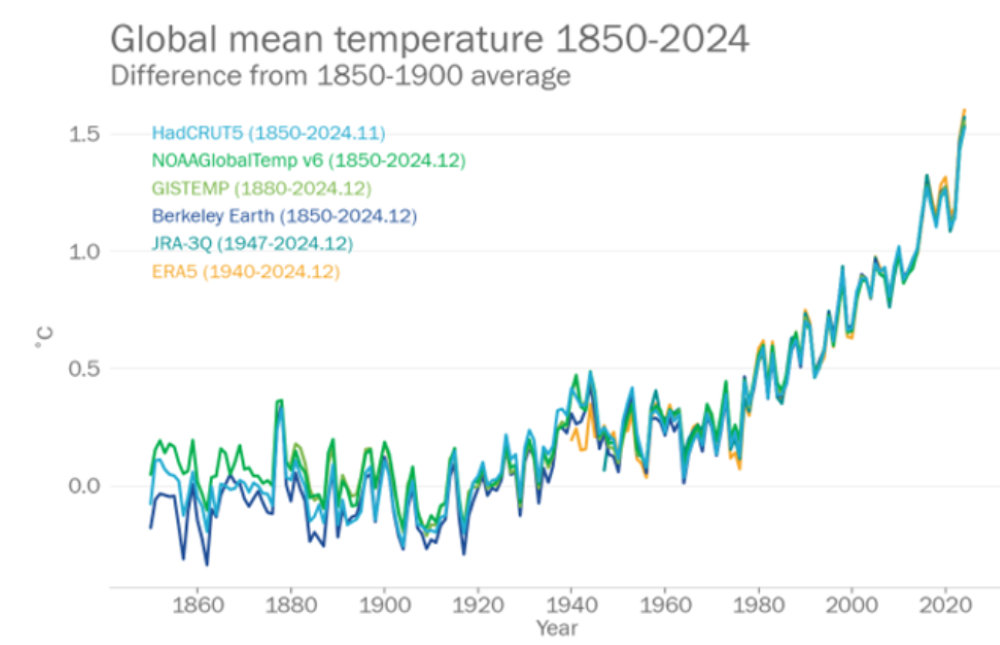
It may be difficult to imagine after the very cold temperatures we have had this last week in Orkney, but perhaps the extensive news coverage of the wildfires in California might help – UN weather experts from the World Meteorological Organization (WMO) confirmed on Friday, 10th January 2025, that 2024 was the hottest year on record, at 1.55 degrees Celsius above pre-industrial temperatures.

Four of the six international datasets examined by WMO indicated a higher than 1.5℃ global average increase for the whole of last year but two did not.
WMO spokesperson Clare Nullis explained:
“We saw extraordinary land, sea surface temperatures, extraordinary ocean heat accompanied by very extreme weather affecting many countries around the world, destroying lives, livelihoods, hopes and dreams.
“We saw many climate change impacts retreating sea ice glaciers. It was an extraordinary year.”
The datasets used by WMO are from the European Center for Medium Range Weather Forecasts (ECMWF), the Japan Meteorological Agency, NASA, the US National Oceanic and Atmospheric Administration (NOAA), the UK Met Office in collaboration with the Climatic Research Unit at the University of East Anglia (HadCRUT) and Berkeley Earth.
WMO Secretary-General Celeste Saulo added:
“climate history is playing out before our eyes. We’ve had not just one or two record-breaking years, but a full ten-year series.
“It is essential to recognize that every fraction of a degree of warming matters. Whether it is at a level below or above 1.5C of warming, every additional increment of global warming increases the impacts on our lives, economies and our planet.”
About 90% of the excess heat from global warming is stored in the ocean, making ocean heat content a critical indicator of climate change.

A separate study published in Advances in Atmospheric Sciences found that ocean warming in 2024 played a key role in the record high temperatures. The ocean is the warmest it has ever been as recorded by humans, not only at the surface but also for the upper 2000 meters, according to the study led by Prof. Lijing Cheng with the Institute of Atmospheric Physics at the Chinese Academy of Sciences. It involved a team of 54 scientists from seven countries and 31 institutes.
What does this all mean ?
In Orkney – we’ll have more rain, stronger winds, rising sea levels and increased coastal erosion. These are important for the farming sector for which the weather is crucial in determining how successful a year will be. For fishing, the warming of the ocean means that shoals of fish are no longer to be found where traditionally they were – feeding grounds change for all marine life. This has a knock on effect to seabird populations whose food source is in that changing ocean.
2024 was a year of climate events that affected the lives of billions of people worldwide: persistent droughts in southern Africa and Central America in the early part of the year; devastating extreme rainfall in Spain; and the deadly Hurricane Helene along America’s east coast.
In a recent paper published in Advances in Atmospheric Sciences, by an international team of scientists led by Dr Wenxia Zhang at the Institute of Atmospheric Physics, Chinese Academy of Sciences, it looked at the characteristics and impacts of the most notable extreme events of the year, including rainfall and flooding, tropical cyclones, and droughts. Dr Zhang and her team have been conducting an annual review of the global climate extremes since 2022, and this year they found it to be marked by exceptional rainfall and flooding.
In particular, many of the extreme rainfall and drought events of 2024 were related to the atmospheric configurations associated with the El Niño in winter 2023/24. Layered on top of that, according to studies of extreme event attribution, or “attribution science”, human-induced climate change since the pre-industrial era has in many cases exacerbated extreme rainfall, tropical cyclones, and droughts, and therefore their associated socioeconomic impacts.

“Some of the extreme events witnessed in 2024, such as Hurricane Helene, were well forecasted”, explained Dr Zhuo Wang from the University of Illinois. “The destructive impacts were partly due to the vulnerability of the underprepared community to a changing climate”.
The wildfires raging through California not only cause massive destruction of property, the deaths of people and wildlife, but also have implications due to the exposure to smoke inhalation from the fires. A study found that exposure to fine particle matter (PM2.5) from wildfire smoke in California is associated with higher rates of emergency department visits for all causes, non-accidental causes, and respiratory disease. This risk varied by age and race, but was especially high for individuals who lived in areas with lower availability of air conditioning.
Dr. Stowell and a team of researchers from BUSPH, Boston University College of Arts & Sciences (CAS), and the Health Effects Institute’s study “Emergency department visits in California associated with wildfire PM2.5: differing risk across individuals and communities”, published in IOP, found that very little research has examined how the health effects of wildfire smoke exposure may differ based on individuals’ access to air conditioning for smoke which can permeate the air from hundreds or thousands of miles away.
Dr. Stowell said:
“The current fires in LA are out-of-season fires driven by severe Santa Ana winds coming from the mountains. As climate change continues, the temperature differentials between land and sea will grow and, potentially, drive stronger and stronger late-season or out-of-season wind events.”
No one is immune from the effects of climate change, no matter where you live. Even if you live in an area where there is no possibility of wildfires or massive flooding – it will impact on your food security, what can be produced and bought locally – and the supply chain of imports, on which we rely.
What can be done?
Climate change and its effects have been warned about for decades. It is the rapid acceleration of global warming – past the tipping point – that is the greatest threat. The use of private jets by celebrities, the very wealthy, and ironically even politicians going to climate change conferences, is a considerable contributor to global warming:
Flight times for 25,993 private aircraft and 18,655,789 individual flights in 2019-2023 are linked to 72 aircraft models and their average fuel consumption. We find that private aviation contributed at least 15.6 Mt CO2 in direct emissions in 2023, or about 3.6 t CO2 per flight. Almost half of all flights (47.4%) are shorter than 500 km. Private aviation is concentrated in the USA, where 68.7% of the aircraft are registered. Flight pattern analysis confirms extensive travel for leisure purposes, and for cultural and political events. Emissions increased by 46% between 2019-2023, with industry expectations of continued strong growth. Regulation is needed to address the sector’s growing climate impact. Private aviation is making a growing contribution to climate change
The Fossil Fuel industry is where we can make the big change that needs to happen but as yet world economies are so linked to this top contributor to rapid climate change that politicians the world over have never taken the action needed to reduce our reliance on fossil fuels.
UN Secretary-General António Guterres described the WMO’s findings as further proof of global warming and urged all governments to deliver new national climate action plans this year to limit long-term global temperature rise to 1.5C – and support the most vulnerable deal with devastating climate impacts.
“Individual years pushing past the 1.5℃ limit do not mean the long-term goal is shot,” Mr. Guterres said.
“It means we need to fight even harder to get on track. Blazing temperatures in 2024 require trail-blazing climate action in 2025.
“There’s still time to avoid the worst of climate catastrophe. But leaders must act – now.”
Fiona Grahame






Leave a Reply