

In an exam driven curriculum should we be surprised that Robert Burns, Lewis Grassic Gibbon, and George Mackay Brown are relegated to the ‘also ran’ division?
In 1967 a pupil of Clermiston Primary School, in Edinburgh, of quite unremarkable intelligence stood in front of classmates and recited Scots Wha Hae. The teacher had given out the poem to be learned weeks ago to all the pupils for a competition run by the Burns Federation. The child had practised at home in front of her parents for months before this day and was very nervous as she’d never done anything like this before. She didn’t understand all the words but there was something about the sound of them, the rhythm of the lines, a power of this poet’s work, that she enjoyed sharing with others. She won the competition and it was to instil in her a love of the Scots words and the joy of poetry, not just by Robert Burns, but of many diverse poets from that day to this.
In the child’s home was an anthology of poets. A hardbacked book of indeterminate age. Many nights, she would read Tam O’ Shanter, a rollicking tale which filled her dreams with ghosts and witches. Many of the words were unknown to her but that didn’t matter, because if she read the poem aloud, their meaning became clearer. Words, no longer in everyday use anymore in Scotland but which could describe a feeling or an action that would require a whole phrase in English. As an anthology the books contained the works of Byron, Tennyson, Wordsworth, and other great poets – she fed on them – but it was to be Tam O’ Shanter that she returned to many times.
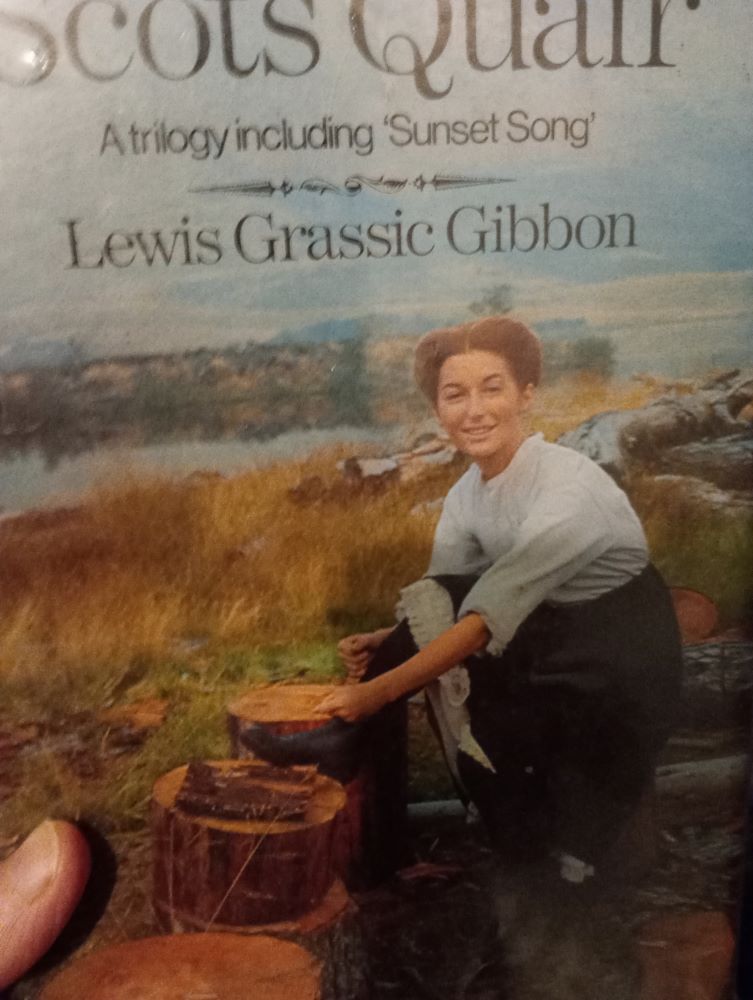
In 1971, the same child, was captivated by a TV production of ‘Sunset Song’ by Lewis Grassic Gibbon. It was not just the superb acting and landscapes that attracted her but again it was the words and the sound of them.
It was so unusual to watch a programme about the life of a strong woman, not someone from the upper classes, but of working folk, the power of the ancient land around her, and the devastation wreaked upon the people by war.
For her birthday that year the child received ‘A Scots Quair’, from her parents. The trilogy by Gibbon which starts with Sunset Song. She still has that copy.

In 1973, now at a new Comprehensive School, the number of subjects the girl had squeezed into her timetable meant that ‘English’ was just one of many jostling for attention. Some lessons could be as short as 35 minutes once everyone settled down. Her teacher, a budding poet himself, introduced the class to 20th century Scots poets like; George Mackay Brown, Edwin Muir, and Edwin Morgan. She began to seek out poets for herself like Hamish Henderson who she encountered first through folk song. ‘Freedom Come A Ye remains a favourite song for her to this day. The power in those Scots words. Words of rebellion, of change, and of the rights of people.
The Scottish Qualifications Authority announced, after conducting a survey of pupils and teachers, that it was making changes to what would come up in the Higher English exam in Scotland. Out went Sunset Song. Robert Burns, removed as a discrete writer. Orcadian George Mackay Brown only features now in the new anthology of short stories at National 5 and Higher questions.
2,500 people took part in the SQA survey upon which the authority based its decision to either remove or relegate these writers to the periphery of study.
Why should we care?
Unfortunately the Scots education system at secondary level has a curriculum driven by exam content. Schools and teachers are limited in what they cover by a results based society and parents who, naturally, desire to see their child, do well in the Highers. If you thought the ‘Curriculum for Excellence’ was some sort of creative launch pad for every child to achieve its full potential, as it was originally intended to do – think again. Exam success is all that counts.
We have an education system stifling our heritage, our culture and that very creativity it should be celebrating.
“With them we may say there died a thing older than themselves, these were the Last of the Peasants, the last of the Old Scots folk. A new generation comes up that will know them not, except as a memory in a song…” Sunset Song, Lewis Grassic Gibbon
Fiona Grahame



Leave a Reply to Howie FirthCancel reply