
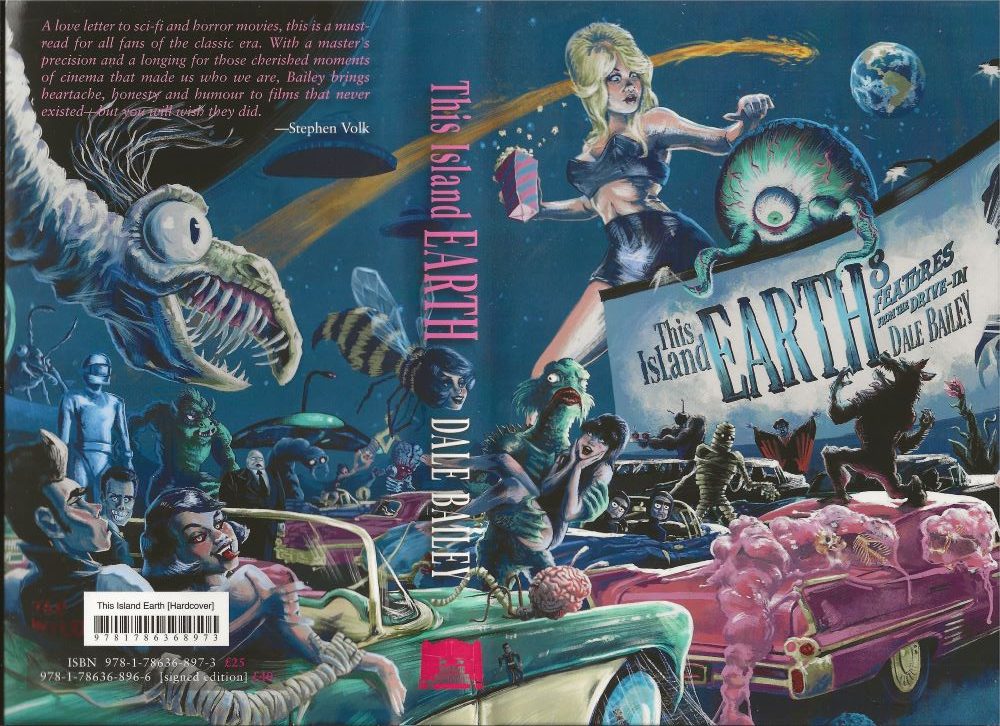

Dave Bailey, “This Island Earth, 8 Features from the Drive-In”, £25, PS Publishing, 2023.
(First published in slightly different form in ParSec # 11, July 2024.)
This island Earth does for a number of 1950s movie creatures what James Morrow (I think) did for The Blob, thawing it out and bringing it back with good intentions. The Blob doesn’t feature in this book, though it has central billing on the cover by Ilan Sheady. Other beings in the cover melee, harder to spot and not in the book, include Gort from The Day the Earth Stood Still, The Mummy, Robbie the Robot and the insectile worker from the original This Island Earth. (There is another Gort in Bailey’s version of I Married a Monster from Outer Space, but don’t let that confuse you – Michael Rennie’s robot is not here.)
What we do have is Dave Bailey’s take on fragments of classic 1950s SF and horror which he saw in childhood on clapped-out TVs with indoor aerials, in a caravan on a trailer park. Lacking the full picture, literally, he would make up his own stories for the characters. (I had a similar experience in the 50s with Nigel Kneale’s Quatermass II, a scene from which inspired one of my first published stories in 1971, so I know where he’s coming from.) The Ghost Goes West, which I saw once, in my teens, on an Ayrshire-French Schools Exchange, becomes ‘The Ghoul Goes West’. On the jacket, Stephen Volk says, ‘Bailey brings heartache, honesty and humour to films that never existed – but you will wish they did.’
It doesn’t always work: the implausibility of the human-coelacanth hybrid of ‘The Horror of Party Beach’, like an aquatic version of The Fly, kept that story from working for me at all. But some of the stories are very good indeed. Bailey’s version of Creature from the Black Lagoon portrays it as a real creature from the Amazon, trying to make it in Hollywood, warned by Bela Lugosi and Boris Karloff that it’ll never work. (Lugosi’s death in the unforgiving Hollywood environment is the inspiration for ‘The Ghoul Goes West’, which includes more films that were never made.) What begins for the Creature as a biopic (literally) turns into one more horror potboiler, and his subsequent career in films is frustrated by type-casting. It’s like the prediction that there would be lots of films after Forbidden Planet starring Robby the Robot (which never happened to that extent), but it’s much more poignant, and the Creature’s eventual escape recalls the endings of Conan Doyle’s The Lost World, in both the book and the silent film.
It comes as a relief that the protagonist of ‘Creature from the Black Lagoon’ isn’t a 1950s US teenager. British readers, especially of my age, would be well advised not to read this book cover to cover at a sitting. There’s a great deal of snogging and more in big American cars at beauty spots and drive-in theatres, and there’s a lot of High School ‘stuff’ about places on football teams, Proms and Homecoming Queens. With violent deaths proliferating across the USA, the reaction of the school board in ‘I Was a Teenage Werewolf’ is that the Prom Must Go On, albeit with armed police presence, an embarrassment of chaperones, and all-too-predictable results. I couldn’t help contrasting it with my own final years at school, when the senior teachers were looking for any excuse to cancel dances after the Twist took away their control. And there are an awful lot of references to 1950s pop music which either was before (even) my time, or never made the UK charts, because most of those references are lost on me, but the remorseless flow of 1950s Americana does become repetitive.
That said, in the best story in the book the central character is a radio DJ. ‘Next Caller from Outer Space’ is an in-depth study of bereavement following a UFO abduction. The government agents who interrogate the bereaved DJ are anxious only to secure his silence, suggesting there’s government conspiracy or at least collusion in the abductions – possibly because the abductors’ powers are so great that nothing can be done to prevent them. The story has echoes of Ian Watson’s Miracle Visitors, though unlike that novel, it offers only one explanation for what’s happened. That explanation turns on the concept of ‘life-force’, which was exploded in biology a century before, as Richard Dawkins makes clear in Unweaving the Rainbow (Allen Lane, 1998). There was a last attempt to revive it in the 1930s, which failed, but it persists even today in series like Doctor Who, Torchwood and Star Trek. It says a lot for this story that it makes the idea sound credible in a 1950s context.
‘Next Caller from Outer Space’ is also the only story in which the authorities take what’s happening seriously. In ‘I Was a Teenage Werewolf’ the police just arrest teenagers at random and declare the problem solved. ‘Invasion of the Saucer-Men’ has the adults so indifferent to alien landings that the teenagers, brainwashed by the sci-fi movies of the day, believe it’s up to them to fight and save the world. It’s like Red Dawn, Ronald Reagan and Robert McNamara’s favourite movie, in which Cuba and Nicaragua invade the USA and only the teenagers will fight – except that here the consequences are tragic rather than unintentionally absurd. And in ‘Teenagers from Outer Space’, where the aliens establish an enclave, like Peter Jackson’s District 9 without the hovering ships, the authorities most concerned are the school board, when the aliens’ adolescents enrol in school and are too big to wear the uniform. That problem’s quickly solved when they prove to be good at football..
Those most upset by the incursion are the parents, who don’t like the relationships their children form with the newcomers. When one of them saves a girl from rape (outside a school dance, after a football victory, of course), her parents’ reaction is to throw her out – better to be raped by an all-American boy, even if he is ‘a cheap hood’, rather than to be saved by a bug – which is what the adults call the aliens, though they look nothing like insects. This is a story about immigrants, minorities and prejudice – it could be told as a mainstream narrative, but sometimes the SF tropes are needed to get the point across. Frederik Pohl’s ‘The Day After the Day the Martians Came’ has the same effect – that’s in Harlan Ellison’s Dangerous Visions, and possibly the best story in it.
To paraphrase Woody Guthrie (1942), one of the few musicians Bailey might have quoted but doesn’t: with This Island Earth, take it easy – but take it.



Leave a Reply