
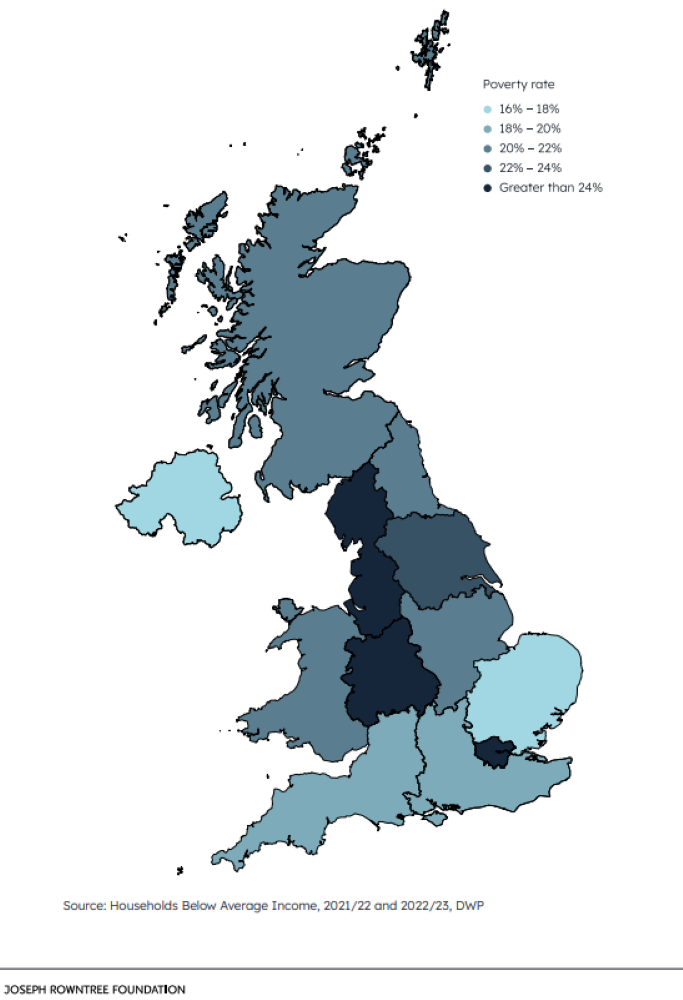
Child poverty rates in Scotland (24%) remain much lower than those in England (30%) and Wales (29%) and are similar (if slightly higher) than in Northern Ireland (23%). This is likely to be due, at least in part, to the Scottish Child Payment. This highlights the effect benefits can have in reducing poverty. Joseph Rowntree Foundation (2025) UK Poverty 2025
UK Poverty 25 – published by the Joseph Rowntree Foundation on 29 January looks back at the period before the 2024 General Election and the steps needing to be taken if there is to be positive change in child poverty rates.
The statistics are shocking for one of the world’s richest states:

- More than 1 in 5 people in the UK (21%) were in poverty in 2022/23 – 14.3 million people.
- 8.1 million were working-age adults
- 4.3 million were children
- 1.9 million were pensioners.
There has mostly been no change to these rates since before 2020, and the Covid-19 pandemic.
And the report states:
“economic growth on its own won’t reduce poverty, and it is deeply unjust to force families to wait for economic growth before they feel their situation improve, especially given the picture of deepening poverty.”
Some more shocking statistics:
In 2022/23, 6 million people were in deep poverty
Between 2017/18 and 2020/21, over 12 million people had experienced very deep poverty in at least one year
The poorest families – those living in very deep poverty – had an average income that was 57% below the poverty line, with this gap increasing by almost two-thirds over the past 25 years.
3.8 million people experienced destitution in 2022, including around one million children.
The levels of poverty hit larger families the most, those with 3 or more children. The 2 child benefit cap (aka the rape clause) was introduced in April 2017 by the UK Tory Government and is continued by the Labour Government. In Scotland, the SNP Scottish Government has mitigated the 2 Child Benefit Cap and large families will not be penalised for having more than 2 children if they wish to claim benefits. Scotland has several benefits which the rest of the UK does not have. These are spending choices made by the Scottish Government through its Budget and the Scottish Parliament. Click on this link to find out more about benefits in Scotland for Children and Family
Ethnic groups and People with a disability are also disproportionately affected by poverty.
Poverty rates vary significantly between UK nations and regions

The rising cost of living: increased prices in food, utilities, rent and other household costs – has meant that by October 2024:
- 2.6 million of the poorest fifth of households (44%) were in arrears with their household bills or behind on scheduled lending repayments
- 4.1 million households (69%) were going without essentials
- 3.2 million households (54%) cut back on food or went hungry.
Within Scotland there are also significant variations between each constituency area, although child poverty rates in Scotland (24%) remain much lower than those in England (30%) and Wales (29%) and are similar (if slightly higher) than in Northern Ireland (23%). See table at the end of the article
The report concludes that the levels of poverty in the UK are ‘unacceptable’. It offers solutions:
- Offer help and space for those looking for work to find a secure job that sticks, while making work possible and desirable for those outside the labour market if this is feasible.
- Improve financial protection if people lose their jobs or cannot work for a period, such as paid leave due to caring demands or sickness, building on new policies which have started to raise the basic level of workplace rights and protections.
- Give people the ability to care alongside work without falling into hardship, including by increasing the value of carer benefits while making paid care services more affordable and accessible.
- Ensure social security is there for all of us when we need it, with the basic rate set so it is at least enough to afford life’s essentials. This includes permanently re-linking the Local Housing Allowance (LHA) to local rents and removing the 2 child limit in the benefit system, alongside forging a ‘social safety net’ of crisis support, practical help and social connection where people live.
- Put future pension provision on a more secure footing by raising minimum contribution rates and establishing good options for people to use their savings pot to provide a secure standard of living in retirement.
- Help people accrue modest savings, access affordable credit, gain relief from problem debt and hold assets (especially those without access to family wealth).
- Expand access to affordable, secure, decent homes, whether rented or owned, by increasing the supply of homes, including those for social rent, and ensure that the benefit system works to support households with their housing costs by ensuring housing benefit is unfrozen and reflects the actual cost of rents.
- Work closely with devolved governments where powers overlap to make services as easy as possible to access and collaborate on shared priorities, such as supporting individuals into work.
And to the Labour UK Government it says,“With limited action on poverty and hardship seen in the first 6 months of the Government, there is huge scepticism over what can be delivered. ‘
Child Poverty Rates: Scottish Constituencies
| Ayr, Carrick & Cumnock | 32% |
| Berwickshire, Roxburgh and Selkirk | 27% |
| Central Ayrshire | 31% |
| East Renfrewshire | 14% |
| Na h-Eileanan an Iar | 19% |
| Kilmarnock and Loudoun | 30% |
| Midlothian | 23% |
| North Ayrshire and Arran | 32% |
| Orkney and Shetland | 16% |
| West Aberdeenshire and Kincardine | 13% |
| Aberdeen North | 25% |
| Aberdeen South | 20% |
| Aberdeenshire North and Moray East | 24% |
| Airdrie and Shotts | 31% |
| Alloa and Grangemouth | 27% |
| Angus and Perthshire Glens | 29% |
| Arbroath and Broughty Ferry | 28% |
| Argyll, Bute and South Lochaber | 23% |
| Bathgate and Linlithgow | 26% |
| Caithness, Sutherland and Easter Ross | 19% |
| Coatbridge and Bellshill | 28% |
| Cowdenbeath and Kirkcaldy | 31% |
| Cumbernauld and Kirkintilloch | 27% |
| Dumfries and Galloway | 30% |
| Dumfriesshire, Clydesdale and Tweeddale | 27% |
| Dundee Central | 30% |
| Dunfermline and Dollar | 26% |
| East Kilbride and Strathaven | 22% |
| Edinburgh East and Musselburgh | 20% |
| Edinburgh North and Leith | 17% |
| Edinburgh South | 13% |
| Edinburgh South West | 16% |
| Edinburgh West | 13% |
| Falkirk | 28% |
| Glasgow East | 37% |
| Glasgow North | 36% |
| Glasgow North East | 37% |
| Glasgow South | 34% |
| Glasgow South West | 38% |
| Glasgow West | 34% |
| Glenrothes and Mid Fife | 33% |
| Gordon and Buchan | 18% |
| Hamilton and Clyde Valley | 26% |
| Inverclyde and Renfrewshire West | 25% |
| Inverness, Skye and West Ross-shire | 17% |
| Livingstone | 28% |
| Lothian East | 21% |
| Mid Dunbartonshire | 15% |
| Moray West | 22% |
| Motherwell, Wishaw and Carluke | 30% |
| North East Fife | 24% |
| Paisley and Renfrewshire North | 21% |
| Paisley and Renfrewshire South | 19% |
| Perth and Kinross-shire | 26% |
| Rutherglen | 28% |
| Stirling and Strathallan | 21% |
| West Dunbartonshire | 28% |
Fiona Grahame

Leave a Reply