
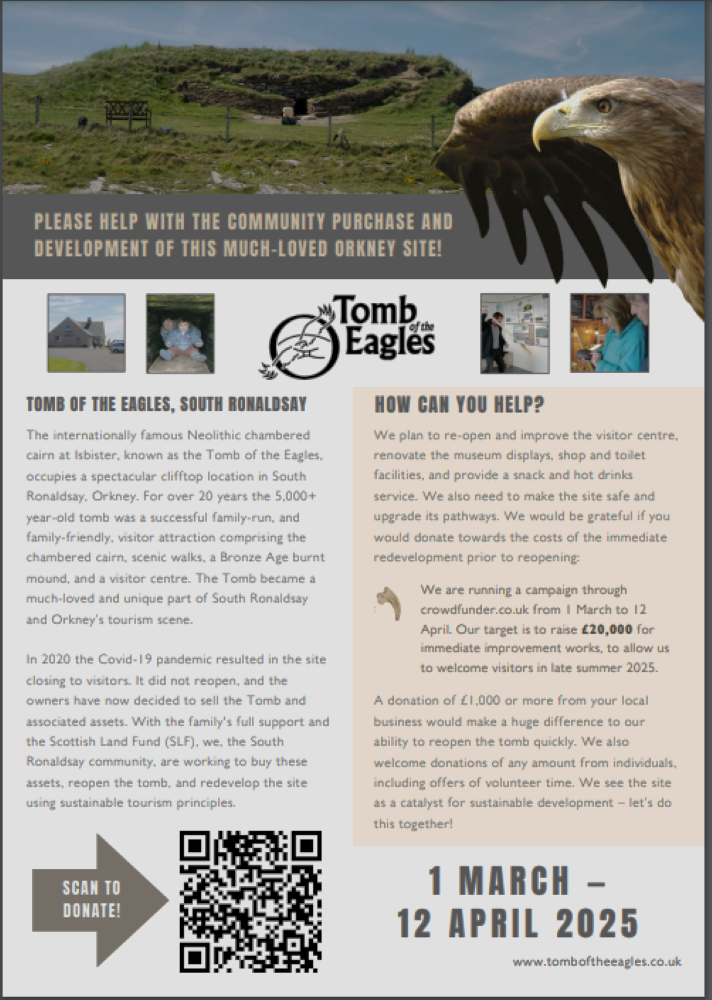

The Crowdfunder goes live on March 1st for 6 weeks and ends on 12th April. The QR code takes to where you can donate.
The South Ronaldsay & Burray Development Trust is undertaking a unique project to purchase the Tomb of the Eagles as a community buyout which is a first in Scotland for a scheduled monument. This will secure the reopening of the site which has been closed for over four years as result initially of the pandemic and then the Simison family owning and running the site and visitor’s centre retiring. The family fully supports the project to take over and reopen the site.
Major funding applications for the main purchase price and some initial set up costs have been made and are due to receive decision at the start of March 2025 from the Scottish Land Fund and National Heritage Lottery Fund.

The project was raised in the Scottish parliament by MSP Liam MacArthur and received the support of the Scottish Government through the Culture Secretary Angus Robertson. Indeed the support of the public, heritage bodies, local council, local councillors, visitors and tourism organisations has been very positive. It is seen as a way to reinvigorate South Ronaldsay and also relieve pressure on the World Heritage Sites in West Mainland at the height of the season. It will secure employment, volunteer opportunities and develop sustainable tourism.
While we believe the purchase price and some start up costs are covered to achieve our initial three year business plan outcomes for an accessible replica tomb, camper van park and establish up to date interpretation and rejuvenate the visitor centre the Trust is approaching business and the public for donations and part of this has developed a crowdfunding campaign to raise funds to help achieve these outcomes and reach a sustainable business model to secure the long term future of this unique site.
Importance of the Site
The Tomb of the Eagles is an important part of South Ronaldsay community life and culture, as well of being of international importance. Archaeologically the Tomb of the Eagles is unique in its level of preservation, architecture and contents. Architecturally, the Tomb of the Eagles combines two different styles of chambered tomb design in a single monument. The first is a ‘stalled’ arrangement of paired orthostats sub-dividing the main chamber; a form that is restricted in distribution in northern Scotland. Second, the presence of side cells relates to ‘passage grave architecture’ which has a much broader distribution. This merging of styles is of great significance as it relates to two entirely different traditions and social groups.
As many as 341 people were interred here representing the largest number of Neolithic burials in Orkney or any megalithic tomb in Britain and Ireland. This assemblage holds great anatomical significance for the study of Neolithic populations, and advances in DNA and isotopic analyses gives great potential to provide information concerning the continental origins and kin groups of the Neolithic population in South Ronaldsay. Skeletal and other material has been removed and now forms an important component of the Orkney Museum collection. The intention is to create a small replica collection, to be displayed in the Visitor Centre.
Together with Maeshowe, the Tomb of Eagles has been the most famous Neolithic tomb in Orkney, an archipelago acknowledged to possess some of the best-preserved Neolithic sites and landscapes in Europe. The ‘Heart of Neolithic Orkney’ was awarded UNESCO World Heritage status, comprising the monumental complex around the Stenness and Brodgar area and the late Neolithic village of Skara Brae. Being situated on the southern tip of South Ronaldsay, close to the Scottish mainland, Tomb of the Eagles is outwith this area but is of equal importance in providing complementary information regarding the arrival of the first Neolithic settlers to the islands.
Nearby, part of the site that can also be visited is the well-known Bronze Age Liddle burnt mound. Also unique in Orkney because of the presence of an upstanding internal building, dating of the burnt mound suggests a range of around c4,000 years ago, in the Middle – Late Bronze Age. Most Orcadian burnt mounds have been destroyed or remain unexcavated, but this site provides a unique opportunity for both enhanced archaeological interpretation and for visitors to enjoy a prehistoric farm building. The site comprises two parts, the mound of burnt stones and an internal structure, which remain open and accessible to visitors by means of an overlooking gantry.


Together these monuments provide a unique visitor experience, one that was famous and attracted 16,000 visitors annually to South Ronaldsay. This was largely attributable to the Visitor Centre and in this respect, a combination of finds from the tomb and the novel approach to interpretation was entirely different to the other attractions of Orkney. This is acknowledged by the positive feedback of thousands of people who have come to Orkney who state that visiting the tomb, burnt mound and Visitor Centre provided a very special and unforgettable experience.
Please help if you are able
The Crowdfunder goes live on March 1st for 6 weeks and ends on 12th April. The QR code takes to where you can donate. Even if its just a a pound this demonstrates to other funders the public support we have. The rewards requiring postage can only be distributed in the UK.


Leave a Reply