
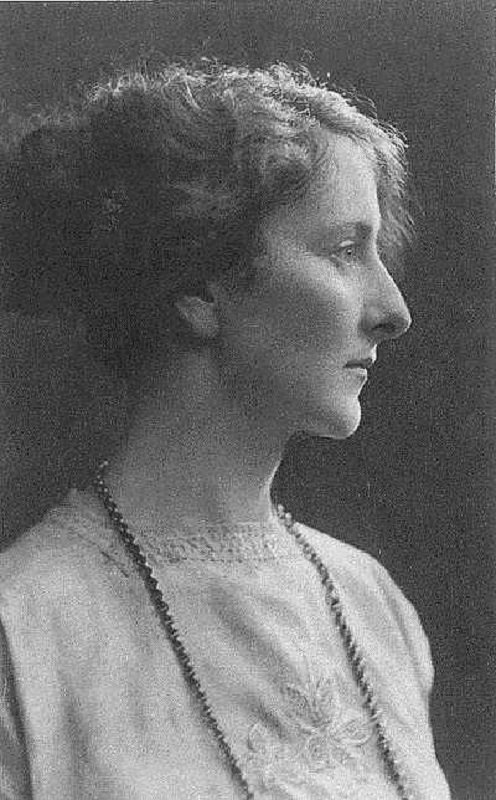
Today, 8th March is International Women’s Day, “For ALL women and girls: Rights. Equality. Empowerment.”

Born in Holm, Orkney, on 26 March 1885, Florence Marian McNeill, campaigned for women’s rights and was politically active all her life.
Her father the Rev Daniel McNeill and his wife Jessie produced 12 extraordinary children with ‘more than a dash of the pagan’ beneath their Presbyterian veneer. The McNeill’s believed that their daughters should be educated to the same high standard as their sons.
Florence is probably the most well known of the McNeills. She was a leading suffragist in her role as organiser of the Scottish Federation of Women’s Suffrage Societies.
Central to the suffragist movement were issues of social reform and equality which led Florence in 1915 to be the organising secretary of the Association for Moral and Social Hygiene, a gender equality pressure group.
She conducted social research in London and in 1916 jointly published with F.J. Wakefield “An Inquiry in Ten Towns in England and Wales into the Protection of Minor Girls “ .
After the war and travels to Greece and Palestine she joined the Women’s International League for Peace and Freedom taking part in the Peacemakers Pilgrimage – ‘Law not War’.

Despite this activism Florence is most remembered now for her writings on Scottish folklore, tradition , cookery and the founding of the Clan MacNeill Association.
What receives less attention is that Florence and her brother Duncan were founding members of today’s Scottish National Party in 1934 and Florence was its first Vice President that same year.
In 1962 she was awarded an MBE for services to Scottish culture. She died in Edinburgh on 22 February 1973.
You may also like:
Fiona Grahame



Leave a Reply