
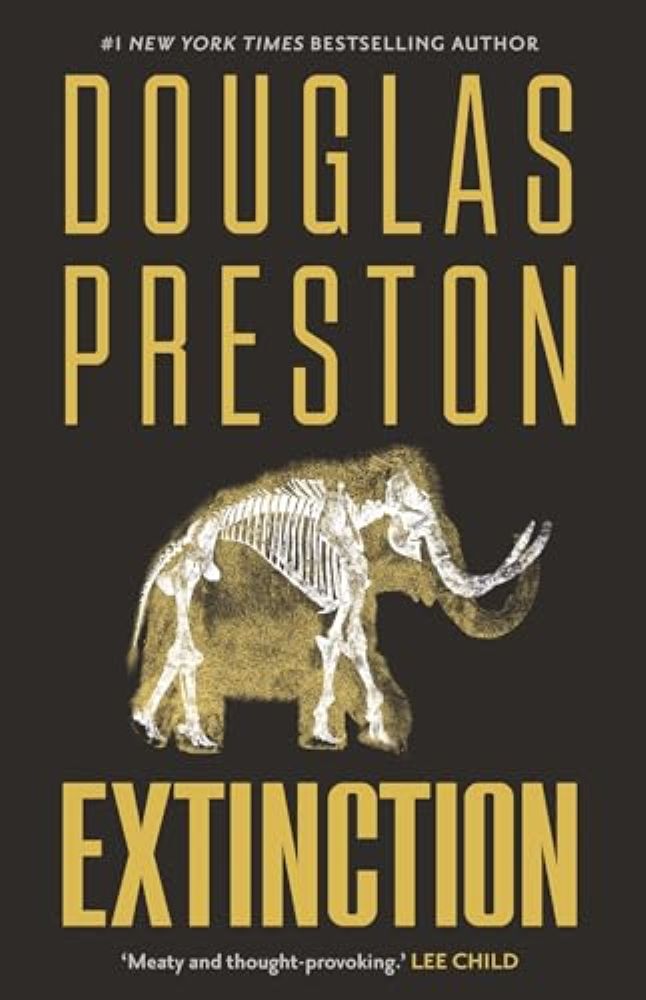

Douglas Preston, “Extinction”, hbk, 384 pp., £20, Head of Zeus, 2024.
First published in ParSec #11, June 2024.
There are few writers who can get me so absorbed that I miss my stop on a train: the late Bob Shaw did it to me (twice!). The opening chapters of Extinction made me 20 minutes late for an appointment, so it’s definitely a page-turner. The setting is fascinating: an isolated mountain valley, almost unreachable, where animals from the Pleistocene have been recreated in a playground for billionaires and their offspring, two of whom have suddenly been abducted and murdered.
One mark of success in thrillers is when the author can rush the reader past holes in the plot or inconsistencies without noticing them. Here, my first warning sign came when the organisers of the resort started knocking Jurassic Park. Nothing like that can happen here, they say, because there are no predators, and accepting that large herbivores are the most dangerous killers when roused, these recreated mammoths etc have had all aggressive tendencies removed by genetic engineering – nursing mammoths can be panicked into leaving their young by a few shouts and burning branches. Can ‘fight or flight’ be separated so effectively? I could imagine it being done for one animal, but for herds as described here? You’d have to eliminate not just individual aggression but a lot of the genes for herd behaviour, so would herds still form? And most importantly – wouldn’t a resort with predators and mothers who protect their young be more interesting, for the same reasons that safari parks (and real safaris) are preferred to zoos? It’s advance warning that this isn’t going to be about the animals, and it’s not a recipe for making money.
Then the billionaire father of one of the missing turns up. Almost his first words on arrival are, “I’ve been lied to,” but nobody asks about what. He and the resort’s owner claim not to have met in ten years (the police check that out), yet almost his first words to him are, “You know what I’m talking about! You said it was safe!” And to the police: “Ask him what he’s doing up here!” Clearly they both know what’s really happening and what’s gone sideways. But the police don’t react – not even the maverick detective whose job is on the line because she doesn’t respect billionaires, who simply flags it as something to look into later.
The newcomer brings a new experimental drone, to hunt for the abductors, and when it finds them, the ‘drunken, distraught’ father seizes the controls and crashes it, so giving them the technology they need for the next stage of their plan. I wondered how they knew he would do that, before realising that they know how to use the new technology, and it must have been prearranged. The police miss that too, just locking him away to calm down and sober up, only to let him out instead of putting him under pressure.
The final chapters are a bloodbath which goes on for a long time, and I’ll highlight just three of the cracks in it that I noticed. I thought I’d spotted one when an Air National Guard helicopter, brought down by ground fire, crashes and troops spill out of it, running. But that one was just careless writing: it wouldn’t be possible if the Black Hawk came down on its side, but when it comes down ‘sideways’ that’s not what is meant.
The crash is witnessed by the Director of the Colorado Bureau of Investigation, who took over the case but was preoccupied with his media image, wanting only to keep the billionaires and the state Governor happy. Just like in Jaws, the Governor’s priority is to keep the resort open, even with crazed killers roaming around, if you can believe it. Assuming the Director came up through the ranks, and isn’t just a political appointee, somewhere in his career he must have had training in the use of his weapon when attacked, ‘the old one-two’ or ‘knock-knock’ (as the Special Operations Executive called it) – body shot and head shot, a dinned-in reflex. Yet when charged by an assailant, he misses three times because in his panic he forgets to aim. As they say round here, ‘Aye, that’ll be right’.
And finally… a cliché I’ve hated since childhood is where the haunted house or whatever turns out to be a film set, or the variant ‘and it wasn’t a film after all’. This highly protected valley has an old mining town which has been renovated as a film set for cowboy movies. Just think how many credits there are at the end of an average action film, and what that would do to resort security – and the company currently occupying it is a cowboy outfit if ever there was. Their set-piece is going to be the destruction of a replica train using real dynamite, enough to blow up the whole resort complex, which doesn’t need security because the resort’s is so good. The one person watching it, on TV, walks off before his replacement arrives. And if you can’t guess what happens to it next, you’ll probably enjoy the closing chapters of Extinction a lot more than I did.



Leave a Reply