
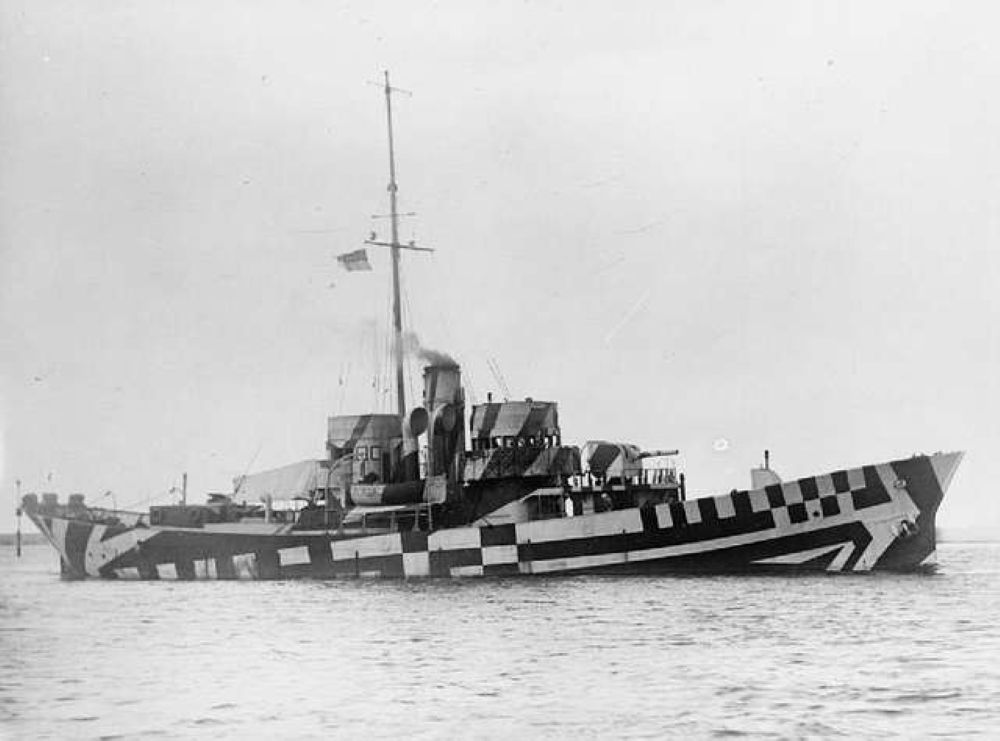
During World War I, navies experimented with painting ships with ‘dazzle’ camouflage – geometric shapes and stripes – in an attempt to confuse U-boat captains as to the speed and direction of travel of the ships and make them harder to attack.

Dazzle was a type of camouflage developed by the artist Norman Wilkinson in 1917, in response to the heavy losses sustained by British merchant ships to German U-boat submarines. This involved painting the sides and upper works of a ship in contrasting colours and shapes arranged in irregular zebra-like, angular patterns to create a distorted effect. This was designed to deceive enemy shipping about the size, outline, course and speed of a ship, since the consequent distortion made it impossible to assess speed and distance and therefore made attack problematic. – Royal Museums Greenwich
Despite widespread use of dazzle camouflage, it was not until 1919 that a proper, quantitative study was carried out, by MIT naval architecture and marine engineering student Leo Blodgett for his degree thesis. He painted model ships in dazzle patterns and placed them in a mechanical test theatre with a periscope, like those used by U-boat captains, to measure how much onlookers’ estimations of the ships’ direction of travel deviated from their actual direction of travel.
A new analysis of 105-year-old data on the effectiveness of ‘dazzle’ camouflage on battleships in World War I by Aston University researchers Professor Tim Meese and Dr Samantha Strong has found that while dazzle had some effect, the ‘horizon effect’ had far more influence when it came to confusing the enemy.
The separate ‘horizon effect’ is when a person looks at a ship in the distance, and it appears to be travelling along the horizon, regardless of its actual direction of travel. Ships travelling at an angle of up to 25° relative to the horizon appear to be travelling directly along it. Even with those at a greater angle to the horizon, onlookers significantly underestimate the angle.
Professor Meese and Dr Strong realised that while the data collected by Blodgett was useful, his methods of experimental design fell short of modern standards. He’d found that dazzle camouflage worked, but the Aston University team suspected that dazzle alone was not responsible for the results seen, cleaned the data and designed new analysis to better understand what it really shows.
Dr Strong, a senior lecturer at Aston University’s School of Optometry, said:
“It’s necessary to have a control condition to draw firm conclusions, and Blodgett’s report of his own control was too vague to be useful. We ran our own version of the experiment using photographs from his thesis and compared the results across the original dazzle camouflage versions and versions with the camouflage edited out.
“Our experiment worked well. Both types of ships produced the horizon effect, but the dazzle imposed an additional twist.”
If the errors made by the onlookers in the perceived direction of travel of the ship were entirely due to the ‘twist’ on perspective caused by dazzle paintwork, the bow, or front, of the ship, would always be seen to twist away from its true direction. However, Professor Meese and Dr Strong instead showed that when the true direction was pointing away from the observer, the bow was often perceived to twist towards the observer instead. Their detailed analysis showed a small effect of twist from the dazzle camouflage but a much larger one from the horizon effect. Sometimes these effects were in competition, sometimes in harmony.

Professor Meese, a professor of vision science at the School of Optometry, said:
“We knew already about the twist and horizon effects from contemporary computer-based work with colleagues at Abertay University. The remarkable finding here is that these same two effects, in similar proportions, are clearly evident in participants familiar with the art of camouflage deception, including a lieutenant in a European navy.
“This adds considerable credibility to our earlier conclusions by showing that the horizon effect – which has nothing to do with dazzle – was not overcome by those best placed to know better.
“This is a clear case where visual perception is more powerful than knowledge. In fact, back in the dazzle days, the horizon effect was not identified at all, and Blodgett’s measurements of perceptual bias were attributed entirely to the camouflage, deceiving the deceivers.”
Professor Meese and Dr Strong say that more work is required to fully understand how dazzle might have increased perceptual uncertainty of direction and speed but also the geometry behind torpedo-aiming tactics that might have supported some countermeasures.
Click on this link to access, Blodgett’s (1919) “Ship camouflage” 105 years on: A misperception of dazzle perception revealed and redressed, published in i-Perception



Leave a Reply