
In 1925 the residents of Burray sent a petition to The First Lord of The Admiralty.
To protect Royal Navy vessels in Scapa Flow, blockships were put in place during World War 1, later during World War 2 more blockships were sunk, and eventually the Churchill Barriers were built.

This episode takes place between the two world wars when folk in the island of Burray were trying to resume their fishing trade.
As reported in The Orkney Herald 8 April 1925:
WATER SOUND BLOCKSHIPS
PROTEST BY BURRAY FISHERMEN
The inhabitants of Burray have prepared a petition for submission to the First Lord of the Admiralty in regard to the removal of three sunken ships in Water Sound, and thus facilitate the re-opening of the fishing station at Burray.
At a recent meeting of the inhabitants addressed by Mr Fred Robinson, Schoolhouse, it was agreed to ask Sir Robert Hamilton MP, to convey the petition to The Admiralty.
The Petition, which bears 312 signatures is in the following terms:
To the Right Honourable W. C. Bridgeman MP, H.M. First Lord of The Admiralty: the Petition of the inhabitants of the Island of Burray, Orkney, humbly sheweth:
- The population of the island is 590
- Before the war we had the oldest and second largest fishing station in Orkney, which was a source of industry and trade to the inhabitants here and also in neighbouring districts.
- Owing to three sunken ships in Water Sound, this is now the only fishing station in Orkney which cannot resume work.
- Water Sound is an entrance to Scapa Flow, and in order to protect it during the war, three vessels the S.S. Lorne, Clio, and Pontus, were sunk in it and remain here at the present day.
- In Holm Sound, another entrance to Scapa Flow, the Admiralty have moved the steamers (Aorangi and Numidian), and the small fishing station there has resumed work, but nothing has been done or even attempted, here in Water Sound.
- Captain Berrie who was sent by the Admiralty last year to investigate, said there was not a safe passage for sailing vessels through Water Sound, and he saw that all the fishing vessels here are sailing vessels.
- Your petitioners have obtained the opinion of one of the largest salvage companies in Scotland, viz, The Leith Salvage and Towage Co., Customs House Chambers, 2 Commercial Street, Leith, who assure us that the sunken ships can be removed by dispersal, and further, are willing to undertake the task on a ‘time and lime basis’, or a lump sum price.
- The County Council at their last meeting were also of the opinion that the ships can be removed.
- Mr Ammon, late Secretary to the Admiralty, promised in the House of Commons in May of last year to spend £30,000 or more on sunken ships in Orkney, if anything could be done.
- Seeing that competent authorities state that the three sunken ships in Water Sound can be removed, and as nothing has been done or even attempted there, your petitioners earnestly ask for the fulfilment of the Admiralty’s promise, and the removal of at least one of the sunken ships, viz. s.s. Lorne so that the fishing station here may re-open and our industry and trade thus restored.
And your petitioners will ever pray.
The Lorne (ND 49 NE 8008), was a 1,186 ton single-screw steamer, built in Hull in 1873 and sunk in 1915.
The MP Sir Robert Hamilton presented the petition to the Admiralty and met with the First Lord about the issue. The Admiralty informally gave him to understand that although they could not commit to the cost that they would ‘deal generously in meeting the expenses of a successful operation.’ It was proposed by the First Lord of the Admiralty that the Orkney County Council should take over the ownerships of the vessels, in particular, s.s. Lorne, and employ a salvage company to remove it.
The Admiralty letter suggested that any deal with a salvage company should be done on a ‘No cure no pay’ arrangement. This means any risks would be entirely borne by the salvage company.
In the following year, 1926, the East Coast Salvage Company, won the contract to remove s.s.Lorne to an area where it would no longer cause an obstruction. The East Coast Salvage Company had wanted to remove all three vessels and when this was not permitted they said that the deal was no longer financially viable for them.
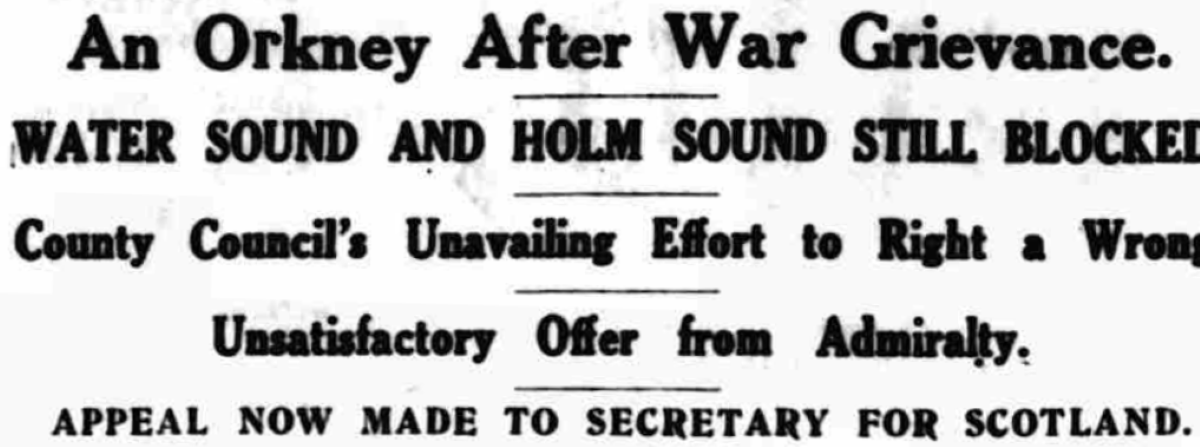
Two years on and in The Orkney Herald edition of 9 November 1927, the paper ran the headline:
AN ORKNEY AFTER WAR GREIVANCE
WATER SOUND AND HOLM SOUND STILL BOCKED.

In 1930 the Treasury agreed to pay £6800 for the removal of the LORNE and another blockship, THAMES.
In July of 1931 the Thames and Lorne Syndicate, the salvage company which won the contract to salve both the vessels had to abandon their first attempts to do so. The contractors reported to the County Council that the vessels were now so rusty that they could not be raised.
The salvage consortium did manage to recoup some of what they had spent with an auction of timber retrieved from the wreck.

On 24 July 1931. “The LORNE is to be dispersed by explosives. A temporary notice to Mariner’s has been issued”. (Canmore). The explosives were used but sections still exist.
Fiona Grahame


Leave a Reply