
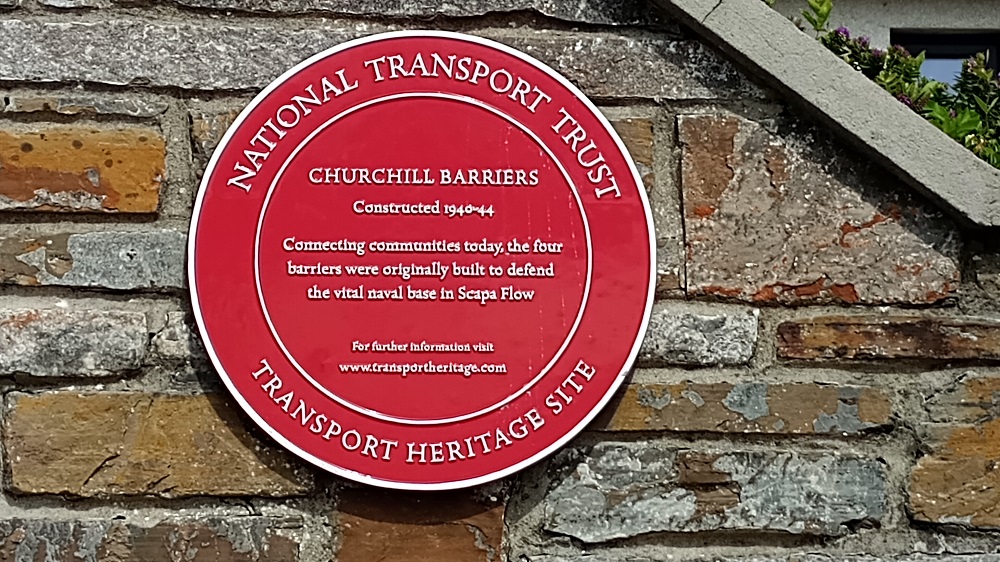
A road was opened to the public on this day, May12 1945, across the barriers linking South Ronaldsay, Burray, Lamb Holm and Glimps Holm, with Mainland, Orkney.
Constructed between May 1940 and September 1944, the Churchill Barriers, as they came to be known, were originally built as defensive structures to protect the vessels in Scapa Flow after the tragic sinking of HMS Royal Oak on 14 October 1939.


A plaque at Celina Rupp’s shop and cafe marks the opening of the public road over the Barriers which changed the South Isles links with Mainland forever.

The public were soon taking the chance to use the road to get to cross the Barriers. In August of 1945 the residents of the Orkney County Home enjoyed a day out by bus where they travelled around Mainland, with teas and meals on the way.
The most pleasant part of the trip was the crossing of the barrier road to Lamb Holm, Glimps Holm, Burray and South Ronaldsay. Some of the patients had their own idea of the construction of the roadway. A few thought that the sounds had been bridged, but all agreed that it was marvellous to travel over a road where once ships had sailed – The Orkney Herald 7 August 1945.
The trip over the Barriers became popular on public holidays when bus companies ran special day trips from Mainland to South Ronaldsay. By late 1946 a survey by the Orkney County Surveyor found that the traffic using the roads was ‘considerable’ and that upgrading the road to an ‘A’ listed was ‘desirable and justified.’ The Barriers were still settling and although still owned by the Admiralty, Orkney County Council carried out repairs ‘from time to time to ensure public safety.’ – Orkney Herald 7 August 1946.

The impact was considerable, not only have the building of the Barriers changed the environment but at the time it was a serious blow to those who provided a ferry service.
The immediate post war meetings of Orkney County Council were filled with complaints about the withdrawal of the South Isles Steamer service and questions over who would maintain the roads across the Barriers. Islanders in Hoy were particularly concerned about the withdrawal of the sailings from Stromness and the South Isles provided by Bremner & Co.
The Bremner service worked on a Wednesday ‘This service the shipping company contends is uneconomic due to the operation of the naval free ferry. (Orkney Herald 23.12.1947). Councillors were urged to contact the Secretary of State for Scotland.
The councillors were also concerned about what should happen when the Barriers were closed. In the summer of 1948 they were scheduled to close for maintenance. Readers will not be surprised that the answer was to form a committee to consult with, Mr J.L. King the Admiralty Superintending Civil Engineer, and John Monroe the local Ministry of Transport representative.
The Admiralty had already decided to remove the blockships which had been put in place as part of the war time defences for Scapa Flow. Islanders were concerned that the barriers would suffer damage once the breakwater effect of the block ships was no longer there.
The closure of the Barriers by the Admiralty in 1948 was according to ‘The Sunday Post’ causing ‘1700 islanders heartache’ (Sunday Post, 08.02.1948). The reporter continued that the only means the islanders would have to transport livestock etc to Mainland was via the Saucy Nancy, ‘a converted lifeboat capable of only carrying 21 persons’.
The Admiralty said that repairs were necessary as Barrier 1 was ‘sliding’ and that this repair work would likely be needed annually.
“The islanders complain they are now totally cut off. Before the war the islanders could rely on a regular two vessel service, but this was withdrawn when the barrier was opened.” – Sunday Post 08.02.1948
In 1949 Barrier 2 between Lambs Holm and Glimps Holm was closed by the Admiralty for repair work. In August, to coincide with local holidays, however, pedestrians were permitted to cross – at their own risk. It was still closed to all motor traffic.
The Barriers had also become something of a visitor attraction with tourists and visits by officials stopping off to view them.

In October 2011, the Orkney Islands Council took control of the barriers from the Ministry of Defence. Since then, with increasingly erratic weather events and rising sea levels as a result of global climate change, the barriers have begun to deteriorate. Of the four barriers, only Barrier No. 2, from Lamb Holm to Glimps Holm, is at high risk for needing to be replaced, according to the Scottish Environment Protection Agency. Replacing even one of the causeways is extremely unpopular in Orkney due to their historical significance. The council was as of February 2021 exploring options that would preserve all of the causeways. – Wikipedia

Orkney Fossil and Heritage Centre has an excellent display where you can discover how the Barriers were built.
Click on this link to access The Churchill Barriers 75 Years, published 5 years ago by Orkney Archive.

And you may be interested in this book.
Fiona Grahame

Donate to The Orkney News
£1.00

Leave a Reply