
By Eamonn Keyes.
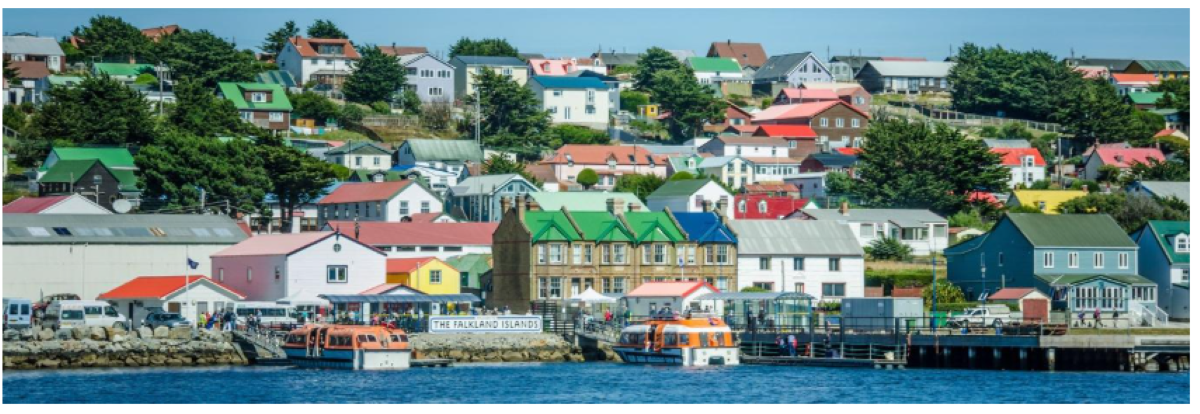
This is the second in a number or articles based around the Falkland Islands, as we highlight the home of athletes travelling over 8,200 miles to take part in the Orkney Island Games which will be taking place from July 12th to July 18th. This piece will look at the history of the Falkland Islands.
Prior to April 2nd 1982 it is probably fair to say that few people in the UK could find the Falkland Islands on a map. The surprise invasion by Argentine forces caught the attention of the world as they began an occupation that lasted until June 14th 1982 with the surrender of the Argentinian garrison commander in Stanley after a defeat by the British task force. However, the Falkland Islands have been around for quite some time, as the geology shows.

The islands themselves were created during the break-up of the supercontinent Gondwana during the Jurassic period between 160-125 million years ago. However the oldest rocks in the Falklands are gneiss and granite in the Cape Meredith complex that radiometric studies place at around 1.1 billion years old. These types of rocks are visible in cliffs at the south end of West Falkland and correspond to the crystalline rocks that made up the interior of the Gondwana supercontinent. This type of rock also has a great geological similarity to rocks currently found in South Africa and in Queen Maud Land in Antarctica.
The effects of ice age erosion that occurred in the Pleistocene Glaciation Period between 25,000 and 15,000 years ago are visible in the islands. The tops of the hills have been exposed to most of the effects of freezing and thawing. During the last glaciation, snow that accumulated year after year formed glaciers in some elevated leeward zones. These and previous glaciers modified the landscape on the eastern mountain slopes that were protected from the westerly winds. Also, the very strong winds that are characteristic of the region carry sand grains up to heights of a metre above ground level; the resulting sand-blasting causes rocks and pillar-shaped rock structures to show the most erosion in their lowest exposed levels, at one metre and below. This unique pattern of erosion is evident in the higher elevations of West Falkland where quartzites are exposed at the surface.
Several oil fields were formed around the Falklands during the break-up of Gondwana, and as a result oil exploration is currently focused on two areas of interest around the Falklands. They are The North Falklands Basin, 200 kilometres to the north of the islands, where it is estimated that there are 325 million barrels of recoverable oil at a depth of between 2000-3500 m below the sea floor. The South and East Falklands Basin covers a larger area than the North Falklands Basin. 320 kilometres from the islands — stretching in an arc from east of the islands to directly south of the islands. The sea floor is between 1000 and 1500 m deep — with the oil 2000-3500 m below the sea floor. There could be up to 5 billion barrels of oil or gas in the fields. This is potentially a significant future resource for the Islands.

The Falkland Islands derive their name from Falkland Sound, the name given to the waterway between East and West Falkland by Captain John Strong, who spent several days in the Islands on his ship Welfare in 1690. Falkland Sound was itself named after Viscount Falkland, one of the owners of Welfare.
Captain Strong was the first person to have been recorded as landing in the Islands, although the first reported sighting was by English navigator Captain John Davis in the Desire in 1592.
The Falkland Islands have never had any native inhabitants and no indigenous people have ever been displaced and during the 18th century claims on the Islands became very complicated. The French navigator Louis-Antoine de Bougainville founded the Islands’ first settlement, on East Falkland, in 1764. The British, in 1765, were the first to settle West Falkland at Port Egmont, but they were driven off in 1770 by the Spanish, who had bought out the French settlement about 1767. The British outpost on West Falkland was restored in 1771 after threat of war, but then the British withdrew from the island in 1774 for reasons of economy, without renouncing their claim to the Falklands. Spain maintained a settlement on East Falkland (which it called Soledad Island) until 1811. In 1831 the U.S. warship Lexington destroyed the settlement on East Falkland in reprisal for the arrest of three U.S. ships that had been hunting seals in the area.
On 6 October 1832, an Argentine military garrison arrived in an attempt to establish sovereignty over the Falkland Islands, disregarding the British claim of 67 years prior. Less than three months later, on 2 January 1833, the Royal Navy evicted the military base with no loss of life. In 1841 a British civilian lieutenant governor was appointed for the Falklands, a small, permanent British administration was established and in 1845 Stanley become the capital. By 1885 a British community of some 1,800 people on the islands was self-supporting. Argentina regularly protested Britain’s occupation of the islands.

In the First World War Battle of the Falkland Islands in December 1914, a Royal Navy fleet defeated an Imperial German squadron. In the Second World War, following the December 1939 Battle of the River Plate, the battle-damaged HMS Exeter steamed to the Falklands for repairs. In 1942, a battalion en route to India was redeployed to the Falklands as a garrison amid fears of a Japanese seizure of the archipelago.

After World War II the issue of sovereignty over the Falkland Islands shifted to the United Nations when, in 1964, the islands’ status was debated by the UN committee on decolonization. Argentina based its claim to the Falklands on Papal Bulls of 1493 modified by the Treaty of Tordesillas (1494), by which Spain and Portugal had divided the New World between themselves; on succession from Spain; on the islands’ proximity to South America; and on the need to end a colonial situation. Britain based its claim on its “open, continuous, effective possession, occupation, and administration” of the islands since 1833 and its determination to apply to the Falklanders the principle of self-determination as recognized in the United Nations Charter. Britain asserted that, far from ending a colonial situation, Argentine rule and control of the lives of the Falklanders against their wishes would in fact create one.
In 1965 the UN General Assembly approved a resolution inviting Britain and Argentina to hold discussions to find a peaceful solution to the dispute. These protracted discussions were still proceeding in February 1982, but when on April 2 1982 Argentina’s military government invaded the Falklands this started the Falkland Islands War, which ended 10 weeks later with the surrender of the Argentine forces at Stanley to British troops who had forcibly reoccupied the islands. Nearly 1,000 Falkland Islands, British and Argentine lives were lost as a result of the war.

Although Britain and Argentina reestablished full diplomatic relations in 1990 the issue of sovereignty remained a point of contention. Today Britain continues to maintain some 2,000 troops on the islands. The British Army maintains a garrison on the Falkland Islands based at Mount Pleasant, with a ground-based air defence of RAF Mount Pleasant in place. The RAF has two flights in place consisting of Typhoon fighters and Voyager aircraft for refuelling and transport. The Royal Navy has a constant on-station maritime presence to protect the UK’s interests in the region. In November 2020, it was announced that all remaining land mines had been cleared from the island.
In January 2009 a new constitution came into effect which provided enhanced local democracy, internal self-government and enshrined the right of self-determination. Four years later in March 2013 a referendum which was overseen by international observers was held, where 99.8% of the electorate voted for the Islands to remain a British Overseas Territory.
Today The Falkland Islands is a diverse society, with people from over 60 nations having made the Islands their home. At the heart are Falkland Islanders whose families have been in the Islands for nine generations, mostly descended from Scottish and Welsh immigrants who settled in the territory after 1833.


Donate to The Orkney News
£2.00



Leave a Reply