
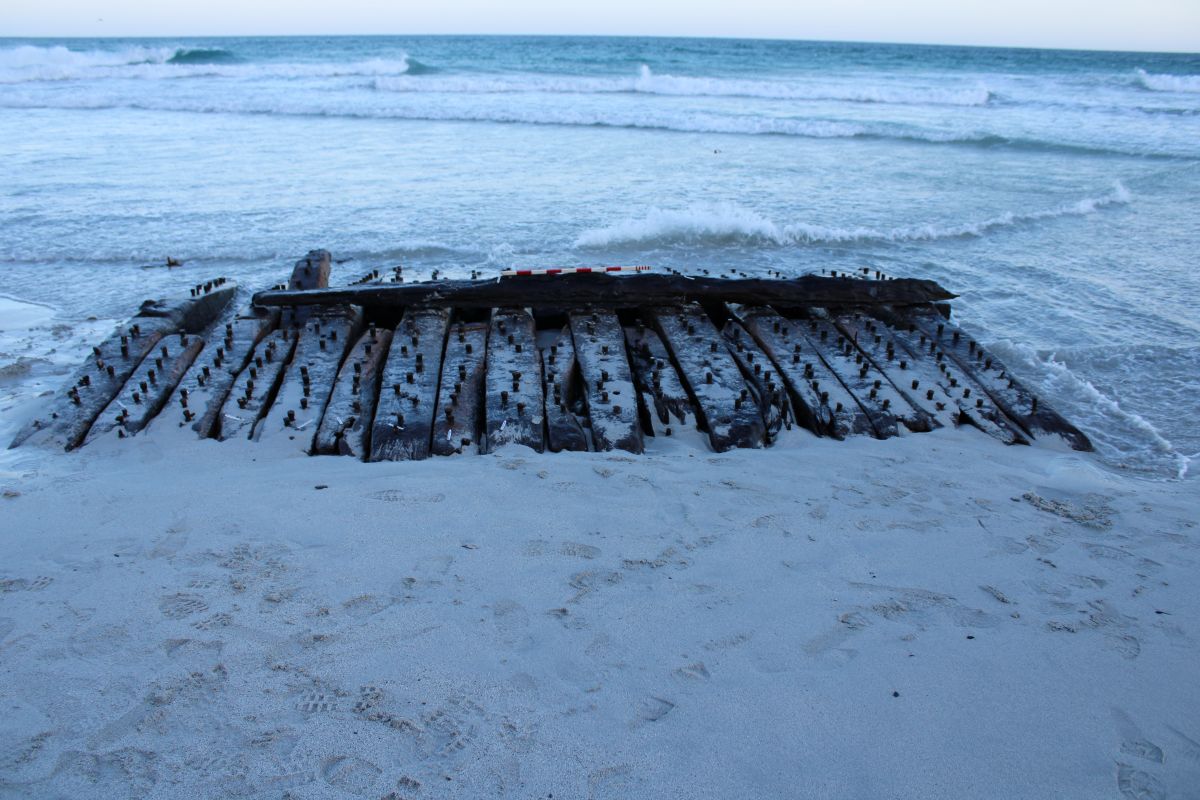
The wooden timbers of a large sailing vessel which were washed up from where they had lain for hundreds of years onto the shores of Sanday, Orkney, have now been tested.
Using dendrochronological assessment, analysis of the wood, archival research by a team of volunteers led by Ben Saunders of Wessex Archaeology, it is strongly believed that the wreck is of The Earl of Chatham.

Ben Saunders, Senior Marine Archaeologist at Wessex Archaeology, said:
“It is thanks to our dedicated team of community researchers and the evidence they have gathered that means we have been able to identify the Sanday Wreck with a reasonable degree of confidence.

“Throughout this project, we have learned so much about the wreck, but also about the community in Sanday in the 1780s.
“Sanday was infamous for shipwrecks at the time, called ‘the cradle of shipwrecks in Scotland’, but the community was equally well-known for its hospitability as it looked after sailors who fell afoul of the area’s stormy seas.
“We are grateful to the support from our partners, and we’re delighted to be able to share our work on this intriguing wreck.”

The Earl of Chatham, a former Royal Navy vessel called HMS Hind was renamed when it was repurposed as a whaling ship.
A sixth rate 24-gun frigate, HMS Hind saw many years of active service, including the sieges of Louisbourg and Quebec in the 1750s and the American Revolutionary War in the late 1770s.
Once it was decommissioned, it was sold and renamed the Earl of Chatham, becoming a mighty 500-ton whaling ship. This was common for Royal Navy ships as their excellent build quality allowed them to withstand the icy conditions of British whaling routes.
As the Earl of Chatham, it completed four seasons in the Arctic before ultimately meeting its end in the Bay of Lopness in March 1788. It carried 56 sailors on-board at the time, all of whom survived.

Clive Struver, Chair of the Sanday Development Trust said:
“The work to uncover the identity of the wreck has been hugely exciting.
“Now that we have this knowledge about the wreck and how it came to rest in Sanday, the next step is very much to explore what the community here would like to see happen in terms of where and how the story of the wreck and our island’s past as the ‘cradle of shipwrecks in Scotland’ can be captured for generations to come – including importantly how that could be achieved in the context of a small island and in a way that honours and reflects the unique character of Sanday.”
Some of the volunteers who took part in the research reflected on the part they played in the project.
- 00:00 – 01:25 Voice 1: Fiona Grahame, Community Researcher
- 01:25- 01:57 Voice 2: Sylvia Thorne, Community Researcher
- 01:57 – 02:12 Voice 3: Ruth Peace, Community Researcher
- 02:12 – 04:02 Voice 4: Raggie Ljosland, Community Researcher
- 04:02 – 04:56 Voice 5: Alan Braby, Archaeological Researcher
- 04:56 – 06:18 Voice 6: Chris Gee, Community Researcher
After the timbers were first discovered by the community of Sanday last year, Dendrochronicle conducted a dendrochronological assessment and analysis of the wood.

They were able to determine that the ship was built with wood from south and southwest England. Once the provenance of the timbers was established, archaeologists from Wessex Archaeology, local community researchers, and the Sanday Heritage Centre spent several months working with archives and community records to find the most likely candidate for the ship. This research was further supported by Sanday Heritage Group and Orkney Archaeology Society.
Alison Turnbull, Director of External Relations and Partnerships at HES, said:
“The discovery of the Sanday Wreck is a rare and fascinating story. Wessex Archaeology worked closely with the community of Sanday to discover the ship’s identity, which shows that communities hold the keys to their own heritage. It is our job to empower communities to make these discoveries and be able to tell the story of their historic environment.”
“We are proud to have grant-funded this work, which supports both Scotland’s Archaeology Strategy of making archaeology matter, and Scotland’s national strategy for the historic environment, Our Past, Our Future.”
The Sanday Wreck, now believed to be the Earl of Chatham, emerged from its resting place due to changes in the climate. Increased storminess and unusual wind patterns led to removal of the covering sands which had hidden and protected the wreck for centuries. Changes to coastlines, which are predicted to accelerate in coming decades, could make similar finds more common.

The timbers are currently housed in a freshwater tank at the Sanday Heritage Centre to conserve them, where visitors can find out more about the wreck’s story and Sanday’s history. The tank was funded by National Heritage Memorial Fund and provides a stable environment for the timbers, which if not submerged in water would begin to dry out and crumble after so long buried in the intertidal sands.
Nick Hewitt, Culture Team Manager for Orkney Islands Council, said:
“It has been a wonderful team effort so far between many and one we’re proud to have been a part of, and will continue to be as we support the Sanday community explore the future possibilities for their wreck.”

This video tells some of the story of the Sanday shipwreck, the efforts of the Sanday community to preserve her, and the work by Wessex Archaeology and the team of volunteers to identify the remains.
Fiona Grahame

Donate to The Orkney News
£2.00


Leave a Reply