
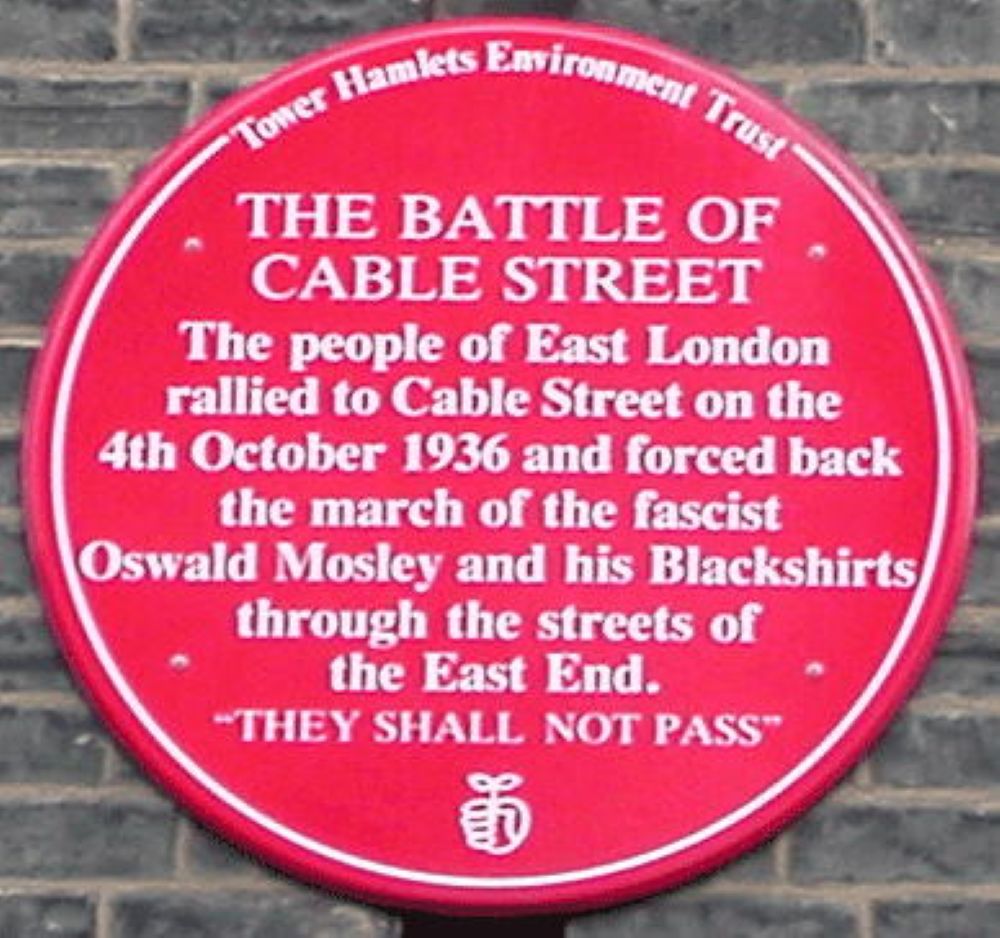
Outrageous is a British historical TV drama following the lives of the Mitford sisters in the 1930s. In episode 6 of Series 1 ‘Point of no return’, it covered in amongst the relationship highs and lows within the family, the violence on October 4 1936 in Cable Street, London.
Fascism was on the rise in Britain. Adolf Hitler was in power in Germany, Mussolini had been in power in Italy since 1922, and in Spain, Franco was leading an armed insurrection. All three of these men would impose Dictatorships upon their people, and the world was plunged into another bloody conflict.
In the Mitford family, Unity became obsessed with Adolf Hitler who had a penchant for young girls and with whom she had a very close relationship. Diana, had a long affair with leader of the British Fascists, Sir Oswald Mosley. They eventually married secretly in Germany in 1936 at the home of Joseph Goebbels and attended by Adolf Hitler.
Outrageous is more than the flimflam of a family of scandal ridden headlining women, it is introducing to a new set of viewers a pivotal time in the history of this country that many will be unaware of.
This year commemorations have been held on the ending of the war in Europe. Many of those have focussed on the victories of the Allies and for the USA in particular, the D Day landings. The sacrifices of that exceptional of all generations to fight the evils of Nazism and Fascism should never be forgotten. But what we also need to remember is that the ideologies of Hitler and Mussolini did not begin in 1939. Ordinary people in this country resisted them from the very beginning.

Cable Street, 4 October 1936, was one of those moments when people from all sorts of backgrounds came together in the East End of London to stop Mosley and his Fascists from parading through their streets. Those who opposed the Fascists included communists, socialists, Jews, and the people of the East End who were determined to block their street to the parade. 6,000 police officers, mounted and on foot, had been drafted in to protect the Fascists and allow their march to take place.
Half an hour before the march was due to start the police baton charged the people assembled in Royal Mint Street. Newspaper reports at the time state:
“The baton charge cleared the streets in two minutes, and a number of men were seen lying in the road.” – The Scotsman, 5 October 1936.
An hour after the march was due to start, Sir Oswald Moseley appeared. Sir Philp Game, Commissioner of Police, informed him that the meetings and parades were to be abandoned. 300,000 people had blocked the streets determined that the Fascist march of 3,000 would not pass.
“Sir Oswald motored down the procession which was nearly half a mile long, in an open car, being escorted by a posse of Blackshirts on motorcycles. Arms were raised in salute as he passed.” – The Scotsman.
Barricades were thrown up and large crowds formed in the surrounding streets.
“William Fishman recounted what happened: “An extraordinary scene took place. From out of the narrow courts, alleyways and main thoroughfares came the steady tramp of marching feet, growing in intensity as the columns were swelled by reinforcements. A forest of banners arose, borne aloft with the watchwords THEY SHALL NOT PASS emblazoned in a multitude of colours, with red predominating.” – The Battle of Cable Street
Many were dispersed by police baton charges. The Scotsman reported ‘lively scenes in Stepney’. 69 arrests were made on the day – the charges were principally of obstruction and assault. 15 people were taken to hospital and dozens of others were injured.
“A common cause of hatred of Fascism brought people together.” – The Battle of Cable Street.
The mass resistance of the people of the East End against the Fascists was a turning point. The Blackshirts and Mosley had been humiliated. In May 1940, after the outbreak of World War 2, Mosley was sent to prison and his British Union of Fascists (BUF) was made illegal. Diana was sent to Holloway Prison. In 1943 they were released but placed under house arrest until the end of the war.
It is possible that there will be a second series for Outrageous as series 1 left us with much of the events above still to tell. Written by Sarah Williams, the series introduces an audience that was not alive during the events leading up to World War 2, to the rise in Fascism that attempted to take hold of this country, but which was stopped through the resistance of the people who took to the streets in protest.
‘If you are neutral in situations of injustice, you have chosen the side of the oppressor’ – Desmond Tutu
Fiona Grahame

Donate to The Orkney News
£2.00


Leave a Reply to berniebell1955Cancel reply