
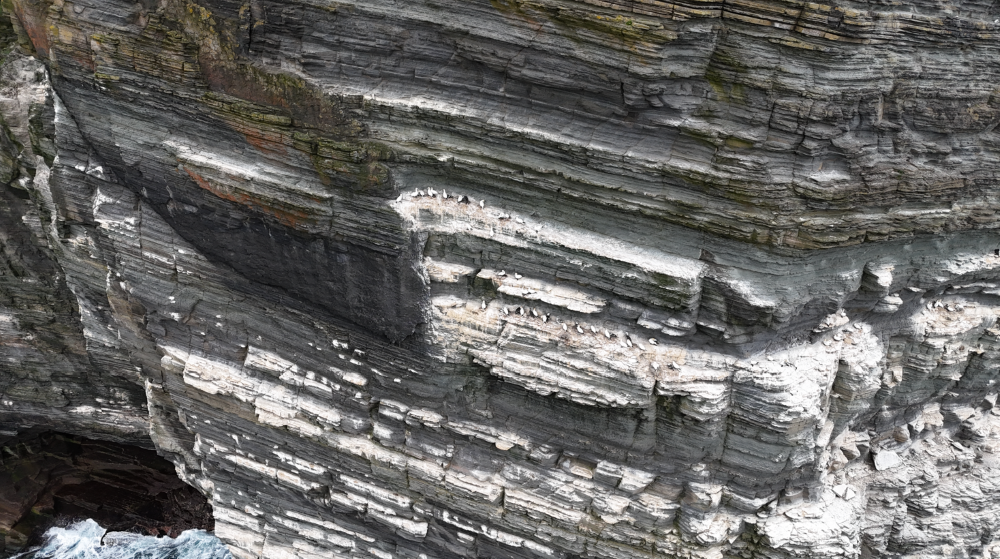
SEVEN years ago, a trip to Marwick Head’s seabird colony would have revealed a host of different cliff-nesting birds but not a single Gannet.
However, this year at least 26 Gannet chicks have fledged at the colony. So, what happened?
These big seabirds, whose closest relatives are the Boobies, used to be seen in large numbers around our coasts. I remember seeing them while onboard the MV Hamnavoe on my first trip to Orkney in 2019.


Like many seabirds, they were hit particularly hard hit by Highly Pathological Avian Influenza (HPAI) in 2022. Populations were decimated with 11,000 deaths recorded in Gannets in Scotland alone. Those Gannets who survived the disease were permanently marked for life with their normally pale blue eyes turning black.
Seabirds have also struggled due to a decline in availability of their food over recent years. The Marwick Head colony lost a huge percent of its Kittiwakes recently – our only species of Gull that nests on cliffs
Gannets have nested on various cliffs around Orkney for years, so it was a bit strange that they had never been recorded nesting at Marwick Head.

Then, in 2019, bird lovers were pleasantly surprised to see that one single pair had decided to try out the site. We don’t know whether they successfully reared chicks, but we know that they liked their new spot enough to come back the next year.
The colony has been growing ever since. The last official survey was done in 2023, during which 29 nests were found, though we’re not sure how many chicks they fledged.
This year, there were 40 apparently occupied nests (AONs) at the start of the nesting season in June. This month, during a visit to the colony with our new drone (keeping a safe distance!), we found that there were 26 nearly-fledged young Gannets at the site. The young birds can be identified by their black backs.
Most seabirds have headed back out to sea for the winter by now, but if you visit Marwick Head next year, the main viewing place for the colony is along a fence 250 metres south of the Kitchener Memorial. From that vantage point, you can look back up the coast to see huge numbers of Guillemots, Razorbills, Fulmars, Kittiwakes, and many other birds.

But Gannets don’t like the sheltered area you can see from that point. They prefer the updrafts of a more exposed cliff. So, to see them, head north from the Kitchener Memorial, find a safe place to sit (it’s safer than standing since you can’t accidentally walk towards the cliff in your awe at seeing the Gannets) and look back down the coast towards Hoy.
If you’ve got good eyesight or a pair of binoculars, you’ll spot the edge of the Gannet colony at the headland just underneath and out from the normal viewing area, 1/3 of the way down the cliff.
Hopefully this colony continues to thrive, as Marwick Head has the potential to be a really strong breeding colony for these incredible birds.
By Parker Hansen, Ross Hunter and Helen Cromarty.
Additional sources included by Alan Leitch, sites manager for RSPB Orkney, Northern Gannet Overview, All About Birds, Cornell Lab of Ornithology,and Avian Influenza: a major threat to our struggling seabirds.



Leave a Reply