
By Ian Cooper from his excellent series, ‘Records of a Bygone Age’, first published in The Stronsay Limpet, and republished here with their kind permission.
Stronsay’s oldest resident, Mrs Brenda Maxwell from Hillcrest, passed away a few months ago at the grand old age of 96. While clearing out Brenda’s house her daughter Elizabeth Ritchie found a few items, photos and documents which she thought would be of interest for the Heritage Centre and was kind enough to gift these to the Centre.
Among these documents was a light-hearted hand written poem by Margaret ‘Bunty’ Stevenson (later Miller) from the Bu, signed and dated 1943, at which time Bunty would have been a young 15-yearold lass. Here is the poem:
The Coat of Arms
Within the lounge of Trolley-Dale, among its many charms,
There hangs above the mantelpiece Harriet’s Coat of Arms.
Now I’ll proceed to tell you how it came to grace that place
And gaze with long and haughty stare on each admiring face.
It fell upon a certain day when Harriet went to dote
Upon her favourite egg-layer, a braw white Wyandotte.
The Wyandotte, I needs must say, lived by the rocky shore
And ‘mid the tangles and the ware found ‘Jumping Jecks’ galore.
As was her wont our Harriet’s eyes swept downward toward the sea.
There strutting to and fro the sand were scorries one, two, three.
Still onward swept the gimlet gaze and came to rest upon
Something lying on the sand so golden in the sun.
With shining eyes and twinkling feet, the Wyandotte forgot,
Harriet clattered down the beach and rushed towards the spot.
Nearer and still nearer till at her very feet
The coat of arms smiled proudly up with paint so bright and neat.
With a screech that made the rabbits cringe and shiver with surprise
She clasped it to her bosom with rapture in her eyes.
And then as if the forest fiend were roaring in her track
She tore along the sandy grass to Trolley-Dale right back.
She burst into the parlour but Mother wisno’ there;
She found her in the garden and did the old dear stare!
“My, Harro! Where’d you find it?” She exclaimed with popping eyes.
“Upon the sands of Cleva, can thoo believe thee eyes!”
“Oh Harriet, come and wash it and we’ll hing it in the lounge;
My, is it no right bonny? Fairly maks me hert tae bounce.”
Harriet washed and polished it and hung it in its place
And long she gazed upon her prize with rapture in her face.
That then is the story of Harriet’s Coat of Arms
And if you ever see it don’t forget to praise its charms.
M Stevenson
Bu 1943
The person referred to in the poem could only be Mrs Harriet Hourston, a friend and neighbour of Bunty’s, with the name Trolley-Dale seemingly a substitute for Harriet’s home of Mount Pleasant. I was fascinated by this poem, the strange story it told and just what might lie behind that story.
Harriet and her husband, both now long gone, had left the island in 1966, with Bunty’s parents Robert and Ruby Stevenson from the Bu buying the house of Mount Pleasant as a retirement home. They too had passed away some time ago but their daughters Liz and Jean Stevenson, still live there. One Sunday a week or two after being given the poem Arna and I went on a social visit to Mount Pleasant, but with me armed with a copy of this poem to show Liz and Jean and very much hoping that they might be able to shed some light on this mysterious Coat of Arms, the subject of the poem.
We were hardly in through the door when Liz turned to Jean and said “Jean, there was something you were going to ask Ian about” to which I laughed, replying “and there was something I was going to ask you about too!” After some discussion about who was going first, Jean explained to us that there was an old wooden Coat of Arms that had been lying in a shed at Mount Pleasant gathering dust for years and they had wondered if this would be of any interest to the Heritage Centre. This was one of those surreal moments when I doubted I had actually correctly heard what had just been said, with thoughts flying through my mind: ‘What if?’ ‘No, it couldn’t possibly be…’ ‘Could it really be?’
Now it was my turn, showing them the poem and explaining how it had made its reappearance after so many years. Jean slipped quietly out through the door, soon to return with a rather dusty but truly magnificent wooden plaque or Coat of Arms, no doubt the very one that had inspired Bunty to put pen to paper. Writing this a few weeks later I still have difficulty taking in the coincidence that led to the Coat of Arms and the poem composed about it being reunited in such a fashion one bonny Sunday afternoon 82 years after the event. Coincidence or fate? I leave you to judge.
The Stevenson sisters remembered clearly the Coat of Arms hanging proudly above the fireplace in the lounge at Mount Pleasant, just where Mrs Hourston had hung it after finding it on the beach back in 1943. It was still hanging there when they bought the house in 1966 but the family soon decided the plaque just wasn’t for them, removing it and consigning it to a shed where it sat quietly gathering dust for the next 60 or so years.
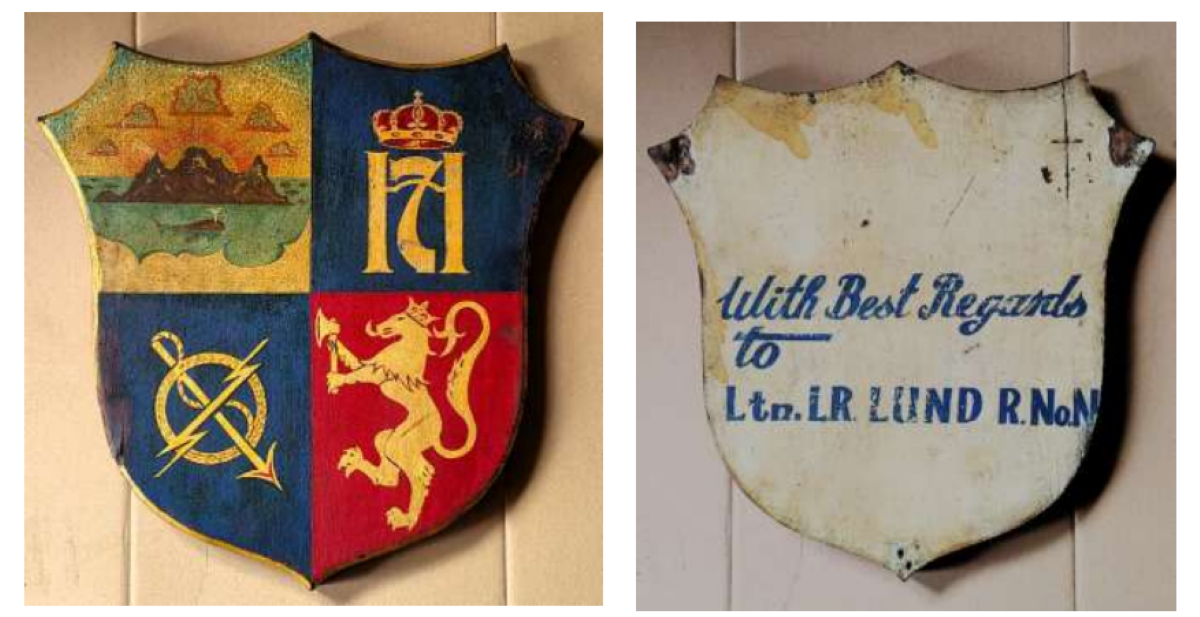
I took the plaque home with me and measured it to be about 500mm left to right, the same top to bottom, about 40mm thick and made of quite a dark coloured wood. Careful wiping with some liquid soap and warm water soon removed 60 years of dust and grime, to reveal a beautifully painted surface, with colours still surprisingly bold and bright. Turning it over, the back showed details of the person this had been presented to all those years ago.
You’ve seen and read the poem and heard a little of the story behind it so hopefully that has piqued your interest and, if you’re curious to see the Coat of Arms for yourself, I’ve included photos of both its face and back below.

A quick visit to Google was enough to find out that Lieutenant Leif Lund had been a ship’s captain in the Royal Norwegian Navy during World War II but little more could be found there. I then contacted Leslie Burgher, the Royal Norwegian Consul for Orkney, hoping he might be able to point me in the direction of where more information could be found, and he was keen to help, passing on my query to some of his contacts in Norway.
Comprehensive information on Lieutenant Lund’s life and career came back very quickly from a Norwegian lady, Synnøve Marie Strømsvåg, who had gathered the relevant information from her own contacts in the Norwegian Navy and forwarded a very comprehensive biography of Leif Lund.

This biography stated that Lieutenant (later Commander) Leif Henrik Rosenvold Lund was born in Norway in 1911 and had a long and distinguished career with the Royal Norwegian Navy. One of the ships he commanded during World War II was the 53m (175 ft) escort ship and Submarine Chaser King Haakon VII and it must surely be this ship to which the plaque refers. He took command of the newly built King Haakon VII in July 1942, serving aboard it on Atlantic convoy duties until being transferred to take charge of the corvette HNoMS (His Norwegian Majesty’s Ship) Rose in May 1943. Originally stationed at Halifax in Canada, Lieutenant Lund and the King Haakon VII were stationed at the submarine base at Rothesay on the island of Bute from January until the end of March 1943, before returning to Canada to be based at St John’s in Newfoundland. There can be little doubt that it was during this time when the ship was based at Rothesay that the plaque found its way into the sea, and it must have been sailing quite close to Stronsay at that time. It seems reasonable to assume that this plaque may have been a memento presented to (or due to be presented to) Lieutenant Lund around the time he finished his tour of duty on the King Haakon before transferring to take command of the Rose.
In addition to Lieutenant Lund’s biography, Ms Strømsvåg also gave her thoughts on what the four quarters on the face of the plaque signified. The top left section of the plaque features an island silhouetted against a rising (or setting?) sun with a whale in the foreground, the significance of which she didn’t know at the time, but the other sections were apparently well understood: the top right displays ‘H7’, representing King Haakon VII of Norway, which was also the name of Lieutenant Lund’s ship; bottom right bears the lion rampant, the official Norwegian coat of arms, while the symbol bottom left depicts a harpoon crossed with a lightning bolt, representing Asdic (sonar), the technology used at that time to detect submerged submarines.
The reverse of the plaque, as noted earlier, would appear to indicate this would have been a personal gift to Lieutenant Lund, relating to his time commanding the King Haakon VII. Although there is no record of when Harriet found the plaque ‘lying on the sand so golden in the sun’, given the date of the poem and the date the King Haakon VII was in Scottish waters this must have been in the early months of 1943.
My original thoughts on seeing the plaque were that this, sadly, could well have been washed ashore from a ship lost at sea but, on considering the information that has come to light, this now seems highly unlikely. Given the condition that the Coat of Arms is still in it could only have been in the sea a few days at most, possibly only a matter of hours, but how it came to be in the sea in the first place must remain a mystery. The Coat of Arms and information about it is now on display in the Stronsay Heritage Centre and I believe we’re very fortunate to be able to see, wonder at and enjoy such an unusual object, given up by the sea and now reunited with the poem and what is known of its history. I’ll leave the last word to Bunty Stevenson and the closing lines of her poem from 1943.
‘That then is the story of Harriet’s Coat of Arms,
And if you ever see it don’t forget to praise its charms’.




Leave a Reply