
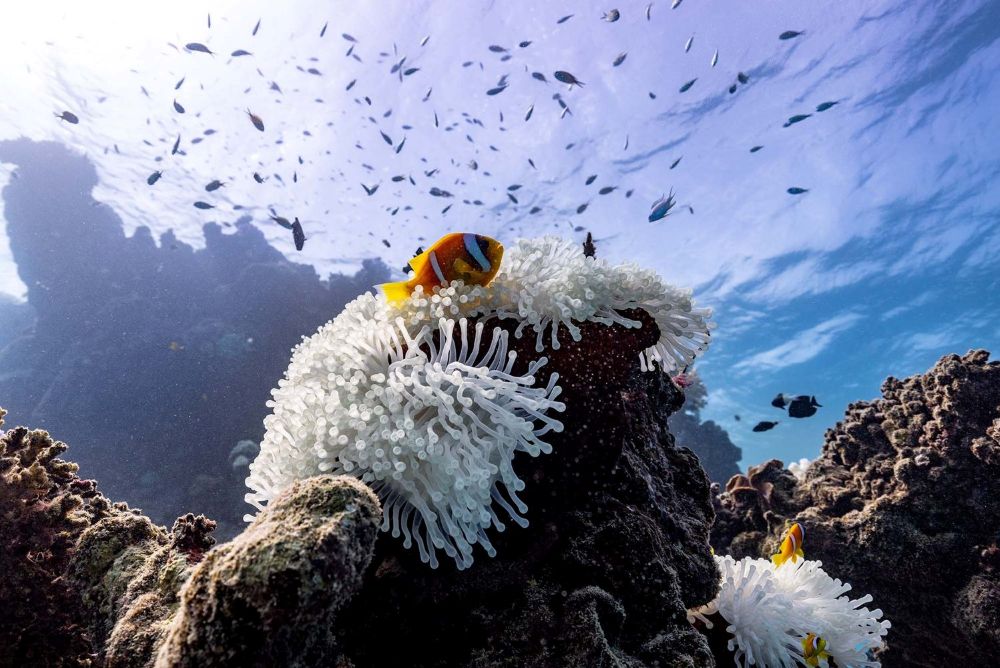
In the past three years, marine heat waves have made the Red Sea hotter. Rising ocean temperatures, there and around the world, have been devastating for many sea creatures, including an iconic ocean duo: clownfish and anemones.
Marine life in The Red Sea are accustomed to temperatures of over 30C but a new paper from a Boston University–led research team has found that this new extreme heat has caused a breakdown in the mutualistic relationship of clownfish—also called anemonefish— and anemones and has resulted in a population collapse in the central Red Sea.
This pair forms one of the most widely recognized mutually beneficial relationships in the ocean—as captured in the animation Finding Nemo. They’re adapted to work as a team to get nutrients and for protection.

Anemones also have a symbiotic relationship of their own—with a microscopic algae called zooxanthellae, the same algae that pairs with coral. Just like corals, anemones expel the algae from their tissue during periods of unusually high heat, causing them to bleach.

The researchers found that prolonged bleaching can not only lead to the death of the anemone and the anemonefish, but collapses the entire mutualistic system.
To a clownfish, anemone bleaching is a catastrophe—their once safe home turns white, exposing them to dangers lurking in the surrounding reef. Under normal conditions, clownfish are camouflaged and protected underneath the swaying, stinging tentacles of an anemone, which are related to jellyfish. The clownfish secrete a mucus that shields them and their eggs from getting stung, so when they attract a predator fish to the anemone, it gets zapped and eaten.
Human-caused climate change has heated the ocean to new extremes, and has started to unravel the mutualistic relationships that sustain underwater environments, like those between algae and corals, algae and anemones, and anemones and clownfish.
Even if wild anemones recover from the bleaching, once the anemonefish are gone, they become much more vulnerable to their own predators, like butterflyfish, who feed on anemones.
Losing these important species has cascading effects on the reef.
Peter Buston, a Boston University College of Arts & Sciences associate professor of biology explained:
“We’re seeing nearly a 100 percent die-off in a population of fish in response to a heating event. This should be a big warning for ourselves as well.
“I’ve studied anemonefishes for a long time, and unavoidably, I and all my students now study them in the context of climate change.
“You get enough of these local extinction events, and it ultimately leads to complete extinction.”
Click on this link to access, Near complete local extinction of iconic anemonefish and their anemone hosts following a heat stress event, published in npj Biodiversity


Leave a Reply to Inspiring “Oceans – Wellbeing – Youth” Project – The Orkney NewsCancel reply