
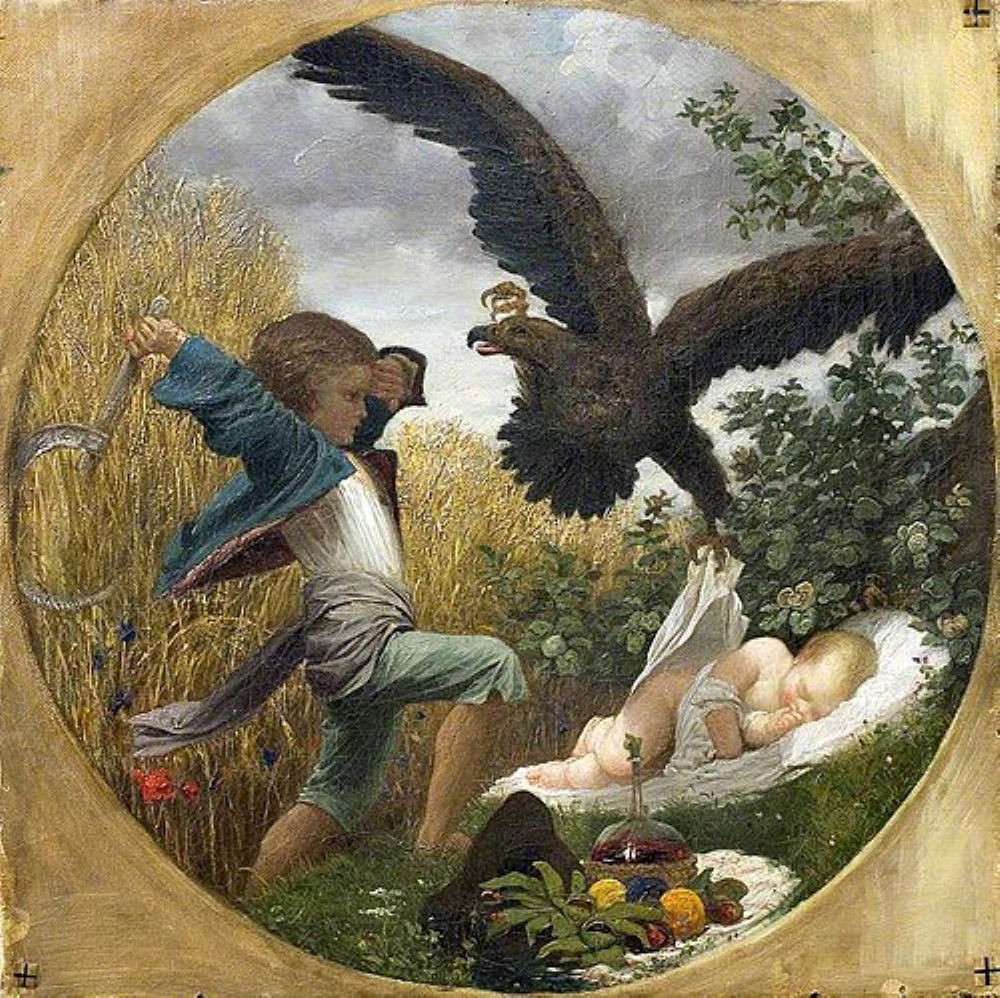
By Edwin Heath.
Stories, sagas, myths, legends: what makes them stand the test of time? By definition almost never their relationship to truth. Fake news, it seems, is as old as the hills …
Sometimes, constant repetition of a plausible idea is enough. Take, for instance, the centuries-old accounts of a baby being abducted by an eagle in Orkney.
Not much of this ancient yarn is recounted these days, but when I first came to these islands nearly fifty years ago, the eagle-snatch story would come up not infrequently, especially with older inhabitants. What is more, they were backed up by such renowned authors as the late George Mackay Brown; not to mention, it turns out, Sir Walter Scott himself!
But first, a few nature notes, as it were …
Up until the nineteenth century, two species of ‘erne’, as they were called, bred successfully on the island of Hoy. Golden eagles could be seen flying around the eyries at the Snook, near Rackwick, and at the meadow of Kame; while white-tailed eagles would be discovered nesting at White Breast, Hammers, and the Old Man.
Unfortunately, as elsewhere, this king among birds was widely persecuted for its alleged habit of carrying off not only poultry, but lambs, sheep and even pigs. Long-held farmers’ resentments were even supported by local law. As far back as 1626, a Kirkwall act was passed awarding the then princely sum of 20 shillings for an eagle’s egg; while anyone who succeeded in killing the creature itself became entitled to a payment of 8 pence from every sheep farmer in the parish.

Little wonder, then, in face of such attitudes and such monetary incentives, that no more white-tailed eagles were to be found breeding in Orkney after 1873, or that the golden eagles, never very common, had by that time become noticeably scarce. From then on, those birds’ days were effectively numbered. The last reported sighting, never confirmed, was in 1923.
What have survived, to this day, are immensely curious rumours of child abductions, or attempted ones, by eagles in Orkney ‘ages past’ – some of them from apparently impeccable sources!
Sir Walter Scott was told of the eagles’ outrageous proclivities when he came to Hoy in 1814: The clergyman told us that a man was very lately alive who, when an infant, was transported from hence by an eagle over a broad sound, arm of the sea to the bird’s nest in Hoy. Pursuit being instantly made, and the eagle’s nest being known, the infant was found there playing with the young eaglets.
Yes, quite. But then, you had George Mackay Brown reminiscing about an almost identical account, in his ‘Under Brinkies Brae’ column: It was so long ago that we read the story in the class-room, that I remember being very impressed when somebody of the older generation said the events of the story actually happened in Hoy.
So far, so vague. But a surprisingly detailed version, involving the Orkney Mainland once again, was re-told in her own words by Jeannie Nicolson from Hoy, who was born in 1900:
It was in Orphir, in the harvest time, and they had a bairn lying rolled in a shawl in a stook of sheaves. And they thought it was safe in the time they were working. And then they noticed this eagle had come over and picked it up in the shawl and carried it right across Scapa Flow and right over to Hoy, to the Bring. And he had gaen up in the Bring wae it, and laid it in his nest. And I don’t ken if he had haen young ones or what, but he had left it lying and had gaen away! And the men gaed over and got it safe and they got doon the Bring again. They had an awful job! Yes, climbing up and it was still rolled in the shawl. And the bairn wasnae really hurt wae it. It was fine! He had never touched it! They got doon safely and got doon wae it and got home. And it was none the worse. Back to Orphir then.
But that’s not the end of it. Jeannie had heard it all from her grandmother, who in turn had heard it from her mother … and where had she heard it from? And so the story goes, back into the recesses of time: or at least, at best guess, before the 1820’s …

But wait! Mythological lightning may have struck twice! Could it be true that the exact same scenario had already played out much earlier, even further north? And all with highly specific names and dates? It might be advisable, for any Orcadian wishing to establish the eagle-snatch story as a piece of original Orkney folklore, to first consult the Shetland Folk Book, volume four, pages 51-52.
There, two notable local historians, Laurence Williamson and Andrew Gray are given as authorities for a startlingly similar tale from our northern neighbours. The late Ernest Marwick relates their account:
One harvest day in 1680, Mary Anderson, the baby daughter of William Anderson of Norwick, was lying snugly wrapped in her shawl under a ridge of the cornfield, when an eagle swooped down and picked up the bundle. The people had been working in the harvest rig, and those neighbours who had seen the happening, rushed across the island in the direction the bird had taken. They ran until they were almost spent with breathlessness and fatigue. When the eagle was over the Hill of Colvadale, the watchers saw it change direction and fly towards the island of Fetlar. Sharp eyes followed it all the way, and saw it settle at a place known as the Blue Banks.
All the boats were away at the fishing, but a boat of sorts was found at Uyeasound, to the south of Unst. Baling the leaky boat continuously as it was frantically rowed over the sea to Fetlar, the Unst men landed at last near Kalbeinstoft, and there they were joined by some of the Fetlar men. The latter knew of a place half way down a precipitous cliff where there was a green sloping ledge known as the Sail. Here, they said, a pair of eagles had nested for several years. The combined party hurried along the coast to the cliff edge, where Robert Nicolson, a Fetlar lad of thirteen years, volunteered to descend on a rope to the eagle’s eyrie.
Robert had a find that the anxious men from Unst, waiting at the top of the cliff, had not dared to anticipate. He discovered Mary, still rolled up in her shawl, fast asleep and unharmed. On either side of her was a large eaglet. The eaglets were also sleeping, with their beaks tucked into the shawl.
It was a tremendous moment for the boy when he brought the child safely to the top of the precipice. An Unst man said, in answer to Robert’s broad smile, ‘Du’ll mebby get her for dee wife yet’, a light-hearted and unlikely prediction. Oddly enough, it came true. Many years afterwards Robert Nicolson went to Norwick with a fourareen’s (four-oared boat) crew to bring home a set of mill stones. He seized the opportunity to visit Mary Anderson, who had grown into a fine-looking girl. They liked each other so much that on many a subsequent occasion Robert’s boat skimmed over the sound to Unst. The day came when they were married, and looked for a home in another Shetland island – at North-a-voe, Mid Yell. Nearly three hundred years have passed since Mary Anderson was rescued from the eagle, but there are still Shetland families who tell her story and claim kinship with her.
So there you have it. Or do you? Did history really strike twice? Or was the Shetland occurrence simply too good a tale not to be repackaged for another location: albeit with fewer social or chronological points of reference? Was it, in other words, a case of a legend ‘crossing the sea’ from one island group to another? It seems like a theory worth pursuing. Not to imply that Orcadians loved telling yarns so much that they deliberately ‘stole’ a legend from Shetland; more likely, it was a gradual process of assimilation, a mixing and blurring of details, perhaps by visiting sailors or fishermen: a muddling and repetition of a story which also fitted perfectly into the topography of Hoy, with its own supply of eagles, plus a common belief that such creatures were capable of anything.
One has to remember, too, that in former times literally everyone was a storyteller; there being scarcely any other form of amusement, aside from homemade music. And, in an ambience where the more fantastic a tale, the greater credence it was allowed, it would not be surprising if ‘alternative facts’ should take precedence over objective ones. One has only to look at the established folklore of Hoy, with its water horses, trows, fairies, bogie-men and giants, to see how naturally a baby-snatching eagle would have fitted into the scheme of things. To a Hoy man who had just finished telling the story of the fairies of Trowie Glen, what better way than to round off the evening with: ‘And then there’s aal the beasts o’ the sky’ ‘(pointing meanwhile across the brooding contours of his island) … ‘beuy, I could tell ye summit aboot this eagles to mak’ ye speechless!’
These days, in our wonderful, hi-tech internet age, one might well assume the line between fact and fiction is better defined. Who could be so stupid as to fall for any kind of misinformation? However – before we get too smug – did we not just hear the President of the United States accusing some immigrants of ‘eating cats and dogs’?
In this regard, modern versions of the eagle-baby-snatching story – from places as far apart as France, Mexico and the United States – ought not to surprise us. Even though, with time, they may have become a bit more sophisticated.
One particular example comes from Norway, in June,1932. To quote from the UHI Institute of Northern Studies:
It happened on the little island of Leka, where a 3-year-old girl named Svanhild and her family were visiting on the occasion of a christening. After dinner, her parents had gone to have a rest, while Svanhild was playing outside. Suddenly, somebody noticed that the little girl was missing. She was nowhere to be seen. A search-party went out for her, and as the evening progressed, the whole island heard the news, and 200 people joined in the search. Her handkerchief and shoe were found, but no sign of the girl. People noticed, though, that some eagles were behaving strangely, but they thought it was because 200 people were shouting and searching. The eagle nest was high up on a mountain called Hagafjellet. In the end three men decided that they would climb up and check the nest. And there Svanhild was found, high up on a mountain ledge below the nest, sleeping and unhurt. Svanhild Hartvigsen is still alive today, but has no recollection of what happened. Since 1932, there has been much speculation over whether she was really lifted there by an eagle, or if she had climbed up by herself. The believers say that it is impossible for a 3-year-old to walk that far and climb that high, while the sceptics say that an eagle can’t possibly lift the weight of a 3-year-old child. The doubt over whether the story is true did not, however, stop Leka island council in 1989 from choosing an eagle’s claw and wing as their coat of arms! The story remains popular; it has been turned into a book and a film, and is now an important part of the island’s identity.
We seem to have come a long way already from the putative ‘Orkney Eagle Saga’ … but at least we know now that these islands are not alone. The debate still rages about the feasibility of an eagle being able to carry a small human being any distance. Some ornithologists claim that, even for a large female golden eagle, carrying away a hare or a deer calf weighing 4kg would be a struggle, and that prey much over 2kg would require favourably high wind conditions.
Yet, despite apparent biological implausibility, the stories keep coming, even with photos – whose authenticity have been disputed – of eagles attempting to carry off toddlers. In the US, several old newspaper accounts have been unearthed of bald eagles savagely attacking infants, even carrying them up and then dropping them to their deaths. And, inevitably, virtually that same old story, according to Dr. Terry L. Jones, professor emeritus of history at the University of Louisiana at Monroe:
Another tragic attack occurred in 1908 at Eagle’s Nest, Alaska, when a young girl, age unknown, was carried off by a bald eagle. Searchers later found her mutilated body in the eagle’s nest and were able to capture the bird. A Seattle, Washington businessman bought the eagle and had the audacity to put it on display in his store until a game warden ordered it to be released.
Yet another piece in the jigsaw of so-recalled avian kidnappings! There are sure to be more. So, how best to sum up? At least, where the Orcadian version is concerned, we might do best just to shake our heads, conceding perhaps that the jury might be out on that one. Not forgetting, of course, to look on the bright side…
In other words – roll on that book or film!




Leave a Reply