
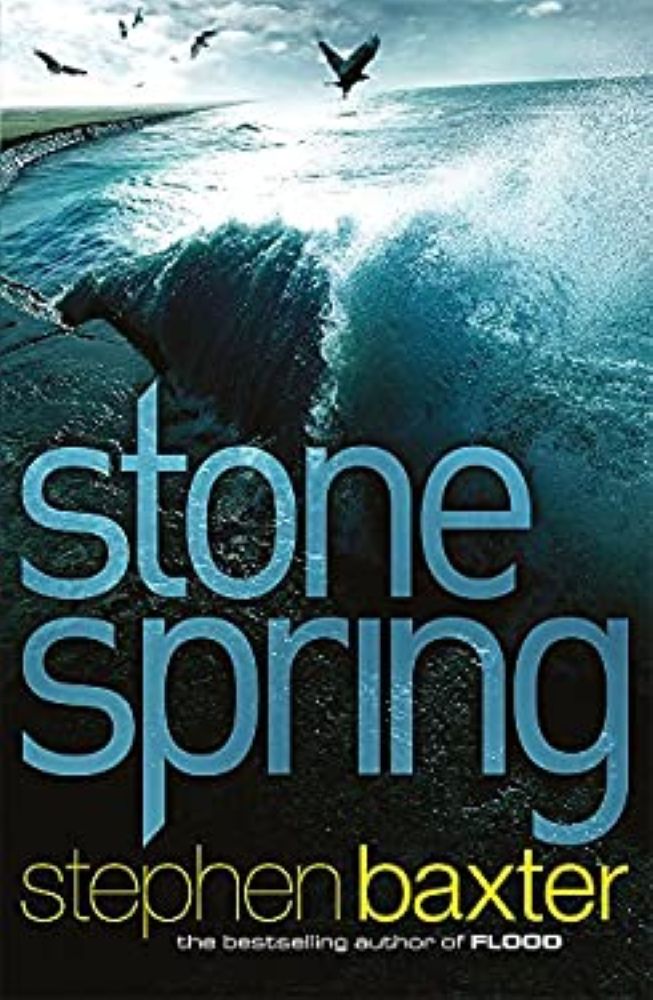

Stephen Baxter, “Stone Spring – Northland: Book One”, £18.99/12.99, 464 pp, Gollancz, 2010
First published in different form, Concatenation, online, 2010.
In ‘The Sky Above You, February 2026’ (ON, 3rd February 2026), I mentioned how I learned about the Storegga mudslides off the continental shelf of Norway, from Prof. David Smith’s lecture, ‘Orkney’s Killer Waves BC’, at the Orkney Science Festival in September 1991. In 50-30,000 BC those events raised 50-foot high tsunamis which wiped out Mesolithic settlement of Scotland.

1500 feet thick debris spread over 500 miles of deep sea floor, half-way to Iceland (Fig. 2), causing tsunamis all round Europe. In 6200 BC Scotland was swept again by 70-foot high tsunamis from the same source, and Stephen Baxter has set his ‘Northland’ series in the aftermath of a similar event, not quite as bad, but quite bad enough – ‘The Year of the Great Sea’, as its survivors name it..


Book One – Stone Spring is set mostly in Doggerland, the plain which occupied what is now the North Sea, when sea levels worldwide were lower during the Ice Age (Figs. 3 & 4), occupied by humans since 24,000 BC. As the Afterword explains, at the end of the Ice Age in 8000 BC the north coast of that plain stretched from England to Denmark, and its southern estuary was the size of the Bristol Channel. On it there were 24 major lakes and wetlands, linked by 1600 km of rivers.


Settlements and remnants of a wide range of fauna have been found under the present sea (Figs. 5 & 6), subject of a Time Team Special in April 2007. In our world, the tsunami carved Doggerland into isolated patches, penetrated 25 miles inland by deep river valleys on the north (Figs. 7 & 8), and the remnants were swallowed by the rising sea thereafter.


The novel’s main action takes place on Extelur, a name coined from Basque, whose inhabitants have already lost a ritual site, the House of the Mother, in the form of a giant cup-and-ring marking (found at many Neolithic sites in Britain). Their best flint pits have also been covered by the rising sea, and their Mesolithic crescent-shaped middens of shells, used as burial places for the dead, provide the inspiration for a post-tsunami project to build dykes and protect the land from further incursions.
The novel begins with the leader of Extelur’s people missing on a whale hunt, and his daughter taking charge. It coincides with a seven-year event, the arrival of a trading delegation of Pretani, that name derived from an old Gaelic word which was in use when the Romans came, and may be the origin of ‘Britain’. Pretani society is male-dominated, and the obvious complications arise. The missing leader has gone all the way to North America, and he returns with a new wife and her child, the last of a tribe of the Clovis people, who died out after occupying North America late in the Ice Age, (possibly in climate change due to impacts c.10,200 BC, Fig. 9). Much of this is explained in the Afterword, but is sometimes a little hard to follow in the text.

Meanwhile, as far away as Jericho, an unwanted son is enslaved to a passing trader, who heads north and west before dying, leaving the boy to continue in that direction because he has no alternative. His skills are in making and working bricks, with which the first walls of Jericho have been built to protect against floods and mudflows – again a possibility, with references in the Afterword. By the time of the tsunami these characters have met, and the necessary elements are in place for the great project, to hold back the sea from Extelur (Fig. 10), ultimately from the whole of Doggerland. The new social organisation which that requires is to prove crucial when the Pretani and their slaves invade.

I’ve kept from giving the names of the characters here, to avoid being drawn into the web of relationships which drives the action. Stephen Baxter does a masterful job of making great events emerge out of individual loves, hates and rivalries – it’s much like the history of (say) the US space programme, of which he’s already given us an alternative version in Voyage. The novel text leaves us uncertain whether the dykes will save Doggerland, so perhaps the Afterword and the jacket blurb spoil some of the suspense for Book Two.
Duncan Lunan’s recent books are available from bookshops and through Amazon; details are on Duncan’s website, www.duncanlunan.com.


Leave a Reply